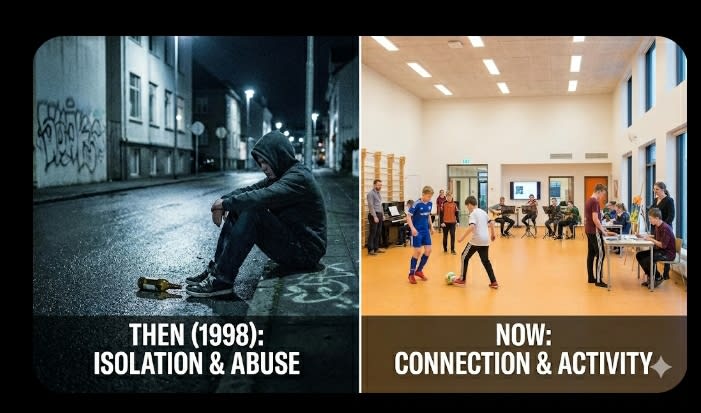
The incredible true story of the Icelandic Prevention Model, which curbed teen drinking and drug use not through punishment, but through community, art, and sports.
Introduction: The Lost Generation of Reykjavik
If you walked the streets of Reykjavik on a Friday night in 1998, it looked like a scene from a dystopian movie.
It was dark. It was cold. And the streets were full of teenagers.
They weren’t just hanging out. They were wasted.
At that time, Iceland had the worst youth substance abuse problem in Europe. The statistics were terrifying:
* 42% of 15- and 16-year-olds had been drunk in the past month.
* 23% smoked cigarettes daily.
* 17% had tried cannabis.
The city center was a chaos of vomit, broken bottles, and sirens. Parents were terrified. Police were overwhelmed. Politicians gave speeches about the “moral decline” of the youth.
The traditional response was to crack down. More police. Stricter laws. Scared-straight programs.
Iceland tried all of that. It didn’t work. The numbers kept going up.
The country was facing a demographic catastrophe. A whole generation was tuning out, dropping out, and burning out before they even turned 18.
Then, a group of sociologists, led by a man named Harvey Milkman (an American professor who had studied addiction for decades), proposed a radical idea.
They suggested that maybe the problem wasn’t the drugs.
Maybe the problem wasn’t the teenagers.
Maybe the problem was the world the adults had built for them.
Part I: The Theory of Boredom
Milkman’s theory was simple, but it challenged everything.
He argued that teenagers don’t take drugs because they are bad. They take drugs because they are bored, anxious, and isolated.
Adolescence is a period of intense brain development. The teenage brain craves dopamine. It craves risk. It craves sensation.
If society doesn’t provide healthy ways to get that dopamine rush, teenagers will find unhealthy ways.
* Alcohol is a rush.
* Cannabis is a rush.
* Vandalism is a rush.
Milkman looked at the data from Reykjavik. He saw a generation of kids who were latchkey children. Both parents worked long hours. The afternoons were empty. The evenings were unsupervised.
The kids weren’t rebels. They were lonely.
The drugs were just a coping mechanism for a life that felt empty.
So, the Icelandic government made a decision that seems almost impossible in today’s political climate. They listened to the scientists.
They stopped declaring a “War on Drugs.”
And they started a war on boredom.
Part II: The Great Pivot
The program was called “Youth in Iceland.”
It wasn’t a PR campaign with posters saying “Just Say No.” It was a systemic reconstruction of society.
They didn’t ask the kids to change. They forced the adults to change.
Here is what they did:
1. The Parental Contract
The government got parents involved—not by shaming them, but by empowering them. They created parent groups in every school. They asked parents to sign a social contract.
The contract was simple: We promise not to let our kids throw unsupervised parties. We promise to know where our kids are at night.
It wasn’t a law. It was social pressure. Suddenly, it wasn’t “cool” to be the parent who didn’t care.
2. The Currency of Time
The government realized that kids were drinking because they had too much free time.
So, they bought their time.
The government issued a “Leisure Card” to every child in Reykjavik. It was a debit card loaded with about $500 a year.
The money could only be spent on one thing: organized activities.
* Sports clubs (soccer, basketball, gymnastics).
* Music schools (piano, guitar, choir).
* Art classes.
* Dance studios.
They didn’t just fund these things a little bit. They flooded them with cash. They built indoor soccer arenas so kids could play year-round, even in the freezing winter. They hired professional coaches and teachers.
They made “after-school” the most exciting part of the day.
3. The Legal Nudge
They didn’t rely solely on carrots. They also used a stick.
They passed a national curfew law. Children under 12 had to be off the streets by 8:00 PM in winter and 10:00 PM in summer. For ages 13-16, it was 10:00 PM and midnight.
But here was the key: The police didn’t enforce it. Parents did. Community volunteers walked the streets, not to arrest kids, but to tell them to go home.
It wasn’t a police state. It was a community watch.
Part III: The Slow Miracle
It didn’t happen overnight. For the first few years, the numbers barely budged.
Critics said it was a waste of money. They said you couldn’t “buy” good behavior. They said kids would just take the money and use it for drugs anyway (they couldn’t; the cards were tied to specific vendors).
But the sociologists told the government to hold the line. “Culture change takes a generation,” they said.
They kept surveying the kids every year. They listened. They tweaked the programs based on what the kids actually wanted to do.
And then, the data started to turn.
Slowly at first. Then, it plummeted.
Year after year, the surveys showed the same thing:
* Fewer kids were drinking.
* Fewer kids were smoking.
* Fewer kids were trying cannabis.
Why?
Because they were too busy.
They were at soccer practice. They were at band rehearsal. They were at the art studio.
They were getting their dopamine rush from scoring a goal, or nailing a guitar solo, or finishing a painting. They were getting it in a room full of peers and supportive adults.
They didn’t need the drugs because they had something better: belonging.
Part IV: The Data Don’t Lie
Fast forward 20 years to 2018.
The streets of Reykjavik on a Friday night were different. They were quiet. The vomit was gone. The sirens were silent.
The statistics were almost unbelievable:
* Teen drinking (drunk in the last month) had dropped from 42% to 5%.
* Daily smoking had dropped from 23% to 3%.
* Cannabis use had dropped from 17% to 7%.
Iceland had gone from the worst country in Europe for teen substance abuse to the best.
They didn’t build a single new prison. They didn’t militarize the police. They didn’t launch a moral crusade.
They just gave kids something better to do.
Conclusion: The Uncomfortable Mirror
Why does this story matter outside of Iceland?
Because it forces us to look in the mirror.
In many parts of the world, we are still fighting the “War on Drugs” with the same old tools: punishment, fear, and isolation. We expel kids from school. We put them in the juvenile justice system. We label them “troubled” and wonder why they don’t get better.
Iceland proved that this approach is not only cruel; it is scientifically wrong.
Punishment doesn’t cure addiction. Connection does.
The Icelandic model shows us that if you want to save the kids, you have to build a world where they don’t want to escape.
You have to show up. You have to fund the arts. You have to build the soccer pitches. You have to be home for dinner.
It is expensive. It is hard work. It requires a massive shift in societal priorities.
But the alternative is the silence of the streets of Reykjavik in 1998—a silence broken only by the sound of a generation destroying itself because nobody gave them a reason not to.
Iceland chose a different silence. A silence of peace. A silence born of a society that decided to invest in its future rather than punish it.
And the data proves they were right.