Belousov said that only in 2025 did the ministry “start keeping a unified database and organise its population”, adding “practically everyone” who had been reported missing. “
“The number of servicemen who have been found has increased threefold compared with last year. It has reached 48% of the total number missing, meaning we found every second one,” the minister said.
Before Belousov took office as defence minister in May 2024, Russian courts received only isolated claims concerning soldiers missing in the war. From mid-2024, the situation changed sharply. Courts began registering such cases in large numbers, and since then the pace of filings from military units has only continued to rise.
In his speech, Belousov referred to support from volunteer groups in the search for and identification of the dead. But the capacity of such movements is limited, as is the extent to which they can operate in front-line areas. Since 2022, relatives of those killed have complained that the specialised centre in Rostov-on-Don, where identifications are carried out, has been working at the very limit of its capacity.
That is why Belousov’s claims of success in “searching” for the dead appear, in practice, to be largely explained by the formal process of having a soldier declared dead through the courts.
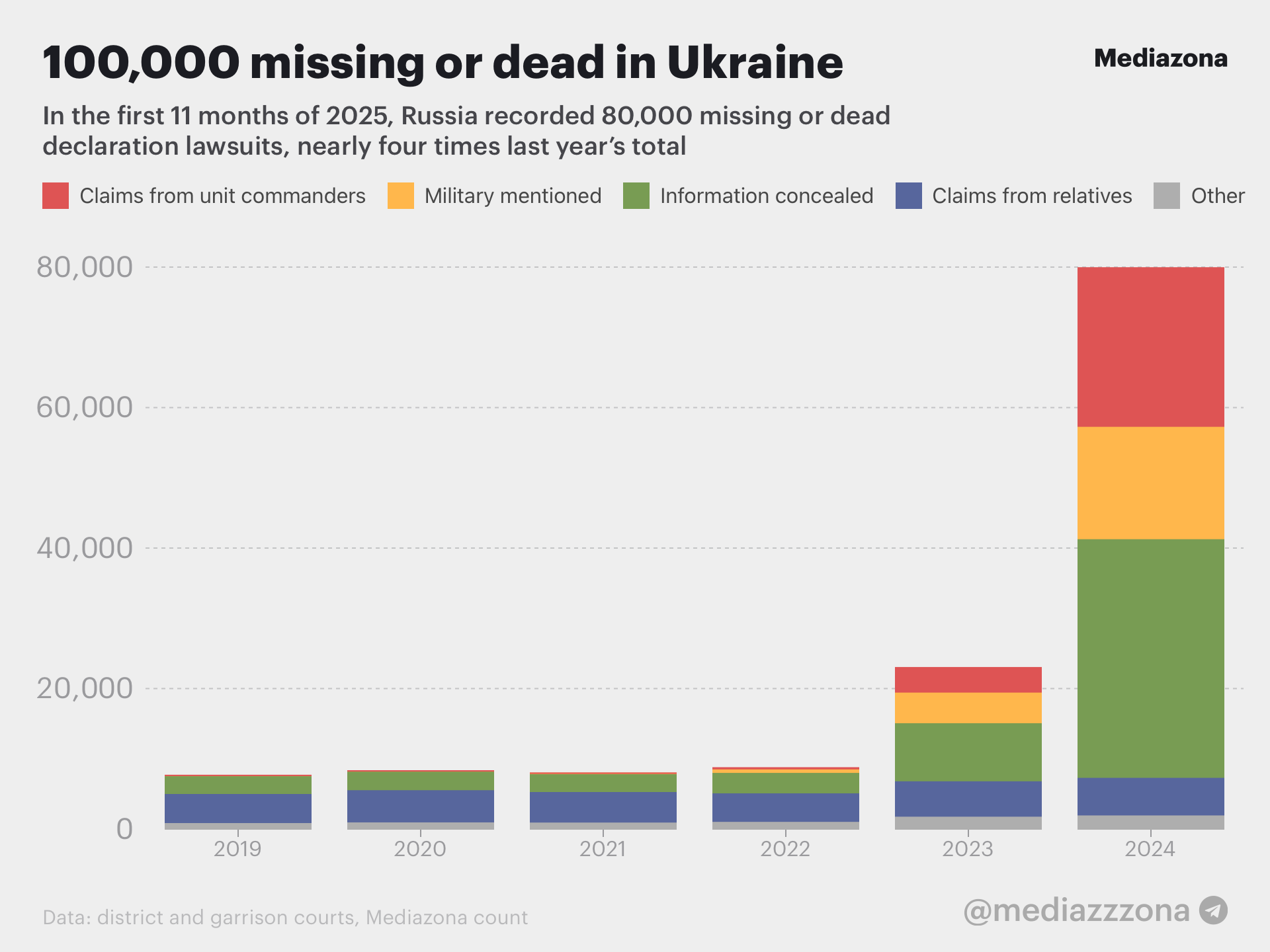
Belousov’s remarks broadly match calculations that Mediazona has begun publishing based on court data on recognising servicemen as missing or dead. In 2025, the number of such claims was more than three times higher than in the previous year, suggesting a concerted effort to secure declarations of death through the judicial system.
Courts have now registered more than 90,000 such claims linked to missing or dead servicemen. The flow has not eased: by the end of the year, around 2,000 cases a week were being registered. If Belousov’s figures are correct, the total number missing in the war could be twice as high—in other words, more than 180,000 men.
ArticleRussian losses in the war with Ukraine. Mediazona count, updated