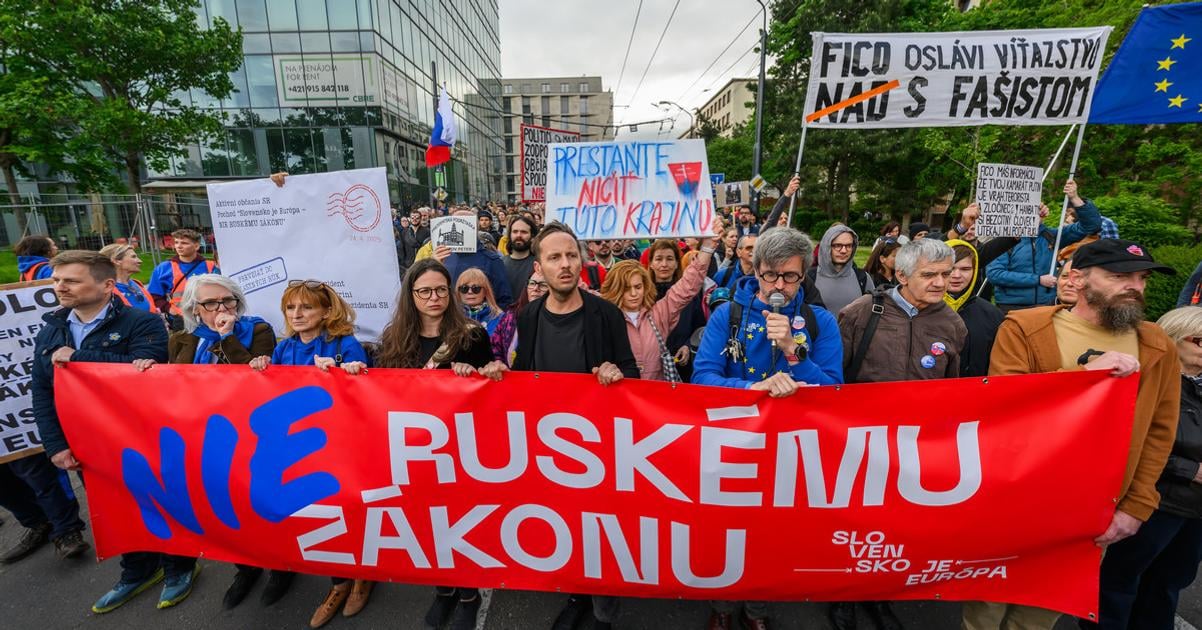
Slovakia’s Constitutional Court on Wednesday, 17 December, ruled that the law on non-governmental organisations (NGOs), pushed through by the governing coalition on 16 April, was unconstitutional.
Once the ruling is published in the Collection of Laws, the legislation will cease to apply. It will then be up to the governing coalition to decide whether to amend the law and bring it into line with the constitution.
Last-minute changes made by the coalition in April failed to avert the ruling. These included dropping a controversial proposal to label NGOs funded from abroad as “foreign agents”. While that provision was removed, critics said the law still imposed excessive administrative burdens and interfered with donor privacy. NGOs and opposition parties repeatedly referred to the legislation as a “Russian-style law”.
Act No. 109/2025 Coll. (non-profit organisations)
The Constitutional Court found that the act is not in compliance with the following provisions:
Constitution of the Slovak Republic
Article 19(1), (2) and (3) – protection of human dignity, personal honour and privacy
Article 26(5) – limits on restrictions of freedom of expression and the right to information
Article 29(1), (3) and (4) – freedom of association
Article 1(1) – the principle of the rule of law
Article 13(4) – the principle of proportionality when restricting fundamental rights
(Articles 26 and 29 were assessed in conjunction with Articles 1(1) and 13(4).)
International instruments
Section 39 of Act No. 34/2002 Coll. (foundations)
The Constitutional Court found that Section 39 is not in compliance with:
The Council of Europe’s Commissioner for Human Rights also voiced opposition to the law.
Shortly after the law was passed in parliament in April, despite repeated substantive objections from people working in the non-profit sector, 32 opposition MPs and Public Defender of Rights Róbert Dobrovodský filed complaints with the Constitutional Court.
“The approved law is a botched piece of legislation that will certainly not stand up before the Constitutional Court,” Progressive Slovakia MP Zuzana Števulová said in mid-April. She also criticised the coalition for curtailing debate in the second reading and ending the third reading despite more than 50 MPs being registered to speak.
The court accepted the petitions for further review in May and in September, but it did not suspend the law at that time.
According to the Constitutional Court, provisions amending legislation on foundations and the Civil Code were unconstitutional as well, although detailed reasoning has not yet been published.
President Peter Pellegrini signed the amendment on 7 May, arguing that his office had found no grounds to conclude that the law conflicted with the constitution or European law. He said changes made during the parliamentary process had eliminated the risk of EU sanctions and insisted that the public has the right to know more about how NGOs are funded.
Lawmaker Lucia Plaváková (PS), chair of the parliamentary human rights committee, said the president had aligned himself with the undemocratic steps of Prime Minister Robert Fico’s government by signing the law.
Criticism of NGOs has been a long-standing theme among all three coalition parties. Organisations such as Stop Corruption Foundation (Zastavme korupciu), Transparency International Slovakia and Via Iuris are frequently accused by government representatives of political bias and foreign funding.
Dobrovodský welcomed the court’s ruling on 17 December, calling it crucial for the protection of fundamental rights and freedoms. “This decision stopped an attempt at disproportionate state interference that undermined freedom, restricted civil society participation in public life and introduced unacceptable surveillance of donors and volunteers,” he said.
Disproportionate interference with fundamental rights
Dobrovodský argued that the law violated basic rights guaranteed by the constitution and international treaties, particularly freedom of association, freedom of expression and the right to privacy
Excessive and unjustified administrative burden
The law imposed new reporting and disclosure obligations on NGOs without a convincing public-interest justification, potentially paralysing their activities
Unlawful interference with donor privacy
Mandatory publication of detailed information about donors — including identity and financial contributions — constituted an unjustified intrusion into private life and personal data protection
Risk of intimidation and chilling effect
He warned that systematic disclosure of donors and contributors could discourage people from supporting NGOs, undermining civil society participation
Violation of data protection principles
The law conflicted with EU data protection rules by requiring publication of personal data beyond what is necessary and proportionate
Unequal and discriminatory treatment of NGOs
Dobrovodský criticised the selective targeting of NGOs compared to other legal entities, without objective and reasonable justification
Threat to the role of civil society in a democratic state
He stressed that NGOs play a key role in democratic oversight, public debate and protection of rights, and that the law weakened these functions
Potential misuse of information by the state
The scope and manner of data collection created a risk of surveillance and misuse of information about activists, donors and volunteers
The Stop Corruption Foundation also welcomed the decision. “The Constitutional Court struck down the entire NGO law. It was unconstitutional, just as we warned,” the foundation wrote on social media. “The government’s attempt to harass active citizens has failed.”