
In the north-eastern German city of Greifswald, the Alfried Krupp Wissenschaftskolleg’s minimal acknowledgment of its patron’s crimes against humanity, committed during the Second World War, indirectly feeds into the political climate that facilitates the meteoric rise of the far-right AfD party. This calculated institutional forgetfulness nurtures extremist revisionism, highlighting the crucial intersection of memory politics and momentous political shifts in contemporary Germany.
December 18, 2025 –
Tomasz Kamusella
– 
Articles and Commentary
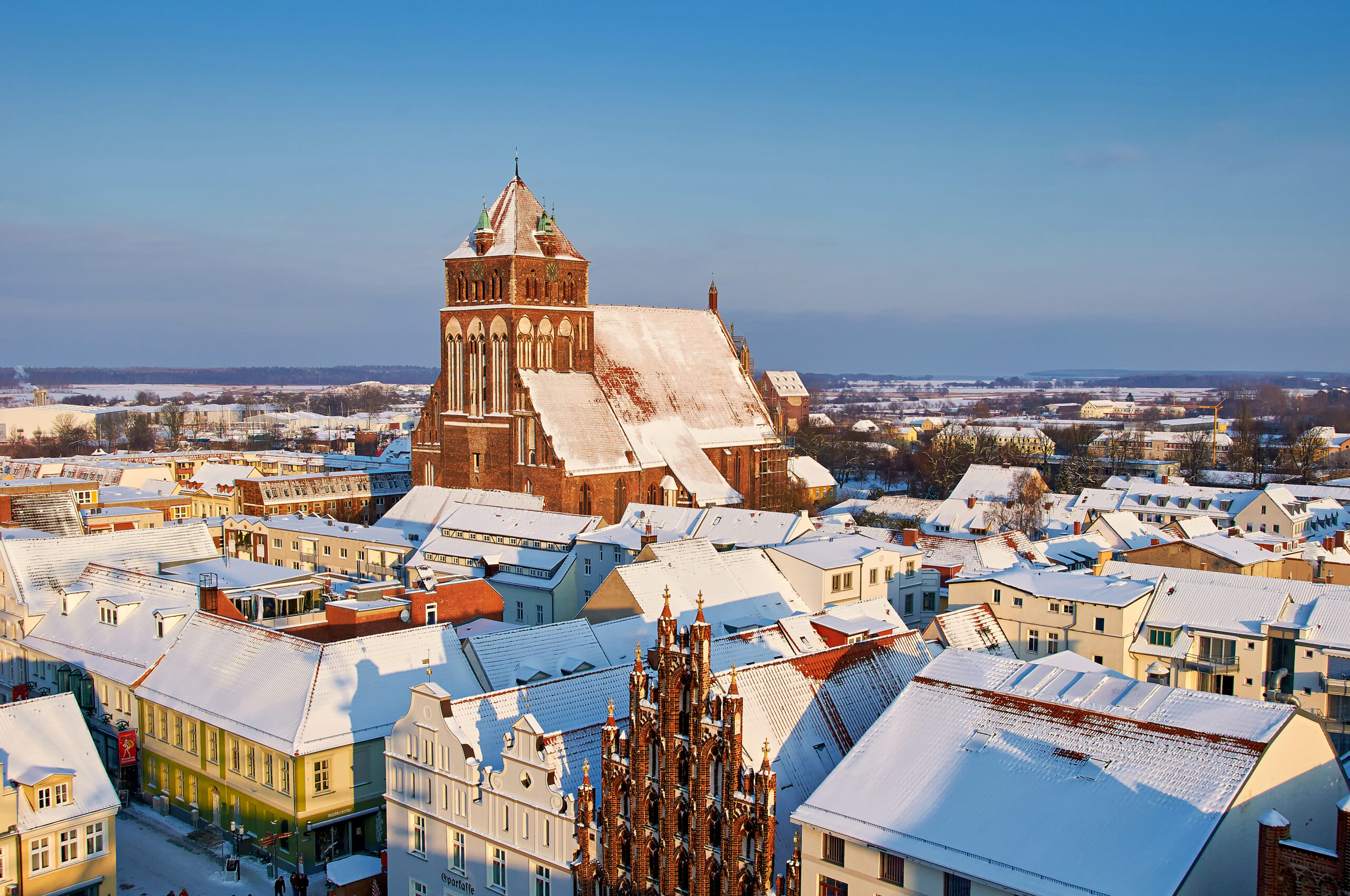
Old town of Greifswald in Mecklenburg-Vorpommern. Photo: Stefan Dinse / Shutterstock
Alfried Krupp, the criminal against humanity
Alfried Krupp was a major German industrialist whose family-owned conglomerate, Krupp AG, played a key role in Germany’s industrialization and military armament through the 19th and 20th centuries. Under Nazi rule, the Krupp enterprise significantly expanded due to its involvement in the manufacturing of weapons, ammunition, and armaments essential to the German war effort during the Second World War. Crucially, these activities involved the extensive exploitation of forced labour, including slave workers from occupied territories, concentration camp inmates (including children and Jews), and prisoners of war subjected to inhuman working conditions. Notably, a Krupp munition factory was located in the Auschwitz concentration camp.
In 1948, the Allied Nuremberg Military Tribunal convicted Alfried Krupp of crimes including “plundering” occupied territories and “crimes connected with forced labour”. These crimes fall explicitly under the internationally recognized legal category of “crimes against humanity”. Krupp received a sentence of twelve years imprisonment, along with the confiscation of his assets. In 1951, Krupp was granted an amnesty but never acquitted of his crimes against humanity. Two years later, his industrial assets came back into his possession.
Despite such unequivocal historical facts, the Alfried Krupp Wissenschaftskolleg’s website conspicuously avoids explicitly labelling Krupp as a “criminal against humanity”. Instead, Krupp’s role in the Second World War is only vaguely mentioned as “crimes in connection with forced labour”.
Selective memory
The Alfried Krupp Wissenschaftskolleg (Institute for Advanced Studies) in Greifswald, funded by the Alfried Krupp von Bohlen und Halbach Foundation, continues to maintain a surprisingly reserved approach regarding Alfried Krupp’s troublingly genocidal past. The institute’s website provides minimalistic descriptions of Krupp’s criminal activities without offering any in-depth context or clear references to original trial documentation or historical analyses. Specifically, the Wissenschaftskolleg’s information material notably refrains from using legally accurate terminology like “crimes against humanity”, or explicitly mentioning Krupp’s systematic use of slave labour across his companies during the war.
This selective framing of Krupp’s biography aligns closely with the overarching narrative presented by the Krupp Foundation. Above all, what is emphasized is Krupp’s role as a philanthropist and generous benefactor. The lack of direct bibliographic citations or hyperlinks to primary sources, such as the official Nuremberg trial records, facilitates this sanitized depiction of the Nazi past without a mention of the fact that Krupp was a criminal against humanity. This approach reflects a deliberate institutional choice to protect Krupp’s image from full scrutiny by website users and scholars who avail themselves of the Wissenschaftskolleg’s funding and participate in the institute’s events.
Historical omissions
The Wissenschaftskolleg’s curated historical narrative has broader social and political implications, particularly concerning Germany’s established norm of Vergangenheitsbewältigung, or coming to terms – in a critical manner – with the genocidal Nazi past and other wartime atrocities. Post-war West Germany and present-day reunited Germany’s national identity and international credibility have been significantly shaped by transparent historical accountability. By selectively omitting direct references to Alfried Krupp’s crimes against humanity, the Wissenschaftskolleg undermines this cultural and political practice, indirectly endorsing historical revisionism.
This sanitized presentation of the criminal against humanity Alfried Krupp feeds populist scepticism, which argues that elites manipulate historical narratives. Such scepticism aligns conveniently with extremist discourses promoted by right-wing groups that exploit grievances about perceived inconsistencies in national remembrance. Consequently, the Wissenschaftskolleg’s crude avoidance of confronting Krupp’s crimes against humanity strengthens these extremist narratives.
AfD’s rise and historical revisionism in Greifswald
The far-right political party Alternative für Deutschland (AfD, Alterative for Germany) has experienced significant electoral success in recent years. This has been especially notable within Greifswald and the surrounding Vorpommern-Greifswald district (Landkreis). As of 2025, the AfD is classified officially as a “confirmed right-wing extremist organization” in Germany. It became the second-largest party in Greifswald’s city council, achieved the largest representation in the Landkreis Vorpommern-Greifswald assembly, and secured the position of second-largest party in Mecklenburg-Vorpommern’s state assembly (Landtag).
While the Alfried Krupp Wissenschaftskolleg’s evasive narrative about its patron obviously has not caused the AfD’s rise by itself, it has contributed indirectly by enabling a socio-political environment favourable to historical revisionism. The Wissenschaftskolleg’s reluctance to fully acknowledge Krupp’s complicity in Nazi-era crimes against humanity bolsters extremist claims of elite duplicity, thereby facilitating the AfD’s populist narrative that portrays established institutions as selectively accountable or hypocritical. Notoriously, in 2018 an AFD co-leader commented that the Second World War and the Holocaust were just a spot of “bird shit” on Germany’s millennium-long history
This indirect support for the AfD’s rhetoric is particularly troubling because it weakens the country’s social and historical consensus that unequivocally condemns Nazi-era crimes. In doing so, the Wissenschaftskolleg provides ideological ammunition for the AfD and similar groups across Germany and Europe, who seek to diminish the historical gravity of Nazi crimes to further their nationalist and exclusionary political goals.
Transparency and democracy
Given these significant concerns, the Alfried Krupp Wissenschaftskolleg has a clear opportunity and responsibility to foster a more comprehensive historical engagement with Germany’s genocidal past. Concrete steps could significantly improve institutional transparency. Firstly, the Wissenschatskolleg should explicitly label Alfried Krupp as a convicted “criminal against humanity”, referencing primary historical sources such as the complete Nuremberg trial transcripts and judgments.
Secondly, the Wissenschatskolleg ought to make available direct hyperlinks and detailed bibliographic citations on its website, facilitating public access to historical documents and research studies related to Krupp’s Nuremberg trial and conviction. This openness would reinforce the institution’s scholarly credibility and public accountability, counteracting revisionist tendencies.
Moreover, the Wissenschaftskolleg could host an educational programme dedicated explicitly to examining corporate complicity under National Socialism, thereby providing critical perspectives on Krupp’s activities and their broader historical context. Such initiatives could include public lectures, seminars, exhibitions, and collaborative research projects focusing on Krupp’s crimes against humanity. Relevant themes here include forced labour, industrial complicity, and the ethics of historical memory.
Through these proactive measures, the Alfried Krupp Wissenschaftskolleg would not only reinforce its academic and ethical standing but also positively influence local and regional political discourse. By transparently confronting its historical associations, the Wissenschaftskolleg could significantly contribute to diminishing the allure of extremist ideologies, strengthening the region’s democratic resilience in face of the authoritarian tendencies.
However, any public institution that decides to adopt the name of a convicted criminal against humanity or genocidaire, prominently displaying his bronze bust in the entrance foyer, should not be surprised by a heightened level of scrutiny and international opprobrium. After all, what compels the Wissenschaftskolleg to keep Alfried Krupp, this odious criminal against humanity, as its patron?
Tomasz Kamusella is Reader (Professor Extraordinarius) in Modern Central and Eastern European History at the University of St Andrews in Scotland. His recent volumes include Niapolskaja Polšča (Technalohija 2025), Rreziqet e Neoimperializmit rus (Kristalina 2024), Languages and Nationalism Instead of Empires (Routledge 2023), Politika gjuhësore dhe gjeopolitika (Littera 2023), Politics and the Slavic Languages (Routledge 2021) and Eurasian Empires as Blueprints for Ethiopia (Routledge 2021). His reference work Words in Space and Time: A Historical Atlas of Language Politics in Modern Central Europe (CEU Press 2021) is available as an open access publication.
New Eastern Europe is a reader supported publication. Please support us and help us reach our goal of $10,000! We are nearly there. Donate by clicking on the button below.

AfD, East Germany, European far-right, Germany, memory, Nazi Germany