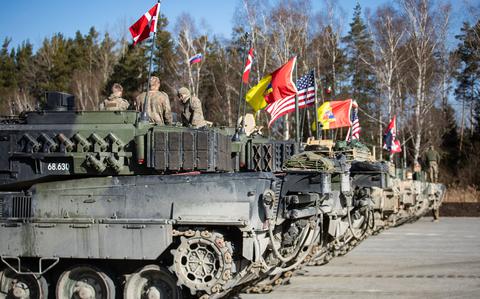
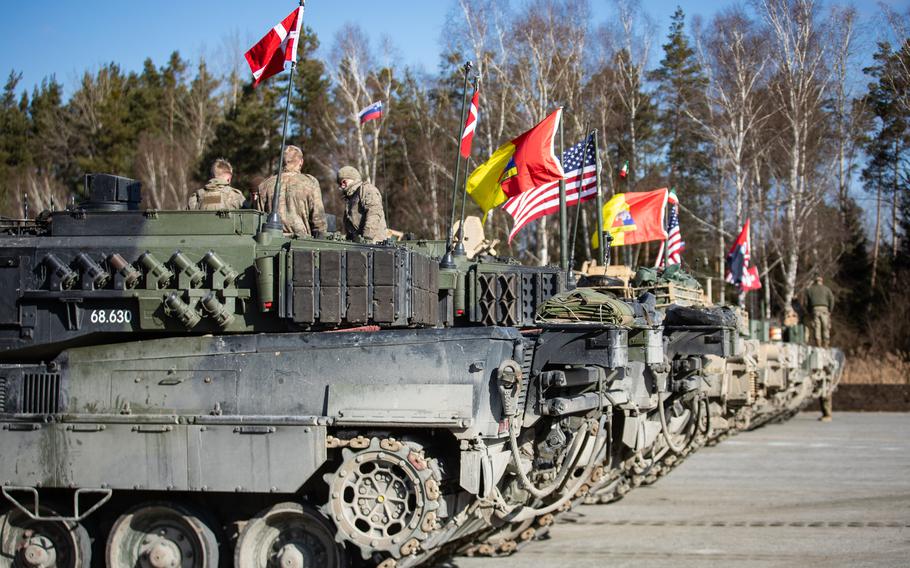
Tanks from the U.S., Denmark, Italy, Slovenia and Switzerland display their national flags during a training exercise near Grafenwoehr, Germany, on Feb. 16, 2025. Europe’s lawmaking body is pushing for a “military Schengen area” to speed cross-border movement of allied troops and equipment in a crisis. (Thomas Dixon/U.S. Army)
European Union lawmakers want to remove internal barriers to the cross-border movement of troops and military equipment, allowing the forces of partners and allies such as the U.S. to move across the Continent faster in a crisis.
A resolution adopted Wednesday in the European Parliament seeks creation of a “military Schengen area,” a reference to the zone encompassed by European countries that have abolished internal passport and customs controls in their combined territory.
“There are still considerable administrative and financial barriers, as well as infrastructure obstacles, which means that it can sometimes take over a month to move military equipment across the EU,” the European Parliament said in a statement Wednesday.
In the resolution, lawmakers said Russia’s war in Ukraine has underscored the “urgent need” for improvements, particularly along NATO’s eastern flank in countries such as Poland and the Baltic states.
Reducing existing obstacles to military mobility is “essential for European security and defense,” they said.
European countries also must invest more in transportation infrastructure, especially along four military transport corridors previously identified by the EU, according to the resolution. All four corridors include central and Eastern European countries.
The move comes amid ongoing pressure on European NATO members from U.S. President Donald Trump to spend more on defense.
In June, NATO leaders meeting in The Hague, Netherlands, pledged to aim toward spending 5% of their gross domestic product annually by 2035 on defense and broader security-related expenditures, including infrastructure and resilience efforts.
The resolution passed by a vote of 493-127, with 38 abstentions. Members of the European Parliament’s transport and defense committees are expected to begin legislative work on the European Commission’s military mobility package in the coming weeks.
The resolution text points to constraints, noting that tanks have been barred from entering some member states because they exceed national weight limits and that convoys have been halted at bridges not designed to support heavy military loads.
Lawmakers endorsed the European Commission’s proposal to raise funding for military mobility to roughly $20 billion in the EU’s next long-term budget, warning member states against cutting the proposal as they did in the 2021–27 budget cycle, when planned funding was reduced by 75%.
Upgrading roughly 500 infrastructure “hot spots,” including bridges, tunnels and rail lines not suited for heavy military vehicles, would require upward of $117 billion, according to the resolution text.
Lawmakers further urged the EU to follow NATO’s example and ensure that rapid-reaction troops could cross internal EU borders within three days in peacetime and within 24 hours during a crisis.
NATO has long planned for rapid cross-border troop movements, but EU lawmakers say civilian rules and infrastructure still prevent those timelines from being met.
Lawmakers also called for a military mobility task force, a European coordinator and a commission-led roadmap to streamline implementation, as well as digital solutions and a one-stop shop to accelerate cross-border movement authorizations.
European Parliament co-rapporteur Roberts Zile said many of the obstacles could be addressed quickly.
Zile represents Latvia, a Baltic NATO member bordering Russia that has been among the most vocal advocates for stronger European responses to the Kremlin.
“Military mobility has become even more urgent in light of Russia’s war of aggression against Ukraine,” Zile said. “There is no time to waste.”