Real journalists wrote and edited this (not AI)—independent, community-driven journalism survives because you back it. Donate to sustain Prism’s mission and the humans behind it.
Mariana’s two young sons clung to her legs in October 2024 as the smuggler’s truck bounced into the hills above San Pedro Tapanatepec, the southernmost town in Oaxaca, Mexico, and a key point on the route north.
In the past, the town was used by Mexico’s migration authorities, the Instituto Nacional de Migración (INM), or the National Migration Institute, as a chokepoint where migrants were contained. When they reached critical mass and there was political will, the INM would sometimes allow them to continue north with a transit visa.
But everything is different now.
Due to the high number of Venezuelan migrants traversing Mexico during the Biden administration in hopes of eventually requesting asylum in the U.S., the INM began requiring a tourist visa from Venezuelans flying to Mexico City. As a measure to restrict the movement of those who made the journey on foot, the INM stopped distributing transit visas in December 2022. Even so, the number of Venezuelan migrants in Mexico only increased—especially after the Biden administration’s implementation of CBP One.
The smartphone app, which was rife with serious problems before it was terminated under President Donald Trump’s second term, was the only means for migrants to obtain permission to present at a port of entry to request asylum. By 2024, a record number of Venezuelans, such as Mariana, passed through San Pedro, hoping to snag one of the limited CBP One appointments that could change their fate.
According to Human Rights Watch, refugee applications and migrant apprehensions in Mexico rose dramatically during the administration of former U.S. President Joe Biden. And—like Trump before him—Biden severely restricted access to asylum at the U.S. southern border. In part, this meant pushing former Mexican President Andrés Manuel López Obrador to heavily regulate travel to and within Mexico in order to prevent non-Mexican migrants from reaching the U.S.
The Biden administration’s decision to effectively outsource immigration enforcement to Mexico left thousands of Venezuelans and other migrants stuck there, where they could be brutalized by local officials and gangs.
Undocumented migrants like Mariana say they felt like sitting ducks in Mexico, easily identified by locals, government officials, and crime networks selling a way through Mexico’s migration checkpoints. Mariana and the other migrant women who spoke to Prism are using pseudonyms for safety reasons.
Due to identification requirements for accessing formal transport north, Mariana and her family first attempted to leave San Pedro in a taxi, but the driver left them in a field, where armed men confiscated their documents and then loaded them into a trailer normally used to transport livestock. At every step of the journey, the smugglers demanded money. At one point, they tried to check her phone to see if she had family in the U.S. who could send money. On the highway, when supposedly transporting her north toward Mexico City, the men asked her for fare. At night, when they arrived at a new location to sleep, they asked her for rent.
“Over and over again, they would deliver us to another guy, who would charge us again. And it turned out we were in the same town the entire time,” Mariana said.
Since Trump virtually eliminated the ability to seek asylum in the U.S. upon taking office in January, the Venezuelan migrants who spoke to Prism have been in Mexico—now a reluctant receiving country—for more than a year. Shifting immigration policies in the U.S. between the Biden and Trump administrations have also created an atmosphere so violent and chaotic for Venezuelan migrants in Mexico that many feel their only option is to return home to the same conditions that originally pushed them to flee.
While Democratic and Republican administrations have generally agreed on enacting oppositional foreign policy toward Venezuela, Trump has taken it to new levels. In 2019, his administration refused to recognize Nicolás Maduro as the president. On the campaign trail ahead of the 2024 election, Trump said Venezuelan migrants coming to the U.S. are “drug dealers, criminals, murderers, and rapists.” And under his second term, the Trump administration has carried out more than 20 airstrikes in the Caribbean Sea and the eastern Pacific Ocean, which have been described by human rights monitors as unlawful. The airstrikes have targeted mostly Venezuelan civilians that the administration alleges are drug smugglers. At least 90 people have been killed. Now, Trump is threatening U.S. military intervention in Venezuela.
And as Venezuelans continue fleeing economic crisis, political persecution, and human rights abuses, Venezuelan migrants in Mexico are now seeking “humanitarian” return flights sponsored by their home country, mostly as a shortcut to travel to neighboring countries, such as Colombia and Peru, where some of their families are exiled.
The global reframing of forced returns—a relative mercy when compared with U.S. deportation that can lead to torture in a foreign prison or indefinitely living in limbo inside a camp in Mexico—represents state abandonment of vulnerable populations.
And migrants like Mariana are in the crosshairs of it all.
“Worn out from so much waiting”
The Venezuelan diaspora is around 8 million people, though Venezuela’s leaders have downplayed this number, calling it “fake news.” The country’s president has taken a harsh tone with citizens who flee Venezuela in hopes of better opportunities in the U.S. In 2018, Maduro compared these migrants to “slaves and beggars.” Paradoxically, the challenges facing Venezuelan migrants in Mexico are largely the result of U.S. foreign policy, and so are the conditions that originally led many to flee their home country.
Even the U.S. Government Accountability Office maintains that U.S. sanctions on Venezuela’s oil exports were a major contributing factor to the inflation crisis there, with rates hitting 65,000% in 2018. With this economic collapse, detention rates of undocumented Venezuelans in Mexico skyrocketed, from 288 encounters in 2018 to 361,203 encounters in 2024. Since 2022, the year Mexico began requiring tourist visas for Venezuelans, they have topped the list of undocumented migrants apprehended.
Maduro’s government has responded to the U.S. and Mexico’s regional pressure, as well as xenophobia against Venezuelans, by facilitating what his administration calls a “dignified return,” providing Venezuelan migrants free flights home through a program called La Gran Misión: Vuelta a la Patria, or The Great Mission: Return to the Homeland. The program expanded to Mexico last year.
On Vuelta a la Patria’s official Instagram page, footage of deportation flights arriving from the U.S. is set to upbeat music and videos intended to be comical repeat Maduro’s warning that those who leave the country in search of the American dream could instead be subjected to “enslavement.” Migrants with tired faces who recently returned on flights to Venezuela gave brief testimonies in a December reel thanking Maduro and his second-in-command, Diosdado Cabello. During one interview, a recently returned Venezuelan said, “In Venezuela, there are possibilities. The thing is, we have to keep going as long as we can and keep fighting here.”
Farida Acevedo Castro, director of the human rights organization Humano y Libre, which was founded by members of the Venezuelan diaspora, and of the organizing network Venezuela Somos Todos, stressed that these returns are not entirely voluntary or even a sustainable option for most Venezuelans.
Acevedo Castro told Prism that Venezuela’s government changes “the narrative to suit their own purposes and exploit people’s vulnerability.”
Venezuelans have one of the most expensive passports in the world. And instead of facilitating access to the documents they need to integrate into new countries, their government primarily offers aid for returns. Maduro’s administration and the Venezuelan opposition routinely disseminate criminalizing narratives about the Venezuelans who flee the country. Acevedo Castro said she believes that Vuelta a la Patria’s supposed embrace of returning migrants is a show and that the diaspora is being used for political ends.
Génesis, 46, is another mother whose primary motivation for leaving Venezuela was to earn enough money to reunite her family. She has two children in Colombia, two in Brazil, and her two youngest accompanied her on her journey through Mexico.
My country is very beautiful, it truly has nothing to envy in any other. But what’s really got us screwed is the economy.
Génesis, Venezuelan mother of six Living in Mexico
“My country is very beautiful, it truly has nothing to envy in any other. But what’s really got us screwed is the economy,” she said.
In December 2023 in Mexico’s northern border state of Coahuila, Génesis’ family rode “La Bestia,” or The Beast, a network of dangerous freight trains that migrants often ride to avoid checkpoints en route to the U.S. They had just disembarked in the desert when they were ambushed by Mexican immigration agents in a raid. Everyone ran to hide among the prickly pear cacti, and Génesis was separated from her teenage daughter, Daniela.
It was a possibility she and her children had anticipated and planned for.
“Mom, if they catch you, don’t hand me over, let me go,” she recalled her daughter instructing her.
With this plea in mind, Génesis, her partner, and her son cooperated with the agents who caught them, but didn’t say a word about Daniela, who remained in the desert. Génesis didn’t expect that her family would be sent to a detention center in Villahermosa, in the state of Tabasco, near the southern border with Guatemala, or that Daniela would be placed in an orphanage on the northern border with the U.S. Their separation lasted three painful months, Génesis said.
Venezuelan migrants apprehended on the U.S. side of the border often experience a similar fate. Since 2022, the U.S. has routinely carried out expedited removals of Venezuelan migrants to Mexico. Some migrants are released directly at the U.S.-Mexico border, while others are transferred south to detention centers in Mexican cities near the border with Guatemala.
One Venezuelan official in Mexico, who declined to give Prism his name, denied that Mexico receives Venezuelans expelled from the U.S. During an interview at the Venezuelan Embassy in Mexico City, he lauded the INM’s collaboration with diplomatic staff to return migrants to Venezuela.
After the Trump administration in January halted the use of the CBP One app and repurposed the technology as a way for migrants in the U.S. to schedule their own deportations, 270,000 migrants were left stranded in Mexico. Many of them were Venezuelans, who now risk facing even more political instability in their home country.
Leading up to Venezuela’s disputed 2024 presidential election, in which opposition leader María Corina Machado was banned from holding office, Edmundo González Urrutia replaced her as presidential candidate. However, the government-controlled electoral authorities declared Maduro the winner. When Machado and Urrutia’s senior advisers were targeted by Maduro in retaliation, both went into hiding. But Machado reappeared earlier this month when the U.S. helped her travel to Oslo to receive the Nobel Prize. During interviews, she said the crisis in her country “is absolutely a priority in matters of national security for the United States.” She also strongly implied she is not opposed to U.S. military intervention in Venezuela to remove Maduro and curb drug trafficking. Experts agree that Venezuela’s participation in the international drug trade is minimal, and like other U.S. interventions in Latin America before it, largely an excuse for political gain.
Meanwhile, many Venezuelan migrants in Mexico continue to be profiled, jailed, and deported while the threat of war between the U.S. and Venezuela looms.
Sara, 25, lives in a government shelter in Mexico City. When she first visited, it didn’t seem like her best option, she said. Multiple, unrelated families sleep together in rooms where bunk beds make the most of limited space. But it was here that she decided to wait months hoping for smoother access to a return flight to Venezuela. Earlier this month, when funds were finally allocated to fly the majority of the shelter population home after months of delays, tensions between the U.S. and Venezuela were at an all-time high.
Fearful of what she’d be returning to, Sara backed out of boarding the flight to Venezuela. Her friends at the shelter preferred to dismiss Trump’s actions as just another empty threat. “They get offended,” Sara said, explaining that sensitivities run high among migrants who know all of their options are bad and don’t like to be reminded. “They’re worn out from so much waiting.”
Sara recently decided to revisit her application for refugee status in Mexico that she abandoned earlier this summer.
For migrants who decide they want to build a life in Mexico, the only accessible path for adjusting their status is through the Mexican Commission for Refugee Assistance (COMAR).
But it isn’t easy.
Génesis makes the hours-long commute to COMAR every 10 days for a check-in that keeps her family’s case active and ensures that she remains in good standing. The paperwork to become a refugee in Mexico is free, so long as migrants can sustain themselves through the process, which usually takes between nine months and a year.
Refugee status determinations have not kept pace with the number of applications being filed. Human Rights Watch reported that in 2021, COMAR received more than 130,000 applications but only processed 38,005. This number reflects not only COMAR’s lack of proper funding, but also the broader systemic issues faced by Venezuelan migrants. INM severely restricted migrants’ mobility when it stopped issuing transit visas, so applying for refugee status became one of the only ways to obtain identity documents in Mexico, leading families to apply even when they had no intention of staying in the country. Now that migrants applying for refugee status do want to stay, they are subject to bureaucratic obstacles instituted by COMAR as a way of filtering out transit migrants. This has slowed down the process for everyone.
The core of the problem, many immigrant rights activists say, is that both the U.S. and Mexico prioritize immigration enforcement over integration. The difference is that Mexico’s immigration enforcement is shaped by U.S. interests.
“Search for a better life”
Due to worsening political instability in Venezuela and harsher immigration policies under the Trump administration, the Venezuelan diaspora continues to settle in different countries around the region—even returning in a loop to neighboring countries such as Colombia, Brazil, and Peru, where they previously tried to carve out a life before attempting to migrate to the U.S.
Back when she was still in Maracaibo, a port city in Venezuela where she worked processing seafood, Patricia, 32, grew up with aunts, uncles, and cousins as neighbors. When she had her first daughter in 2011, her family helped with the baby.
But by the time Patricia had her son a few years later, Venezuela’s inflation crisis was in full swing, and her family was dispersed across Latin America. Patricia said it was painful to be separated from all of her siblings. But each was on their own “search for a better life,” she said. “And no one was going to help you because everyone was in the same situation.”
Left with few resources and avenues for support, Patricia ate just one meal a day and was forced to reuse her son’s disposable diapers: She would scrape out the inner lining, wash, and reassemble.
She decided she had had enough, and in 2018, she left Venezuela with her two children to reunite with her family in Colombia. Then, in May 2024, Patricia decided to migrate to the U.S., where she hoped to make more money to help her mother buy a house. She arrived in Mexico with her partner in July 2024 after an arduous journey in which they were extorted and narrowly avoided being kidnapped.
In May, Patricia gave birth in Mexico City to a daughter, Ana. When Patricia and her partner tried to obtain Ana’s birth certificate, she alleged that government officials claimed the couple needed to pay more than $100 for the free paperwork. She said the officials also threatened to call immigration authorities if they refused.
In a series of interviews with Prism throughout October and November, Patricia said she now wanted to reunite with her family in Colombia. But the stress of trying to save money in Mexico without access to formal work or child care was taking a toll on her relationship. Ana’s father was anxious about leaving Mexico without any money and with another mouth to feed.
Patricia told Prism that she feels like a first-time mother again, raising a new baby away from her family and any semblance of a support network. “It’s not easy,” she said.
Rodrigo Yedra, a human rights defender who supports Venezuelan migrants seeking documentation in Mexico City, explained that to prevent undocumented migrants from moving freely, the U.S. government and its ally Mexico—under threat of tariffs—implemented the deterrence strategies that wear women such as Patricia down.
You’re going to be extorted, you’re going to be kidnapped, you’re going to be sexually assaulted so that, through every possible inhumane mechanism, you eventually stop moving north. It’s an exemplary punishment.
Rodrigo Yedra, human rights defender supporting Venezuelan migrants in Mexico City
“You’re going to be extorted, you’re going to be kidnapped, you’re going to be sexually assaulted so that, through every possible inhumane mechanism, you eventually stop moving north. It’s an exemplary punishment,” Yedra said.
It’s been a long road for many Venezuelan migrants, such as Patricia, who try their luck in other countries before ending up in Mexico because they are effectively barred from requesting asylum in the U.S. Now, many of these families have young children who were born in countries other than Venezuela, creating a bureaucratic headache should they decide to return home.
According to Venezuela’s nationality law, Patricia’s daughter Ana is still considered a Venezuelan citizen, even though she was born in Mexico, because Patricia and her partner are Venezuelans by birth. But proving this so that Patricia could take Ana on one of the government-sponsored flights to Venezuela was an expensive and bureaucratic process. Thankfully, shelter staff intervened and helped usher the family through the process. On Dec. 3, they flew back to Venezuela together.
Conditional assistance
No matter Mariana’s hopes and dreams for a better life outside of Venezuela, she, too, finds herself right back where she started.
She first arrived in Ciudad Juárez in December 2024 and turned herself over to Border Patrol officials in the U.S., hoping to restart her life there. She and her two children were immediately detained. For 10 long days, they were held in a cramped processing center, though legally the agency cannot hold children beyond 72 hours. During their time in Border Patrol custody, Mariana’s younger son got sick, and she had to accompany him to the hospital, leaving her other child alone in the facility.
When she returned, Mariana was made to sign papers in English that she did not understand. She hoped her signature would lead to her release. Instead, she told Prism, in January, she and her children were deported by bus to Juárez and then transferred by plane. Officials told them that they were going to a “government shelter,” but Mariana said the facility in Villahermosa was more like a detention center. She was able to leave relatively quickly, and from there, she retraced her steps north to Mexico City. This time, she avoided smugglers by boarding La Bestia and walking long miles along the highways. She remained in Mexico City for nearly a year while figuring out her next steps. As it turned out, her next steps would lead her back to Venezuela.
Mariana and her children were among the 304 Venezuelan migrants who were flown to Caracas as part of Vuelta a la Patria on Dec. 3, just days after Trump announced a unilateral blockade of Venezuela’s airspace. The blockade was temporarily suspended for these return flights, but it’s since been re-enacted.
In an interview prior to her departure, Mariana said that after spending some time with extended family, she planned to once again leave Venezuela—this time for Colombia, where most of her immediate family members now live and where she hoped to have a better chance of accessing vital health care.
Some Venezuelan migrants have decided not to leave Mexico. Many are now settled in Mexico City, but arbitrary detentions, xenophobia, and limited access to basic services make everyday life a challenge.
Mexico City is now home to thousands of people who were stranded after the end of CBP One. As the nation’s capital, it offers more potential for jobs and a wider support network made up of earlier arrivals who have gradually settled in the city. Women who spoke to Prism said that their relatives or acquaintances told them that Mexico City was a place where they could start again.
In 2022, public spaces in Mexico City, such as the Terminal Central del Norte bus station, became important points of convergence for migrants trying to get to the U.S., and migrants who were recently expelled or deported from the border. These populations, often excluded from formal support systems, created encampments near transit stations and offices that serve migrants.
But Mexico City’s newly elected mayor, Clara Brugada, has vowed to end homelessness, and her plan includes clearing these encampments. She ordered local officials to disband and relocate the residents of the migrant camps that emerged after CBP One was eliminated. In practice, this meant the Venezuelan migrants from these camps were subject to surveillance and raids, in direct contravention of Mexico City’s supposed sanctuary policies.
The camp in Colonia Vallejo is the last one standing, largely due to a federal court case that bars city officials from removing the residents without first providing dignified housing.
More than 100 people currently live in the Vallejo camp, most of them Venezuelan. The camp’s “ranchitos” are built mainly from discarded wood and insulated by ads that were printed on waterproof tarps. While the camp has no running water, there are cables to charge phones and gas ranges for cooking. The migrants work together to maintain their shared space, and many of the houses are lovingly decorated by their inhabitants.
Mexico City, in an effort to provide an alternative to the encampments, announced in March that the newly formed Department of Human Mobility was opening two public migrant shelters. The shelter at Boca Negra was specifically designated for families applying for refugee status in Mexico, and another at Vasco de Quiroga was aimed at those in transit or awaiting return flights to Venezuela.
Emanuel Herrera, director of the Vasco de Quiroga shelter, explained that the space he supervises was originally designed for Mexican migrants deported from the U.S. However, once the Department of Human Mobility identified a significant population of migrants stranded in Mexico City, local authorities shifted the shelter’s focus.
In April, human rights defenders were notified that local officials would soon request that residents move into the city’s new shelter system. In Vallejo, the request was made without accompanying violence, but according to Yedra, Acevedo Castro, and other human rights defenders, prior camps were dispersed by force, with residents bused to surrounding cities or funneled into the city shelter system.
“[The city officials] arrived and surrounded us and closed all the streets,” said Sara, who was living in a camp at the time. “We didn’t have a way out.”
At one point in the city’s campaign, the Venezuelan ambassador to Mexico, Stella Lugo, was brought to the camp. In a speech that circulated on social media, she called the residents irresponsible parents and said that neither Mexico nor Venezuela had any obligation to assist them. Although she was ostensibly invited by city officials to promote the shelter system as a point of access to Vuelta a la Patria, Lugo also suggested that camp residents were deviants unprepared to follow their rules.
Despite the aggressive way the shelters rolled out, they represent a new responsibility being taken on by the local government in an effort to help integrate migrants, rather than outsourcing all aid to civil society or religious organizations. Mexico City’s shelters now provide guidance, legal orientation, and temporary accommodations for those navigating refugee procedures or exploring pathways for return. While these initiatives offer a degree of support, they also highlight the tension between local humanitarian efforts and the binational migration policies from the U.S. and Mexico that continue to confine thousands of Venezuelans to a life in limbo.
For migrants who do want to return to Venezuela, Yedra said the pressure to relocate to a city shelter conditions access to a dignified return. In other words, migrants’ rights are not universally guaranteed but subject to a quid pro quo.
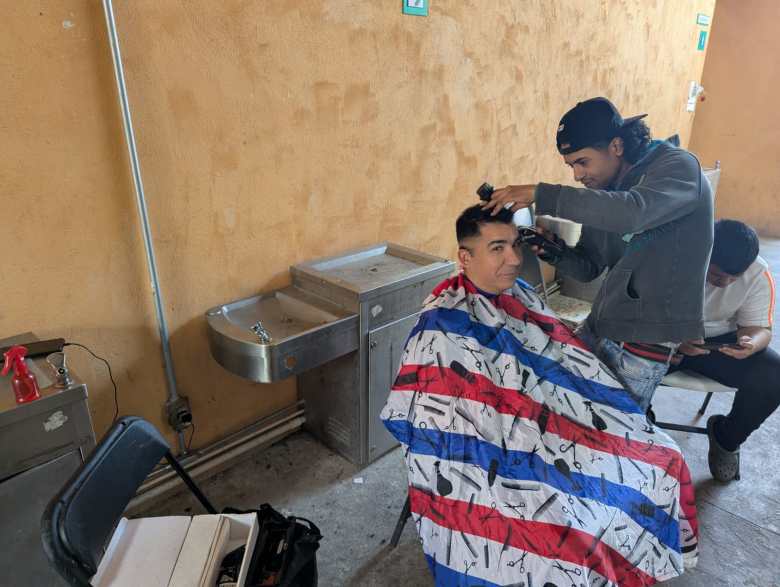 A Venezuelan migrant on his last day at the Vasco de Quiroga government shelter in Mexico City prepares for his return to Caracas with a haircut from a friend, on Dec. 3, 2025. Credit: Liliana Frankel
Some who obtained the shelter system’s help to return to Venezuela are still trying to make sense of their time in Mexico.
“Nothing scares me”
Natalia returned to Venezuela in June through the Vuelta a la Patria program. Before her return, she was living in one of the Mexico City camps that was eventually dismantled. With few places left to turn, shelter staff in Mexico City guided her through the return process.
She told Prism that the decision to return wasn’t easy, but she hadn’t seen her mother in eight years. Returning home not only brought genuine joy, but also the comfort of an extended support network.
Back in Venezuela, Natalia encountered circumstances that felt strikingly similar to what she left behind in Mexico. Within hours of landing, she underwent biometric registration and rounds of paperwork. Government officials made her sign a commitment pledging not to leave the country again and to uphold “good values” as compensation for her free flight home.
Now back in school and rebuilding her life with the help of relatives, Natalia is still making sense of her experience in Mexico.
“Just as Mexico has advantages, it has disadvantages,” she reflected. “One day I’d like to visit Mexico again and reunite with the good people who lent me a hand.” Natalia told Prism that she wept on the plane back to Venezuela and that her “soul hurt.” She would miss Mexico, as challenging as it could sometimes be. She attributes her faith in God to keeping her safe for the years she was away from Venezuela.
As Mexico City shelters more and more migrants, human rights defenders continue to fight to improve conditions on their behalf. As one example, Yedra convinced administrators in Vallejo to waive their stringent identification requirements so that Venezuelan and other migrant children living at the last remaining camp can attend school with their Mexican peers. Acevedo Castro’s team raised money for school supplies for these children. Their efforts underscore how essential mutual aid is when institutional support fails.
Herrera, the shelter director, told Prism that the government must adjust to new realities rather than relying on outdated operations. The institutional response must match the moment, he said.
If nothing else, Venezuelans who found themselves at the center of the U.S. and Mexico’s harsh immigration policies learned not only that they are survivors, but people who deserve—and who are capable of fighting for—a dignified life.
Patricia told Prism that before her migration through Mexico, she felt “weak.”
“I didn’t believe in myself,” Patricia said. “But now, nothing could surprise me. I’m moving forward [and] nothing scares me.”
Editorial Team:
Tina Vasquez, Lead Editor
Carolyn Copeland, Top Editor
Rashmee Kumar, Copy Editor
Related