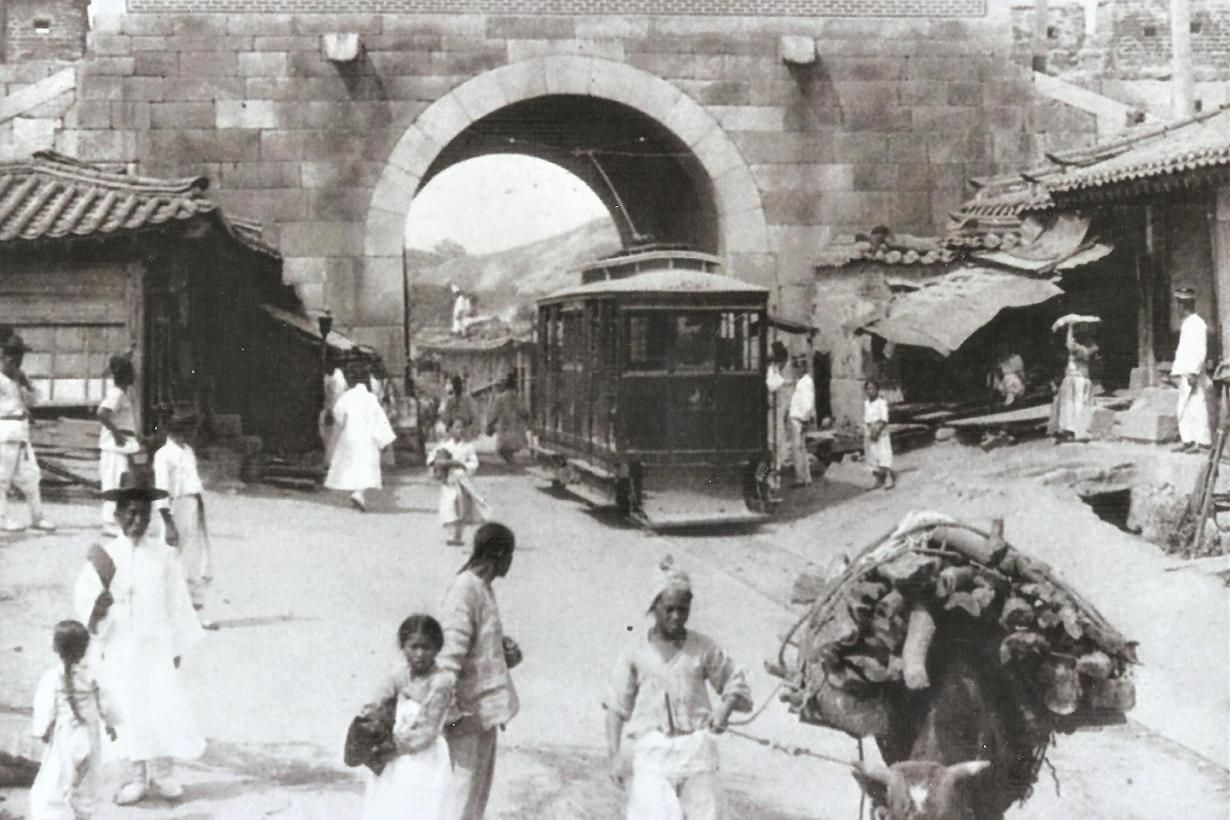
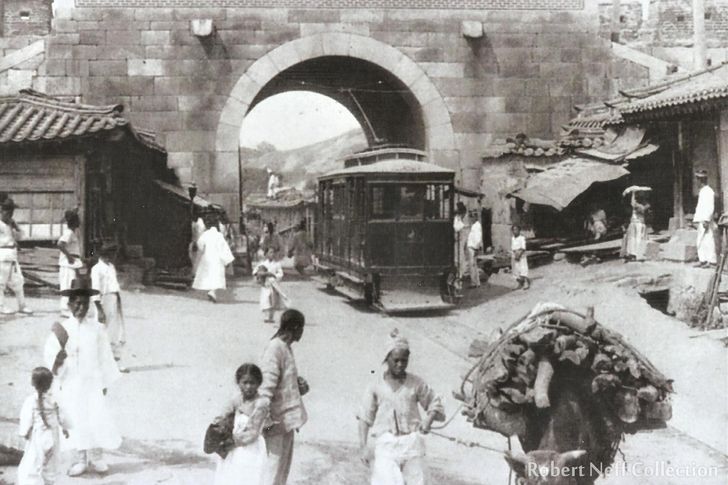
One of Seoul’s streetcars passes through a city gate in the early 1900s. Robert Neff Collection
The claim that streetcars, introduced in Seoul in the spring of 1899, represented “the first step toward civilization in the Hermit Kingdom,” as declared by Harper’s Weekly, provoked both excitement and unease, with many fearing the slow-moving modern vehicles would erode Korea’s long-held traditions as they rolled through the city’s ancient streets.
Horace N. Allen, the American representative to Korea, found the effect amusing. The Korean gentry, long-accustomed to the deference of commoners, now found themselves enslaved by the constraints of time.
Allen described the harsh lessons of punctuality: “So with the electric cars, which also would not tarry at the demand of the attendants of one of the gentry, and even when the great man himself would simply stop at the car steps and give some orders to his menials, the impudent contrivance was likely to go off and leave him standing there in the road.”
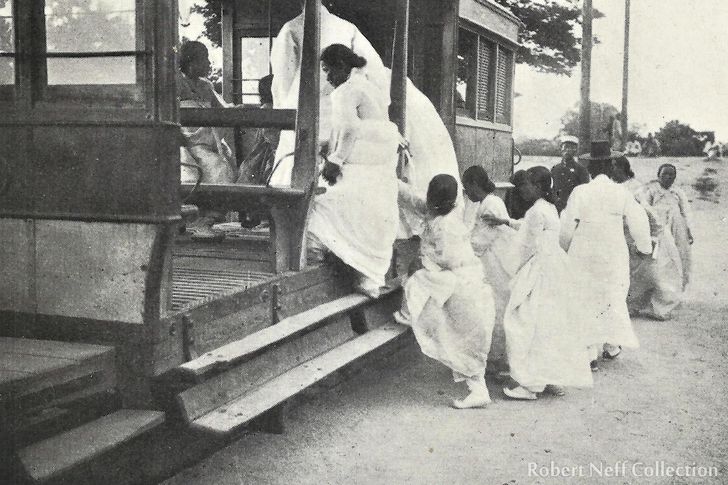
Women board a streetcar in Seoul in 1900. Robert Neff Collection
Even worse was being run down by a streetcar. George Trumbull Ladd described Korean men — presumably members of the gentry — walking with a dignified strut along the tracks, fully expecting that the trolley would go around them. Unfortunately for the self-entitled pedestrians, it did not.
Not only did the streetcars refuse to cater to the gentry’s whims, they also meant traveling alongside commoners — even women. In the past, women had been carefully segregated and were allowed free access to the streets only during the nightly curfew, when men were, for the most part, confined to their homes. With the introduction of streetcars, however, the nightly curfew was abolished. Women were now free to wander the streets whenever they wished, and if they had the fare, even to ride the streetcars.
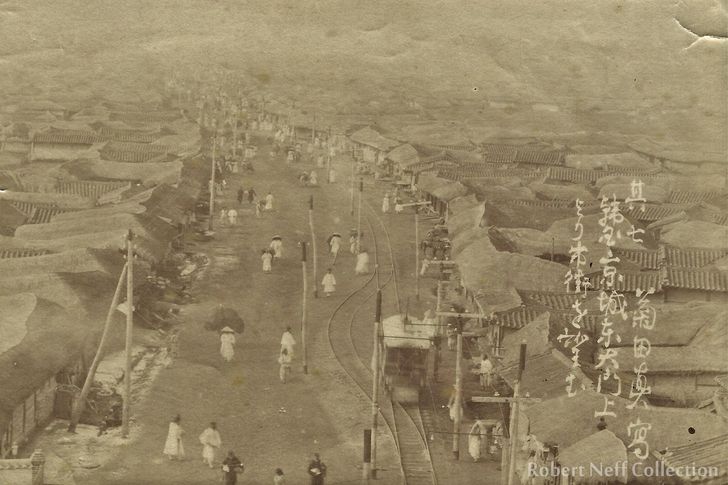
A busy street in Seoul in 1902 / Robert Neff Collection
Some cultural clashes were not socially significant but simply amusing. James H. Morris, manager of the streetcar company, recalled one of the problems they faced was persuading Korean passengers to keep their shoes on while using the streetcars.
“They would leave them on the platform. This was an impossible situation as there were delays in finding shoes and shoes would fall off when rounding curves. It took us over a year to get the people to understand that this was one room where you must be impolite enough to keep your shoes on when you entered,” Morris wrote.
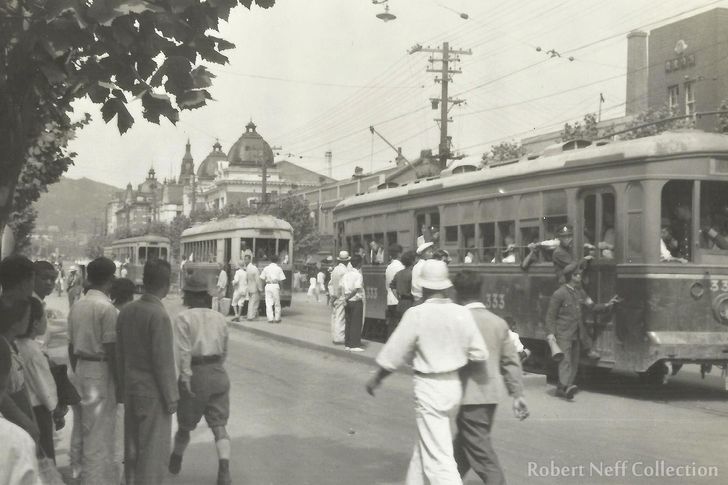
Passengers waiting to board streetcars in downtown Seoul in the late 1950s / Robert Neff Collection
Despite these initial problems, streetcars quickly became popular. Around the turn of the 20th century, the city had a population of between 50,000 and 100,000 people and was serviced by a handful of streetcars carrying roughly 2,700 passengers daily. Over the decades, usage increased so that by 1935, about 150,000 people rode on 154 streetcars each day.
World War II and the subsequent 1950-53 Korean War took a heavy toll on Seoul’s streetcars. By 1951, only 111 cars remained and only half of them were operational. The city’s fleet was augmented by streetcars imported from the United States.
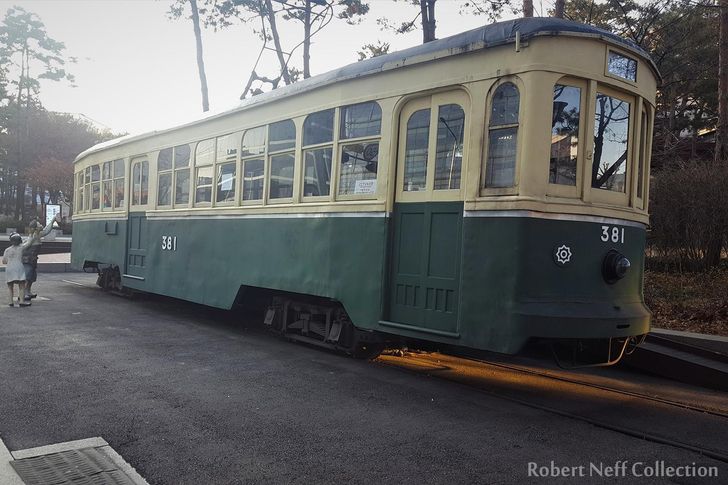
A streetcar is on display in front of Seoul Museum of History. Robert Neff Collection
In the 1960s, 213 cars served more than 350,000 people daily and were affectionately dubbed the “feet of the people of Seoul.” This decade marked the peak of the streetcars’ popularity and the beginning of their decline. Unable to compete with other forms of transportation like buses and faced with rising maintenance and operating costs, streetcar service in Seoul ended on Nov. 30, 1968.
Once hailed as “the first step toward civilization,” Seoul’s streetcars are now remembered as romantic icons of the past. Today, the only streetcars readily found in Seoul are the ones on display in front of Seoul Museum of History and the National Children’s Science Center — running only in the imaginations of children and the memories of the elderly.
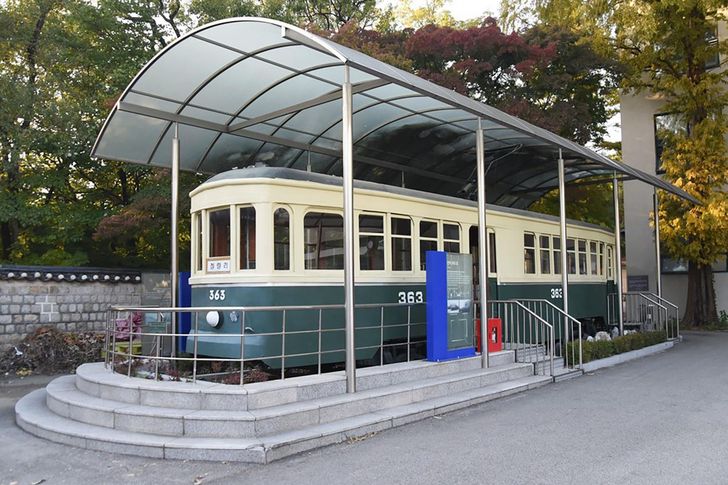
A streetcar is displayed at the National Children’s Science Center in northeastern Seoul, Oct. 20, 2022. Korea Times photo by Jon Dunbar
My appreciation to Diane Nars for her assistance and to Jon Dunbar for kindly allowing me to use one of his images.