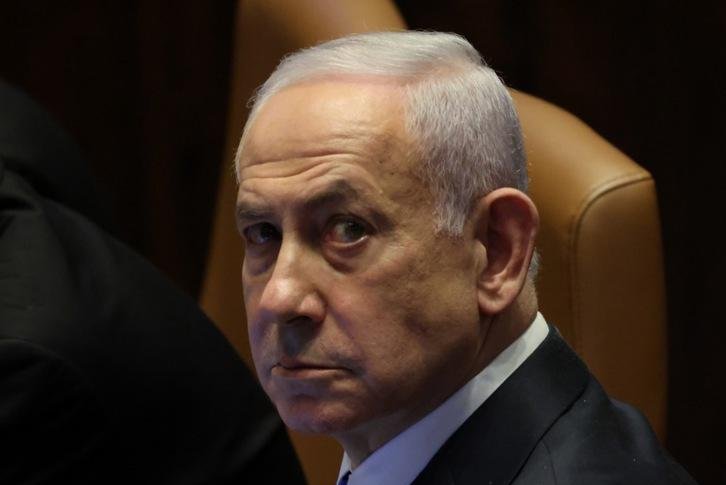
Israeli Prime Minister Benjamin Netanyahu’s ambitions for Israel hold a major key to what will occur in the Middle East in 2026. Photo by Abir Sultan/EPA
BEIRUT, Lebanon, Dec. 19 (UPI) — The conflict-ridden Middle East will stand at a critical juncture in 2026 after power shifts and unresolved wars, teetering between an uneasy status quo, the risk of deepening conflict, and a gradual path toward de-escalation and stability rather than peace or big open war.
The region’s trajectory, however, will largely depend on U.S. President Donald Trump’s continued engagement and “peace ambitions” in resolving its various conflicts, restraining Israel, containing Iran and defusing the risk of a full-scale war, according to political analysts.
U.S.-mediated — but fragile — cease-fires in Gaza and Lebanon, Israeli Prime Minister Benjamin Netanyahu’s determination to pursue his “Greater Israel” dream, Iran’s efforts to preserve its nuclear program and protect its Shiite armed groups, and Syria’s new leadership’s struggle to stabilize and rebuild have left the region highly volatile and fragile.
To Mona Yacoubian, director of the Middle East Program at the Center for Strategic and International Studies in Washington, 2026 promises to be “a defining year” for the Middle East.
“The region is poised on a knife edge between deepening conflict and gradual de-escalation and stability,” Yacoubian told UPI.
She said the Middle East could muddle its way toward greater stability, provided the cease-fires are accompanied by “intensified diplomacy.”
“This would require President Trump’s personal intervention and insistence that conflict across these three zones — Gaza, Lebanon and Iran — not resume,” she said, noting that U.S. engagement, specifically a decision by Trump “to push for peace,” will be the determining factor.
Last October, Trump pressured Netanyahu into accepting a cease-fire in Gaza. He now appears determined to prevent the Israeli Prime Minister from blocking his plan for the Strip, amid reports of rising U.S. frustration and tensions.
Trump’s plan was a U.S.-brokered Gaza peace framework that began with a cease-fire and hostage releases, and aims to force Hamas to disarm and relinquish control while Israel withdraws in phases under international oversight.
Balance of power shifts
The shift in the balance of power in the Middle East in 2025 favored the United Sates and Israel at the expense of the Iran-led “Axis of Resistance,” but it was quickly moderated by growing tensions between the two long-time allies, stemming from a clash of strategic objectives.
While Israel’s far-right government seeks to use the new pro-Western dominance to advance its vision of “Greater Israel,” Trump aims to leverage this advantage to promote regional peace, potentially earning him, the architect of the deal, the Nobel Peace Prize, said Riad Tabbarah, Lebanon’s former ambassador in Washington.
“Most of 2026 will probably witness the internecine fight within the pro-western group,” Tabbarah told UPI. “In the old days, a conflict between Israel and the United States would have been quickly settled in favor of Israel by the Israel lobby in the U.S. … but no more.”
The Israel lobby, he said, has been weakened by a shift in U.S. public opinion against Israel because of “its genocide practices” in Gaza and, more importantly, by a sharp division in support for Israel within the U.S. Jewish community — primarily between younger and older members –shifting the balance of power toward the U.S. administration.
“If this is true, then the veto that the U.S. has placed on an open war in the Middle East will probably hold. Israel is allowed to use force to weaken its enemies — Hezbollah, Houthis, etc. — but only short of open war,” Tabbarah said. “In other words, a status quo in the present situation is likely for the foreseeable future.”
The Gaza cease-fire achieved on Oct. 9 was a clear indication of this shift in power dynamics. It would not have been possible without Trump pressuring Netanyahu to halt the two-year war.
Washington in control
Such a decision highlighted a crucial reality: “Israel’s freedom of action ultimately runs through Washington,” said Kristian P. Alexander, a senior fellow and lead researcher at UAE’s Rabdan Security and Defense Institute.
Alexander said Trump wants a “legacy-defining deal” and stability that keeps energy markets calm and U.S. forces out of another Middle Eastern quagmire. Netanyahu, by contrast, is driven by “personal survival and an ideological project that prioritizes territory and dominance over conflict termination.”
This divergence will shape 2026. Although large-scale offensives are less likely while Trump conditions arms supplies, diplomatic cover and political support on Israeli restraint, they are not impossible, he told UPI.
Potential triggers include a “spectacular attack” targeting Israeli or U.S. forces, a miscalculated strike against Iran or a major escalation in Lebanon or Syria.
According to Tabbarah, Israel will continue to try to drag the United States into an armed conflict with Iran, but Washington appears to have learned “the lesson of not fighting Israel’s wars.”
Difficult choices
During 2025, much has changed in the region, forcing the major actors to confront increasingly difficult strategic choices.
Weakened but not defeated, Iran still retains missile and drone capabilities that could strike Israel, the United States and energy infrastructure in the Gulf as it cautiously seeks to rebuild its nuclear program without triggering another war.
While awaiting a grand bargain with Washington, it could benefit from the continuation of the Gaza war and from rearming its most powerful and loyal proxy, Lebanon’s Hezbollah.
“Its nuclear program remains the ultimate insurance policy. A coordinated regional and international push can constrain Iran’s room to maneuver, but it is unlikely to topple the regime in the short term,” Alexander said.
He cautioned that the “real danger is that a cornered leadership may miscalculate, either by racing toward a bomb or by authorizing escalatory attacks that invite devastating retaliation.”
Israel, which has operated with few military constraints throughout 2025, could find itself drawn into a long, grinding conflict that is increasingly difficult to control if its leaders interpret their temporary military upper hand as a green light to entrench a “Greater Israel.”
“They [Israeli leaders] will likely accelerate three dynamics in 2026: growing legal and diplomatic isolation, a more fragmented but enduring armed resistance from Palestinians and Lebanese actors, and rising anxiety in Arab and Gulf capitals about being dragged into crises not of their making,” Alexander said.
Dependence deepens
At the same time, Israel’s dependence on Washington has deepened, with U.S. support becoming more conditional as its operations in Gaza, Lebanon and Syria have eroded international legitimacy and strained key relationships in Europe.
Although a genuine two-state solution remains distant, the question remains whether Israel would accept greater constraints and move toward political arrangements that give Palestinians meaningful rights and self-determination.
Any new large-scale Israeli military operation could only harden Arab positions again and make normalization much harder and costly, the analysts said.
Israel’s creation of de facto security zones in southern Lebanon and southern Syria would likely destabilize and weaken both countries by provoking renewed guerrilla warfare against these open-ended occupations, Alexander noted.
Furthermore, Saudi Arabia and Turkey, the leading Sunni powers that benefit from Iran’s relative decline, would seek to ensure that any new regional order does not marginalize Sunni interests or leave Israel politically unchallenged.
Saudi power is expected to continue rising in 2026, likely “tipping the balance further toward the status quo,” Tabbarah said, noting that the main contention over the Palestinian issue will be reflected in the clash between the two-state solution and the Netanyahu government’s push for a Greater Israel.
With almost as many countries having recognized the State of Palestine so far as recognizing Israel, it is becoming more difficult for Israel to pursue its expansionism. Yet, Tabbarah said, “it will try with all its might.”
The region, the analysts said, seems to be drifting toward “managed instability,” with the fragile cease-fires in Gaza and Lebanon possibly holding “at a low burn.”
However, they cautioned that if Israel takes its first steps toward Greater Israel — by annexing the West Bank and Gaza Strip and extending influence over buffer zones in Lebanon and Syria –core political issues, including Palestinian statehood, borders and refugees, would continue to fester.
The fear is that “the pursuit of Greater Israel will set the stage for another hundred years of wars,” Tabbarah said.