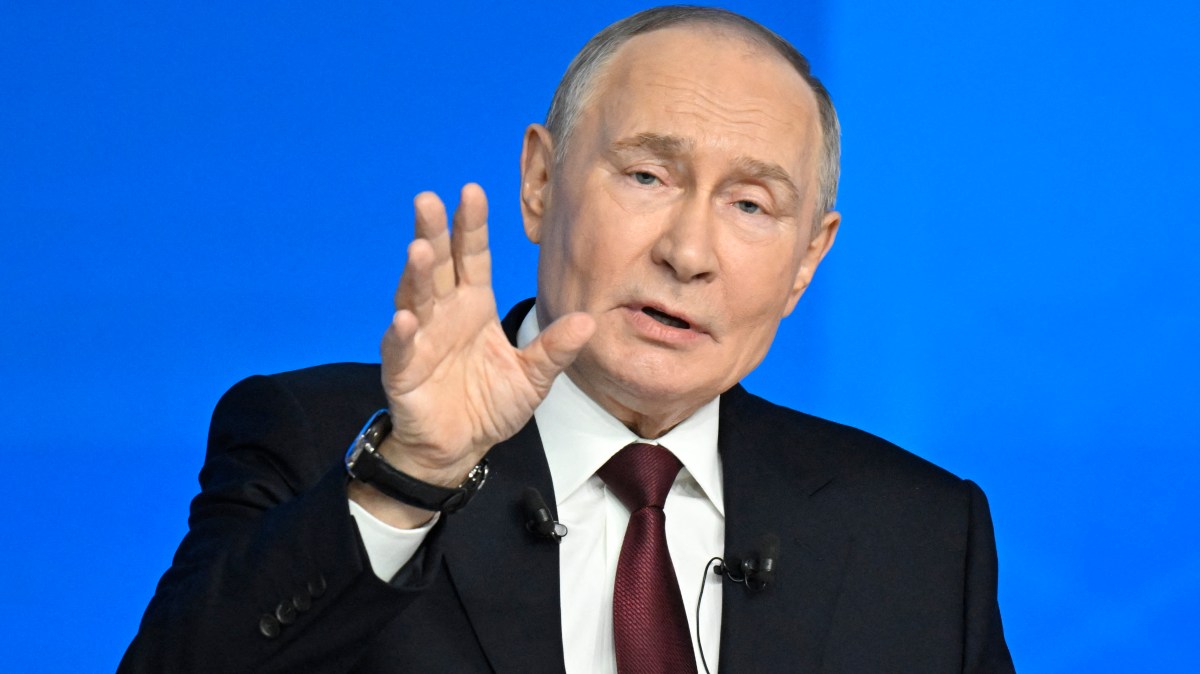
President Putin, giving his annual press conference and phone-in, is asked about the European Union’s decision overnight not to “steal” frozen Russian assets to finance Ukraine.
“Stealing is not the suitable word,” he says. “Stealing is a secret theft and they are trying to do it to us openly. That’s robbery. But why is it not successful? Because the consequences could be very serious for the robbers.
“And what does it involve? After all, they announced that they are not just going to rob us and take [Russia’s money] but one of the ideas was to give a loan with our assets as collateral. But loans have consequences for the budget, an increase in debt.”
Putin says a decision to use the assets would have been “not just a blow to their image, it would have been an undermining of trust, in this case towards the EU”.
Other countries, especially oil-producers, who have gold and foreign exchange reserves in Europe would be concerned, he says. “They are looking at what happens — already looking and having suspicions and doubts and fears. What if that happens to us?”
Viktor Orban, the Hungarian prime minister, said the Brussels deal meant that “we managed to avert the immediate threat of war. We did not let Europe declare war on Russia by using Russian assets”.
However, the compromise was “a bad decision”.
“At the same time, 24 member states decided to provide Ukraine with a war loan for the next two years,” he said. “If the Ukrainians are unable to repay the loan, these European countries will have to repay it.
“Three countries decided not to be part of it, that’s an opt-out for the Czech Republic, Slovakia and Hungary. So we are innocent.”
If you’re Bart De Wever, the Belgian prime minister, President Macron or Giorgia Meloni, the Italian prime minister, it is a very elegant workaround to avoid a potential financial crisis caused by seizing Russian state assets, writes Bruno Waterfield.
If you are Chancellor Merz, Donald Tusk, the Polish prime minister or, certainly, Ursula von der Leyen, the European Commission president — who all lost their argument — it is a messy fudge, wrapped in an evasion.
France sided with Belgium, Italy and some other countries. Meloni did the heavy lifting at the summit table but Macron quietly wielded the dagger.
Using Russian assets as a pain-free funding raid always had an element of “magical thinking” and Merz, with Von der Leyen, committed the cardinal European sin of being German while trying to bounce the rest.
The deal will not mean extra debt for its 24 EU signatories because the money will be raised by “EU borrowing on the capital markets backed by the EU budget headroom”.
That headroom is the difference between the guarantees that member states give for a ceiling to the bloc’s spending and the lower sum that is actually paid out.
The legal basis lies in the EU treaty’s “enhanced co-operation” clauses, and the Czech Republic, Hungary and Slovakia will not take part. However, all three countries, in the EU’s pro-Russia camp, did vote for the deal.
Viktor Orban, the Hungarian prime minister, said: “We gave up our veto, but in return we received an opt-out.” The deal leaves him diminished. The EU’s move to permanently immobilise Russian assets means that Hungary — and anyone else — has lost the power of veto over the sanction to freeze those assets.
The figures are astronomical, on both sides. But even as President Zelensky presses European leaders to give him access to Russian cash reserves to fight on into the New Year, he is outmatched in spending power.
President Putin has transformed the Russian military-industrial complex and, as Moscow is now effectively cut off from much of the outside world, its economy is solely focused on providing resources to the front line. Putin is betting that his stomach for the fight can outlast that of Kyiv and its international backers, and that his wallet is deeper.
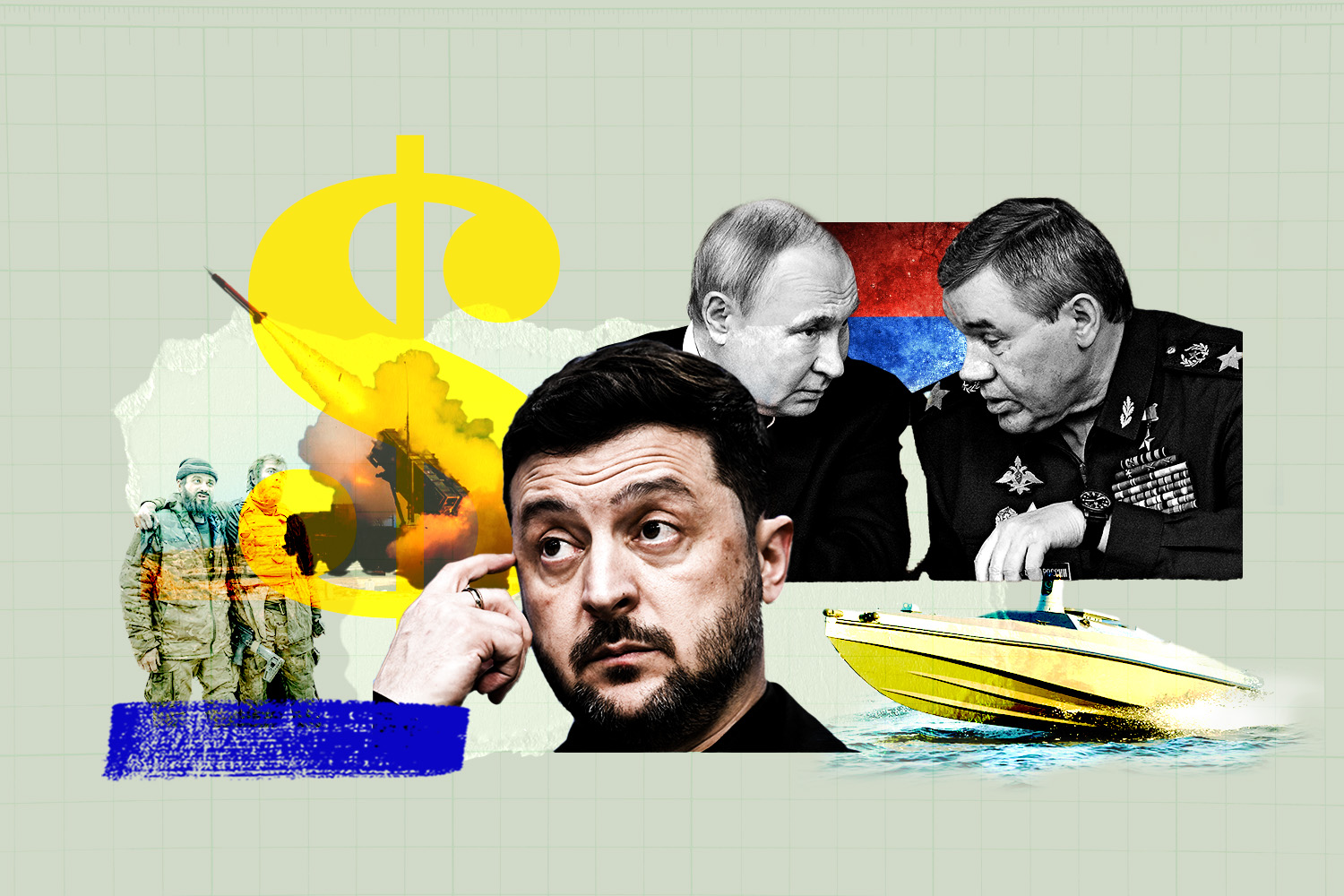
As European leaders agree to give Zelensky a €90bn interest-free loan, we examine what that would buy for Kyiv’s war effort.
• Read in full: How much does it cost Ukraine to keep fighting?
Putin has opened his press conference with a question about Ukraine’s intentions and how Russia can achieve the aims of its “special military operation”.
He says Ukraine is not ready for territorial concessions and refuses steps towards peace “but nonetheless, we feel certain signals, even from the Kyiv regime, about the fact they are ready for some kind of dialogue”.
He claims that Russia has always wanted peace.
Asked about the situation in the combat zone, Putin says that Russian forces are “advancing along the whole length of the front”.
“The enemy is in retreat,” he adds.
In preparation for Putin’s televised press conference, the hosts are speaking to journalists in the audience about the signs they are holding to attract the president’s attention.

The media gathers for Putin’s press conference
MIKHAIL METZEL/SPUTNIK/REUTERS
One woman has a cut-out of a fish with the name of her city, Astrakhan. She wants to ask about the use of natural resources.
A young man in a red bow tie is holding a sign saying “I want to get married!” He wants to ask about demographic politics. A young woman across the hall is holding a sign with the same words. The hosts suggest they could get together.
One of the hosts also sums up questions that have been sent online. “Who is better, Messi or Ronaldo?” is one of them.
President Putin of Russia is expected to address his appetite for war — or peace — in Ukraine at his annual marathon press conference which starts at noon in Moscow.
The highly choreographed event, with questions agreed in advance with the Kremlin, is a chance for Putin to speak off the cuff with little chance of interruption or follow-up from reporters.

A giant digital screen in Moscow promotes Putin’s annual press conference and phone-in
RAMIL SITDIKOV/REUTERS
“A press conference, like home improvements, can never be finished, it can only be halted,” Putin once joked about the event, which is attended by hundreds of accredited journalists and broadcast live on state television.
Putin usually begins with a blizzard of statistics about Russia’s economic performance before progressing to other domestic topics, then blasts of rhetoric about the perfidious West. The press conference is now combined with a citizens’ phone-in, which used to be a separate event.
Russia is gloating over the deal announced in Brussels. Kirill Dmitriev, President Putin’s special envoy for investment and economic co-operation, said on X that it was a “fatal blow to Ursula, Merz, Starmer and the warmongers.”
Please enable cookies and other technologies to view this content. You can update your cookies preferences any time using privacy manager.
Enable cookiesAllow cookies once
On Telegram, he wrote that “for the time being, the law and common sense have won a victory”.
European diplomats observed that Russian schadenfreude would not last. “For Putin the money has gone,” said one EU official. “The last laugh will be on us.”
The compromise was a win for Bart De Wever, the Belgian prime minister. “We remained united and avoided chaos and division,” he said, in a deal that meant “rationality has prevailed”.
“I think Ukraine has won. Europe has won, and financial stability has certainly won. This whole business was so risky, so dangerous, and raised so many questions — it was like a sinking ship, like the Titanic. The die are cast now and everyone is relieved.”
A widely-touted plan to use some of the €210 billion of Russian assets that are frozen in Europe, mostly in Belgium, fell through after opposition from some member states.
Despite trying to reassure Belgium that the EU would protect it from any Russian retaliation if it backed the “reparations loan” plan, the bloc eventually chose to borrow the money on capital markets.
Antonio Costa, president of the EU Council, said in a post on social media: “We have a deal. Decision to provide €90 billion euros ($106 billion) of support to Ukraine for 2026-27 approved. We committed, we delivered.”
President Zelensky of Ukraine backed the Brussels agreement, writing on X that the deal was “significant support that truly strengthens our resilience”.

He added: “It is important that Russian assets remain immobilised and that Ukraine has received a financial security guarantee for the coming years.”
Europe’s leaders have agreed to give Ukraine a €90 billion loan but, crucially, without using frozen Russian state assets after a marathon Brussels summit which lasted 15 hours and ended at 3am on Friday.

Mette Frederiksen, left, Denmark’s prime minister, Antonio Costa, European Council president and Ursula von der Leyen, European Commission president, celebrate the agreement at a summit in Brussels on Thursday
OLIVIER HOSLET/EPA
The deal was a compromise to fund Ukraine’s war effort with joint borrowing between 24 countries backed by the European Union budget.
Russian state assets will be left intact but remain immobilised until Moscow pays reparations to Kyiv, which will then be used to repay the interest-free loan.
The loan has long term implications and internal legal challenges are expected. In a sign of EU divisions, Hungary, the Czech Republic and Slovakia will not be part of the loan.