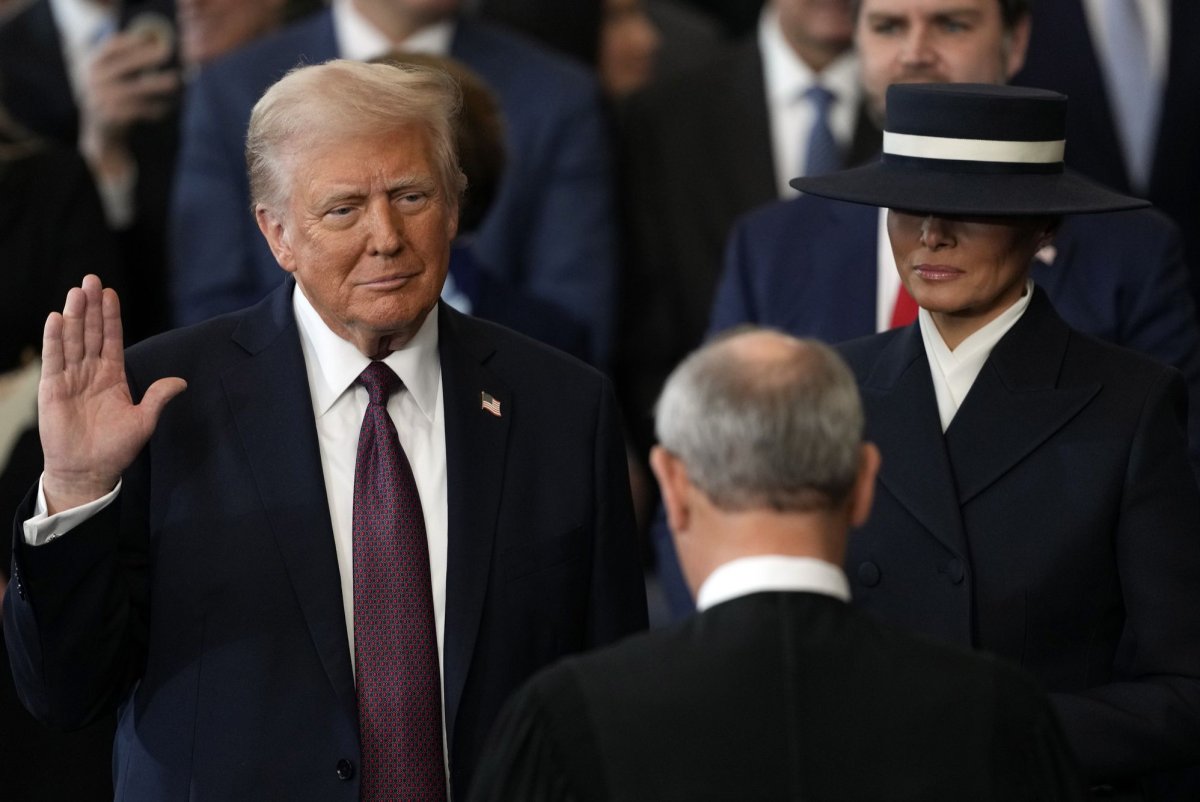
Dec. 16 (UPI) — Beginning his second term as president, Donald Trump‘s upheaval of U.S. policies behind executive action and a congressional budget has shifted the nation’s direction on global trade, foreign aid, education, immigration and more in 2025.
The Trump administration’s policies sparked a year filled with protests and court battles. The temperature around public discourse was turned up by the killing of conservative debater Charlie Kirk and the battle in Congress over the long-awaited release of the Epstein files.
These are the top stories of 2025
Immigration crackdown
Trump’s return to the White House was marked with an almost immediate declaration of a national emergency at the southern border.
The president followed through with his campaign promise to take aggressive action on immigration, directing U.S. troops to the border and calling on law enforcement agencies to work with Immigrations and Customs Enforcement and the Department of Homeland Security to detain immigrants.
“All illegal entry will immediately be halted and we will begin the process of returning millions and millions of criminal aliens back to the places from which they came,” Trump said in his inauguration speech. “We will reinstate my ‘remain in Mexico’ policy. I will end the practice of catch and release and I will send troops to the southern border to repel the disastrous invasion of our country.”
Trump said detainment and deportations would prioritize violent offenders but the ongoing enforcement has been broader than that. DHS and ICE, behind a policy of making detainments based on “reasonable suspicion,” has been accused of racial profiling in its sweeps.
The U.S. Supreme Court decided in the case Noem vs. Vasquez Pedromo that immigration agents may continue using factors like “apparent race and ethnicity” to detain people on suspicion of immigration violations. This can also include a person’s place of work, where they are detained and whether they speak Spanish.
The administration has targeted several cities for increased enforcement, deploying additional agents as well as National Guard troops in Los Angeles; Portland, Ore.; Chicago and Washington, D.C.
U.S. District Judge Karin Immergut enacted a permanent injunction to stop the deployment of National Guard troops in Portland in November. This followed a restraining order blocking deployment a month earlier.
Los Angeles, Chicago and Washington, D.C., have also filed lawsuits to stop the deployment of troops. In the case of Washington, D.C., its Attorney General Brian Schwalb argues that the Trump administration is violating the Home Rule Act.
Immigrant detention centers
The administration’s detainment practices have also faced lawsuits. Trump and Border Czar Tom Homan called on states to prepare for increased detainment capacities dedicated to immigrants.
The first facility, “Alligator Alcatraz,” was erected in the Florida Everglades. It has been used to hold detainees in preparation of deportation.
The facility quickly drew protests and lawsuits over environmental concerns and alleged inhumane conditions. Its location, chosen to make it difficult for advocates and attorneys to visit detainees according to critics, emphasizes the Trump administration’s emphasis on punishment for immigration offenses.
Nebraska, Indiana and Louisiana have taken cues from Alligator Alcatraz by opening detention space for immigration detainments. Like Alligator Alcatraz, these facilities don names like the Cornhusker Clink and Speedway Slammer, which critics say downplays or makes light of their purpose.
“It’s dehumanizing, making light of or sanitizing something so horrific,” Haddy Gassama, senior policy counsel in the ACLU’s National Policy Advocacy Department, told UPI.
Alligator Alcatraz was briefly ordered to cease operations but the federal court of appeals overturned this decision in September, allowing it to continue running.
Kilmar Abrego Garcia wrongly detained
The United States most often deports people to their home country when it is possible to do so. Trump took a different approach, deporting immigration detainees to third countries, notably El Salvador.
In May, the Trump administration asked the Supreme Court to allow it to deport convicted criminals to South Sudan.
This was after federal courts ordered the administration to return hundreds of deportees from El Salvador, an order the administration ignored.
Among those deported to an El Salvadoran prison was a Maryland man, Kilmar Abrego Garcia. The 30-year-old was wrongfully deported and accused by the administration of being a member of the gang MS-13.
Garcia, a native of El Salvador, was granted a withholding of removal by a federal judge in 2019, effectively allowing him to stay in the United States.
The Supreme Court ordered the Trump administration to return Garcia to the United States in April. However it took almost two months for this to happen.
In August, Garcia was released from custody and returned home to Maryland. The U.S. Department of Justice continued to seek his deportation, filing a motion in October to deport him to Liberia.
A U.S. District Court Judge, Waverly Crenshaw Jr., is allowing Garcia to move forward with a hearing regarding his claim of vindictive prosecution against the Trump administration. A hearing is scheduled for December.
“The timing of Abrego’s indictment suggests a realistic likelihood that senior DOJ and [Homeland Security] officials may have induced Acting U.S. Attorney McGuire (albeit unknowingly) to criminally charge Abrego in retaliation for his Maryland lawsuit,” Crenshaw wrote in his decision.
On Dec. 11, Garcia was released from ICE detention after U.S. District Judge Paula Xinis ruled the Trump administration did not have the legal authority to continue holding him.
International student visas revoked, students deported
International students were thrust into the Trump administration’s immigration crackdown as the U.S. State Department revoked thousands of student visas.
Along with having visas revoked, students at institutions of higher learning across the country had their Student and Exchange Visitor Information System records terminated without notice. This created fear on campuses about more removals.
DHS was responsible for blocking access to SEVIS. Several weeks later, it restored access but a DHS spokesperson said it had not “reversed course on a single visa revocation.”
Enrollments by international students subsequently fell by 17% in the fall semester, the Institute of International Education’s Open Doors report says. It is the most international enrollments have dropped in a single year in the past 11 years, aside from the 2020-2021 academic year when the COVID-19 pandemic created mass disruption.
Students continued to protest Israel’s military activities in Gaza and the United States’ support of those efforts in 2025. In response, the Trump administration targeted pro-Palestinian activists, including students, for detention and deportation.
Mahmoud Khalil, a Columbia University graduate student and citizen of Syria, is among those who were detained after speaking out at protests and public demonstrations. He was detained by ICE in March and accused of making statements that were supportive of Hamas. Prior, he was among the key voices in the pro-Palestinian demonstrations on Columbia’s campus in New York throughout 2024.
Khalil’s attorneys argue that he has been targeted in retaliation for exercising his First Amendment rights. In June, Khalil was released from ICE detention in Louisiana on orders from a federal judge.
The case against him has continued with a federal court ordering in October that he is to be deported for allegedly willfully omitting his work with the U.N. Relief and Works Agency for Palestinian refugees. His legal team plans to appeal the ruling.
Trump vs. universities
The Trump administration’s clash with universities also put research grant funding at risk. The administration jostled with universities like Columbia and Harvard over their policies, including DEI programs, and alleged they did not do enough to stop anti-Semitism on campus.
The administration would threaten to rescind grant funding to universities over the claims. It froze $1 billion in funding to Cornell, $790 million to Northwestern University and more than $2 billion to Harvard. It also cut federal contracts to universities including Harvard.
As the government continued to leverage its funding to attempt to change university policies, the administration took to lawfare to pressure university leaders.
In July, Columbia University agreed to pay $221 million to settle a lawsuit by the Trump administration that alleged the university violated anti-discrimination laws. The university did not admit to violating these laws as part of the settlement.
The settlement paved the way for Columbia to receive a majority of the federal funds that had been withheld.
In October, the Department of Education called for nine universities to sign a pledge in exchange for assurance that they will receive federal grant funding.
The universities asked to sign the pledge were: Vanderbilt University, Dartmouth College, the University of Pennsylvania, the University of Southern California, the Massachusetts Institute of Technology, the University of Texas at Austin, the University of Arizona, Brown University and the University of Virginia.
The administration’s list of demands as part of this pact include limiting international student enrollment, freezing tuition for five years, enforcing strict gender definitions and accommodating conservative ideas on campus.
Seven of the universities rejected the pact as of Oct. 21. Texas and Vanderbilt have remained either open to signing the pledge or expressed reservations.
DOGE slashes funding, workers
The newly-formed Department of Government Efficiency stormed through government agencies recommending cuts to funding and the workforce along the way.
Headed by Elon Musk in an opaque capacity, DOGE employees accessed federal databases, including the Social Security Administration, the Office of Personnel Management and the Department of Education’s student loan records, sparking outrage over privacy and overreach.
One of the most immediate marks left by DOGE was the dismantling of the U.S. Agency for International Development. Within weeks of the new administration taking office, it had directed USAID to place most of its international workforce on leave.
USAID employees were seen carrying boxes of belongings from the USAID headquarters in Washington, D.C., as protesters gathered in support. The firing of USAID employees, and the process under which it took place, was challenged in court. By July, hundreds of people lost their jobs with the agency and nonprofit organizations that rely in part on USAID funding had to downsize their operations and workforces.
“The toughest thing about the closure are the literally millions of people who have been denied life-saving aid,” said a former senior foreign service officer.
Concerns about a lack of transparency hovered over DOGE’s work. In March, U.S. District Court Judge Casey Cooper ordered that DOGE needed to comply with Freedom of Information Act requests “eventually.”
The duties of USAID were rolled into the U.S. State Department under the purview of Secretary Marco Rubio. A spokesperson for the department told UPI it is part of a realignment to implement “America First Foreign Policy.”
Despite being front and center in DOGE’s efforts, Musk’s work with the federal government and the agency ended after five months. At the time, DOGE claimed to have cut $180 billion in federal spending. That figure is disputed by experts.
Consumers and ag workers suffer under tariff plan
The president’s plan to give the U.S. economy an infusion of dollars delivered poor results in 2025 as Trump’s aggressive tariff policy deepened global trade challenges for U.S. farmers and prices at the checkout counter rose.
After bloviating about resetting trade deals in favor of the United States, Trump put a pause on his tariff plan until the beginning of April, a day he marked as “Liberation Day.” He announced that the United States would tariff most goods from most countries while imposing higher reciprocal tariffs on a group of 60 nations that have tariffs and trade barriers against the United States.
The United States’ NAFTA partners Mexico and Canada are among the countries that were hit with higher tariffs, up to 25% on some goods.
“Our country and taxpayers have been ripped off for more than 50 years,” Trump said during the Liberation Day event at the White House. “It’s not going to happen anymore.”
Economists told UPI that it would be U.S. consumers, not foreign nations, that would bear the brunt of the tariffs by paying higher prices for goods.
“The effect of all this is it will undermine international business, increase prices, harm trade relations and it will cost jobs, not create jobs,” Joshua Gotbaum, an economist with the Brookings Institution, told UPI in March.
About a week after the Liberation Day event, most tariffs were put on hold by the president for 90 days, except those imposed on China, as the stock and bond market declined. When the news hit of the pause on tariffs, markets rebounded.
The president continued to leverage tariffs in negotiations with trade partners, putting temporary pauses on tariffs against those that have entered trade talks with the United States.
The U.S. Supreme Court is considering the government’s justification for using emergency powers to impose tariffs. Oral arguments were held in November after educational toy manufacturer Learning Resources Inc., alleged the administration misused the International Emergency Economic Powers Act to impose its broad tariff policy.
Charlie Kirk killed
On Sept. 10, conservative figure Charlie Kirk was shot and killed during a Turning Point USA event at Utah Valley University in Orem, Utah.
Kirk was seated under a tent surrounded by a crowd there to observe and engage in debate with him, something he had done at campuses across the country. The event began only minutes before the 31-year-old was shot in the neck by a high-powered bolt-action rifle, according to investigators.
Two people were interviewed by the police within a day of the shooting before being released. When they were released they were no longer considered suspects.
On Sept. 12, 22-year-old Tyler Robinson was arrested after a family member identified him as the suspect shown in photos released to the public.
Robinson was charged with aggravated murder, felony discharge of a firearm, two counts of obstruction of justice, two counts of witness tampering and committing a violent offense in the presence of a child.
Discourse around Kirk’s killing and the incendiary rhetoric he espoused during his public appearances drew a response from the U.S. government.
Days after Kirk was killed, ABC pulled Jimmy Kimmel Live! off the air over comments he made about Robinson during his show. Federal Communications Commission Chairman Brendan Carr threatened the network and owner Disney over the comments.
ABC and Disney were met with backlash over removing Kimmel from the air. About a week later, the show returned, though Nexstar Media Group and Sinclair Broadcasting refused to broadcast it on their stations initially.
Within days of Kimmel’s return, both companies reversed course.
International students were again targets of the administration as some students who allegedly made comments on social media about Kirk after his death had their visas revoked
“The United States has no obligation to host foreigners who wish death on Americans,” the State Department said in a statement.
On Sept. 21, Kirk was memorialized in an event at the State Farm Stadium in Glendale, Ariz. The president and Vice President J.D. Vance were in attendance and the president joined Kirk’s widow Erica Kirk on stage.
Record government shutdown
A U.S. government shutdown was averted multiple times in recent years due to disagreements over funding between Democrats and Republicans in Congress. That changed on Oct. 1, when the government shut down due in part to an impasse over healthcare coverage.
Republicans and Democrats shifted blame as hundreds of thousands of federal workers faced furloughs.
Some of the 42 million people who receive Supplemental Nutrition Assistance Program benefits turned to food banks and community pantries when benefits were not released at the beginning of November. They were joined by federal workers who in some cases were using the charitable food bank infrastructure for the first time due to not being paid.
The Trump administration said it did not have the money to fund full SNAP benefits when the shutdown extended beyond a month. It told UPI it could not use contingency funding to provide benefits despite doing so during the last government shutdown, which also occurred under Trump in 2019.
On Nov. 5, the government shutdown became the longest in history, surpassing the 2019 shutdown, reaching 36 days.
On Nov. 6, a federal judge ordered the government to distribute full SNAP benefits. The Trump administration appealed this ruling, continuing the freeze.
On Nov. 12, the longest government shutdown in U.S. history ended after 43 days. The U.S. House and Senate passed a stopgap funding bill and the president signed it, causing a release of SNAP benefits and a return to work for furloughed federal workers.
The Epstein files
Calls for the government to release documents related to its investigation into disgraced financier and convicted sex offender Jeffrey Epstein reached a fever pitch in 2025 with Congress approving a release of the Epstein files.
All but one member of the U.S. House, Rep. Clay Higgins, R-La., voted in favor of releasing documents that have been long expected to implicate prominent figures around the world. The U.S. Senate followed suit, voting unanimously to send a bill demanding the files’ release to the president’s desk.
Epstein died of suspected suicide in jail in 2019.
The bill, the Epstein Files Transparency Act, requires Attorney General Pam Bondi to release “all unclassified records, documents, communications and investigative materials,” related to Epstein and his co-conspirator Ghislaine Maxwell within 30 days.
Trump, who campaigned on the release of the files, downplayed the investigation after returning to office, calling it a “hoax.” He pushed back on Republicans who continued to encourage their release before ultimately saying Republicans should vote on the bill.
Unlike other notable bill signings, Trump signed the Epstein files bill with no press or fanfare, announcing it in a post on social media.
Prior to the vote in Congress, the House Oversight Committee released a slew of email correspondence between Epstein and others. Trump was mentioned in some of these emails.
Larry Summers is among those who corresponded with Epstein in the emails released by the House Oversight Committee. Summers, the Treasury Secretary under former President Bill Clinton, announced that he is stepping away from public commitments due to shame over the emails that were released.