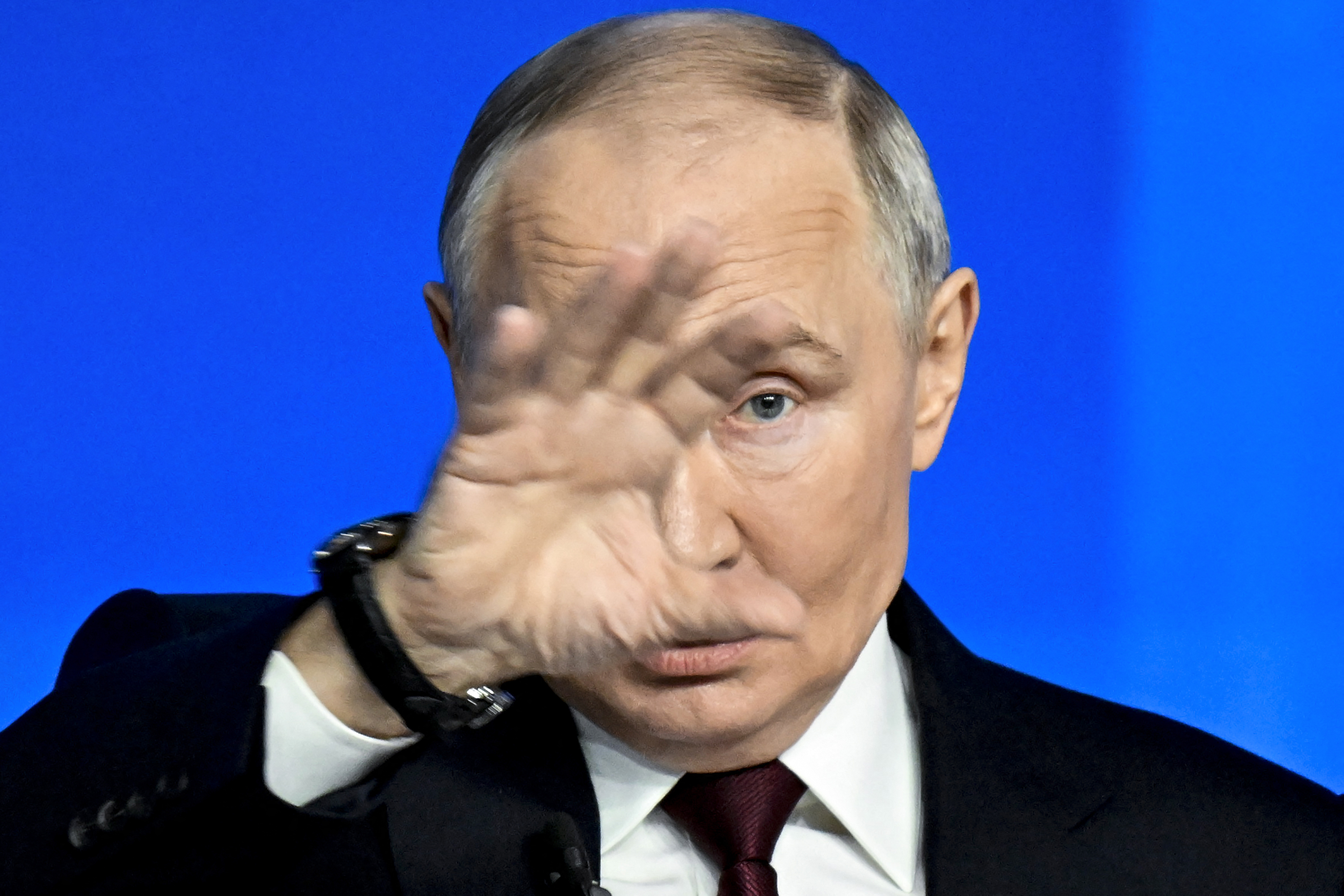
Putin’s marathon phone-in continues. A woman called Kristina asks the president about aliens in outer space, and a young boy wants to know if he drives round Moscow incognito to gather information on the streets. Putin replied that he did, sometimes.
One man said Russia should put up a monument to the Omar Khayyam, the Persian poet. “It’s a good idea. We’ll definitely think about it,” said Putin.
ALEXANDER NEMENOV/AFP/GETTY IMAGES
Kirill Bazhanov, a 23-year-old student with a red bow tie and a flower in his buttonhole, proposed live on air to his girlfriend Olga, who he said was watching on TV. He invited Putin to the wedding before asking a question about financial support for young families.
The Kremlin presents the annual event, which typically runs for at least four hours, as proof that Putin is attentive to the concerns of ordinary people and willing to answer questions on any subject. More than 2.5 million questions for this year’s event were submitted from people from across Russia.
Ukraine is also claiming it has hit a Russian oil rig in the Caspian Sea. An official in Ukraine’s security service, the SBU, said drones were used to attack an oil platform owned by Lukoil.
This was the third oil platform in the Caspian Sea to be struck by Ukraine in the last few weeks. Lukoil is a Russian company, with headquarters in Moscow, and has been sanctioned by the UK and the US.
Ukraine is trying to “coerce Russia into a ceasefire” by targeting oil tankers, Oleksandr Khara, executive director of the Centre for Defence Strategies in Kyiv, told Times Radio.
“I reject the very name of this type of fleet. It’s not a grey fleet or shadow fleet or whatever,” Khara said, highlighting that ships under the flags of Turkey, Greece and other European countries were carrying Russian oil “to circumvent sanctions”.
“They are not out of the blue or unnamed vessels that are helping Russia to fund its war effort,” he said. “By targeting Russian energy, we are trying to coerce Russia into a ceasefire and we are trying to undermine their resource base for their ongoing aggression.”
Putin claims Russia is willing to guarantee the security of elections in Ukraine. He says his forces would hold back from striking deep within Ukrainian territory on polling day.
Putin has repeatedly called for President Zelensky to hold elections. Zelensky’s first term in office was due to expire last year but elections were postponed under the martial law that was imposed when Russia invaded in 2022.
Zelensky said last week he would be ready to hold presidential elections within the next 60 to 90 days if Europe and the United States helped ensure security.
Putin has been Russian president for the past 25 years, apart from a break between 2008 and 2012, when he was prime minister.
Sergei Lavrov, Russia’s foreign minister, has criticised a European proposal to create a multinational force to police any potential peace deal in Ukraine as a “brazen” threat to Russia.
“This is not so much about security as it is about yet another attempt, you know, a brazen one… to carry out the military development of Ukrainian territory as a springboard for creating threats to the Russian Federation,” Lavrov said, during a visit to Cairo.
Putin’s press conference continues. Asked if he was in love, he answered “yes”, without elaborating.
Fortunately for the curious, a book on that subject by two opposition journalists was published in October. The Tsar Himself. How Vladimir Putin Deceived Us All exposes the president’s litany of affairs, the despair of his wife and the hypocrisy behind his “cover story” as he extols traditional family values.
• Read in full: The private life of Putin: strippers, lovers and secret sons
Rachel Reeves welcomed the EU deal and said: “The UK’s support for Ukraine remains iron-clad. We will work with partners to urgently consider options to ensure that Ukraine gets the funding it needs.”
Funds for the €90 billion EU loan will come from borrowing, backed by the EU budget. A proposal to seize frozen Russian assets to fund the Ukrainian war effort was dropped.
But Sir Keir Starmer has been one of the main proponents of the frozen assets plan, and must now decide whether the UK will act alone in expropriating the £10 billion of Russian assets located in Britain.
President Putin’s annual press conference is approaching the four-hour mark. As usual, he has roamed across dozens of topics from international relations to the price of medicines, Satanism and more whimsical themes.
A reporter from the west Siberian oil town of Tyumen asked Putin if there were “guests from the cosmos” aboard a mysterious object which some scientists say could be an alien battleship approaching Earth.
Putin joked that the object, known as 3I/Atlas, was Russia’s secret weapon, then said: “To be serious, it’s a comet. Our scientists know what’s happening there.”
Later a young man holding a sign reading “I want to get married!” asked about demographic policy and took the opportunity to propose live to his girlfriend. Putin said young people, including students, should not put off having children — there was state support for them.
Now Putin is tackling the question: “What will Russia be like in 200 years and will it exist at all?”
Donald Tusk, the Polish prime minister, said he was “not fully satisfied” with the EU’s decision on a loan for Ukraine, which was approved despite the “excessive caution” of some leaders and that there was still an option to use Russian assets.
He wrote on X: “The possibility of using immobilised Russian assets is still on. Am I fully satisfied? Of course not. But it is always better to have a piece of something than all of nothing.”
Slovakia rejected further financing of Ukraine’s military needs because it does not believe in a military solution to the war, Robert Fico, the prime minister, said.
Slovakia, Hungary and the Czech Republic agreed to the €90 billion loan in Brussels, but only if they were not included. Fico said: “Slovakia will not be part of any military loan for Ukraine.”
Fico met President Putin in Beijing in September. Last year he made a surprise visit to Moscow, where he said Putin had been “wrongly demonised” by the West.
Putin is asked about President Trump’s $5 billion defamation lawsuit against the BBC over its editing of a speech he made on the day of the Capitol riot.
The Russian president claims he does not want to get involved. “That’s their family business,” he says. “I don’t want to pour salt on the wound, I don’t want to touch on that theme.”
But he then adds: “Although, of course, there is a problem with unreliable coverage of information and doctoring. That’s obvious. I think President Trump is right.”
The question was inserted by the host as Steve Rosenberg of the BBC, one of the few Western correspondents who has not left Russia because of the risk of prosecution, asked a question about Putin’s clampdown on dissent.
Putin says Russia has no intention of attacking Europe. He said his country would not attack other countries on the condition it was treated “with respect”, dismissing concerns that Moscow poses a security threat to states on Nato’s eastern flank.
“You said: Will there be new special military operations? There will be no operations if you treat us with respect, if you observe our interests, just as we have constantly tried to observe yours,” Putin said.
Even after a gruelling 15-hour summit in which he defeated plans to seize Russian assets worth €185 billion and faced accusations he was pro-Russian, Bart De Wever, Belgium’s prime minister, could not resist a joke.
His father having performed charity work in post-Soviet Ukraine, De Wever quipped about enjoying a luxury villa in Russia, like Gerald Depardieu, the French actor, and Bashar al-Assad, the exiled former Syrian dictator.
“Now I need to go to my dacha in Saint Petersburg, where my neighbour is Depardieu and across the street is Assad. I think I could be mayor of that little village,” he said, concluding a press conference in Brussels early on Friday.
He quickly added: “That was a joke. If you write about it, be sure to say I was joking and you laughed.”
Please enable cookies and other technologies to view this content. You can update your cookies preferences any time using privacy manager.
Enable cookiesAllow cookies once
Text messages are being shown on the screens at President Putin’s annual press conference and phone-in. Here are a selection:
“How can you be such a charming and real man! I waited four hours in a queue in Phuket to vote just for you in 2018!”
“Do you have friends and do you keep in touch with your school classmates?”
“Are we going to de-Nazify [the Ukrainian cities] Odessa, Kharkov, Kiev and Nikolayev?”
There are also signs of Russians’ real concerns — a feature of recent “direct lines” — to give a semblance of debate.
“Stop the crazy rise in prices on everything!” says one. Another pleads for a village road to be surfaced.
Another asks: “Where is Stalin’s soul — in heaven or in hell?”
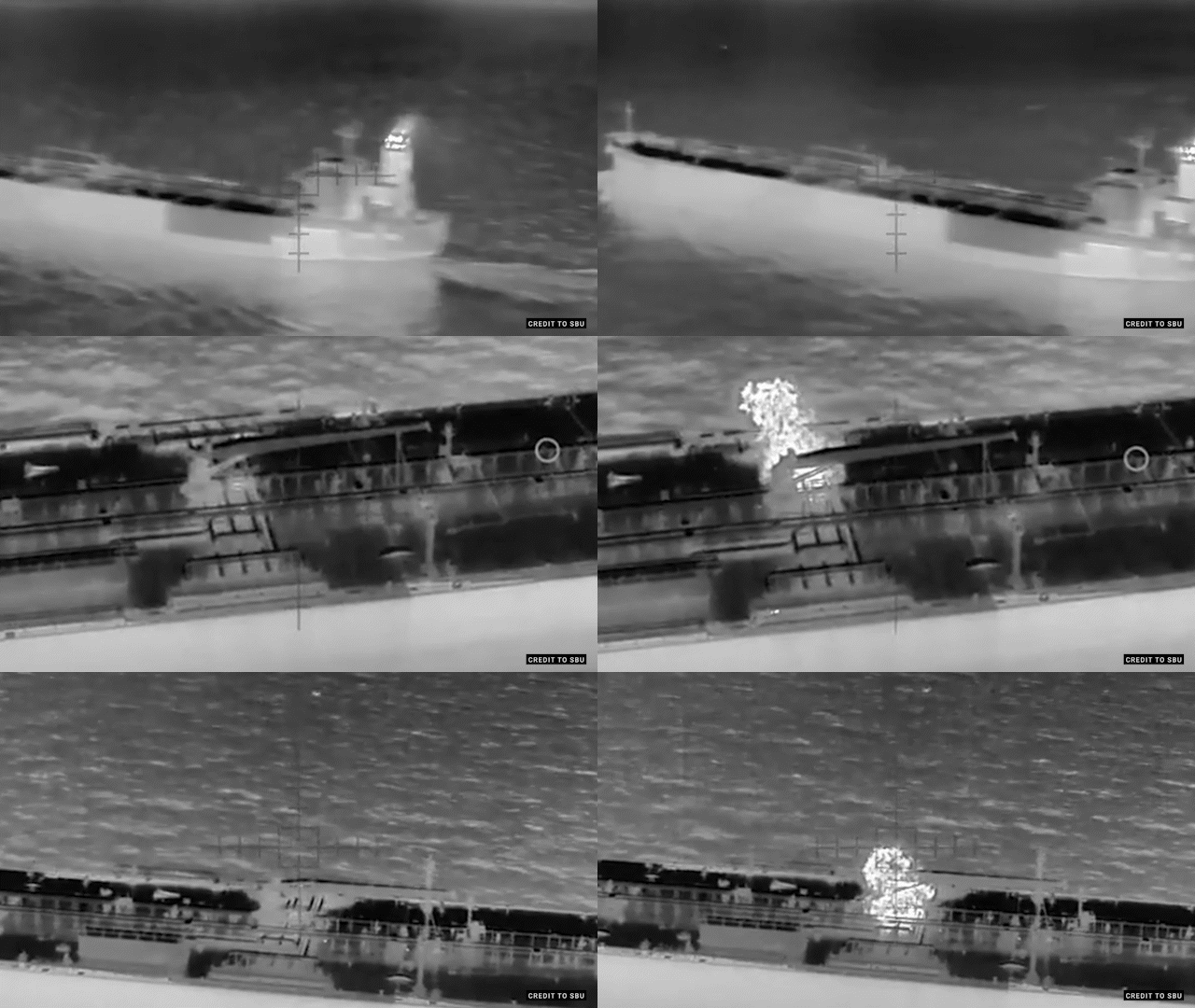
In further details, a source at the Security Service of Ukraine (SBU) said the tanker was called the Qendil and had “sustained critical damage and cannot be used for its intended purpose”.
The tanker was used to circumvent Western sanctions and boost Russia’s war chest, the source said, so was “an absolutely legitimate target. The enemy must understand that Ukraine will not stop and will strike them anywhere in the world, wherever they may be.”
No further details, such as how the SBU deployed a drone in the Mediterranean or which countries it flew over, were given. Kyiv has claimed similar hits off Turkey’s Black Sea coast on tankers linked to Russia. Two empty oil tankers were attacked.
Russia’s “shadow fleet” is estimated to number up to 1,000 ships of unclear ownership which frequently change flags. It has enabled Moscow to continue crude oil exports despite international sanctions, bringing in much-needed revenue.
Experts and several European leaders believe some vessels have also been used to conduct hybrid warfare across the continent.
Ukraine said on Friday it had struck a Russian “shadow fleet” tanker with drones in neutral waters of the Mediterranean.
A source in the Security Service of Ukraine said it was a “new, unprecedented special operation”.
Kyiv said the ship was empty at the time of the attack, which took place 1,240 miles from Ukraine’s border.
Putin says Russia does not believe Ukraine is ready for peace
At his annual press conference, Putin is asked by NBC News about his relations with President Trump and whether he, Putin, will take responsibility for the deaths of Ukrainians and Russians in 2026 as he continues to stall on peace.
Russia “doesn’t consider itself to blame for people’s deaths because we didn’t start this war,” says Putin, repeating his common refrain that the conflict began with the “anti-constitutional coup” of 2014 in which Viktor Yanukovych, the pro-Moscow president, was overthrown with the support of Western countries.
“President Trump is making serious efforts to end this conflict,” Putin said, saying he believes these efforts are sincere. “At our meeting in Anchorage [in August] we were discussing, and practically agreed with, President Trump’s proposals.”
This involved Russia agreeing to several compromises that “would have been difficult” for Moscow, said Putin. Now, he says, “the ball is completely in the court of our western opponents”, by which he means the Ukrainian authorities and “their European sponsors”.
The EU deal leaves Sir Keir Starmer with a difficult decision (Stefan Boscia writes). The prime minister was a leading proponent of an UK-EU proposal to seize £100 billion of frozen Russian assets. He was even deployed last week to try to convince Bart De Wever, the Belgian prime minister, of the legally contentious plan. It was ultimately an unsuccessful effort.
The prime minister will be first and foremost pleased that Ukraine will still get €90 billion in support from the EU. But the inability of Friedrich Merz. the German chancellor, to convince his European counterparts to seize Russian assets in the EU leaves Starmer isolated. He now has to decide whether the UK will unilaterally expropriate the £10 billion of Russian assets located in Britain.
No 10 is yet to comment on whether Starmer is prepared to act alone. Successive British prime ministers have said for years that they would only take such a drastic step if it was done multilaterally. However, the UK’s tight fiscal conditions will make it difficult for Rachel Reeves to find the money required to support Ukraine elsewhere.
Putin’s backdrop during his address to the Russian people sends a clear message as to his war aims.

ALEXANDER NEMENOV/AP/GETTY IMAGES
He is sitting in front of a large map of Russia which also includes Crimea, which has been under Russian control since 2014, and the four regions of eastern Ukraine that the Kremlin annexed at the start of the war — Donetsk, Luhansk, Zaporizhzhia and Kherson.
Territory is a major sticking point in negotiations to end the Russia-Ukraine war.
Giorgia Meloni, Italy’s prime minister, said she was satisfied with the €90 billion loan deal. It “guarantees support for Ukraine for the next two years, but does it with a plan which is sustainable from a legal and financial point of view,” she said. “I am happy that good sense prevailed.”
Meloni said that Russian assets were already “immobilised” and did not rule out their use in the future to “repay loans”.
Before the summit in Brussels, Meloni had hedged on the use of Russian assets held in Belgium, demanding guarantees on their use. She said it would be “short-sighted to focus our attention on a single holder of frozen Russian sovereign assets, namely Belgium, when other partner nations also have assets frozen in their respective financial systems”.
Russia says it has handed over the remains of 1,000 Ukrainian servicemen to Kyiv and received the bodies of 26 Russian soldiers. The figures were announced Vladimir Medinsky, a Kremlin aide.
Friedrich Merz, the German chancellor, had hoped that his recent reversal on the use of frozen Russian assets in the EU — and some fighting talk targeting the bloc’s remaining doubters — would finally get the proposal over the line. It turned out not to be the case (writes Elizabeth Rushton in Berlin).
Merz called the approval of the new package for Ukraine “a great success”, but it falls far short of the full release of Russian assets he had backed so strongly.
As Merz faces domestic challenges over reforms to pensions and welfare payments, he often relies on foreign policy achievements to paint a rosy picture of his government’s record. His disappointment in Brussels not only dashes his hopes of positioning himself as a major EU power broker, but is also likely to turn up the pressure at home as Germans ask whether they will end up footing the bill through their taxes.
President Putin, giving his annual press conference and phone-in, is asked about the European Union’s decision overnight not to “steal” frozen Russian assets to finance Ukraine.
“Stealing is not the suitable word,” he says. “Stealing is a secret theft and they are trying to do it to us openly. That’s robbery. But why is it not successful? Because the consequences could be very serious for the robbers.
“And what does it involve? After all, they announced that they are not just going to rob us and take [Russia’s money] but one of the ideas was to give a loan with our assets as collateral. But loans have consequences for the budget, an increase in debt.”
Putin says a decision to use the assets would have been “not just a blow to their image, it would have been an undermining of trust, in this case towards the EU”.
Other countries, especially oil-producers, who have gold and foreign exchange reserves in Europe would be concerned, he says. “They are looking at what happens — already looking and having suspicions and doubts and fears. What if that happens to us?”
Viktor Orban, the Hungarian prime minister, said the Brussels deal meant that “we managed to avert the immediate threat of war. We did not let Europe declare war on Russia by using Russian assets”.
However, the compromise was “a bad decision”.
“At the same time, 24 member states decided to provide Ukraine with a war loan for the next two years,” he said. “If the Ukrainians are unable to repay the loan, these European countries will have to repay it.
“Three countries decided not to be part of it, that’s an opt-out for the Czech Republic, Slovakia and Hungary. So we are innocent.”
If you’re Bart De Wever, the Belgian prime minister, President Macron or Giorgia Meloni, the Italian prime minister, it is a very elegant workaround to avoid a potential financial crisis caused by seizing Russian state assets (writes Bruno Waterfield).
If you are Chancellor Merz, Donald Tusk, the Polish prime minister or, certainly, Ursula von der Leyen, the European Commission president — who all lost their argument — it is a messy fudge, wrapped in an evasion.
France sided with Belgium, Italy and some other countries. Meloni did the heavy lifting at the summit table but Macron quietly wielded the dagger.
Using Russian assets as a pain-free funding raid always had an element of “magical thinking” and Merz, with Von der Leyen, committed the cardinal European sin of being German while trying to bounce the rest.
The deal will not mean extra debt for its 24 EU signatories because the money will be raised by “EU borrowing on the capital markets backed by the EU budget headroom”.
That headroom is the difference between the guarantees that member states give for a ceiling to the bloc’s spending and the lower sum that is actually paid out.
The legal basis lies in the EU treaty’s “enhanced co-operation” clauses, and the Czech Republic, Hungary and Slovakia will not take part. However, all three countries, in the EU’s pro-Russia camp, did vote for the deal.
Viktor Orban, the Hungarian prime minister, said: “We gave up our veto, but in return we received an opt-out.” The deal leaves him diminished. The EU’s move to permanently immobilise Russian assets means that Hungary — and anyone else — has lost the power of veto over the sanction to freeze those assets.
The figures are astronomical, on both sides. But even as President Zelensky presses European leaders to give him access to Russian cash reserves to fight on into the New Year, he is outmatched in spending power.
President Putin has transformed the Russian military-industrial complex and, as Moscow is now effectively cut off from much of the outside world, its economy is solely focused on providing resources to the front line. Putin is betting that his stomach for the fight can outlast that of Kyiv and its international backers, and that his wallet is deeper.
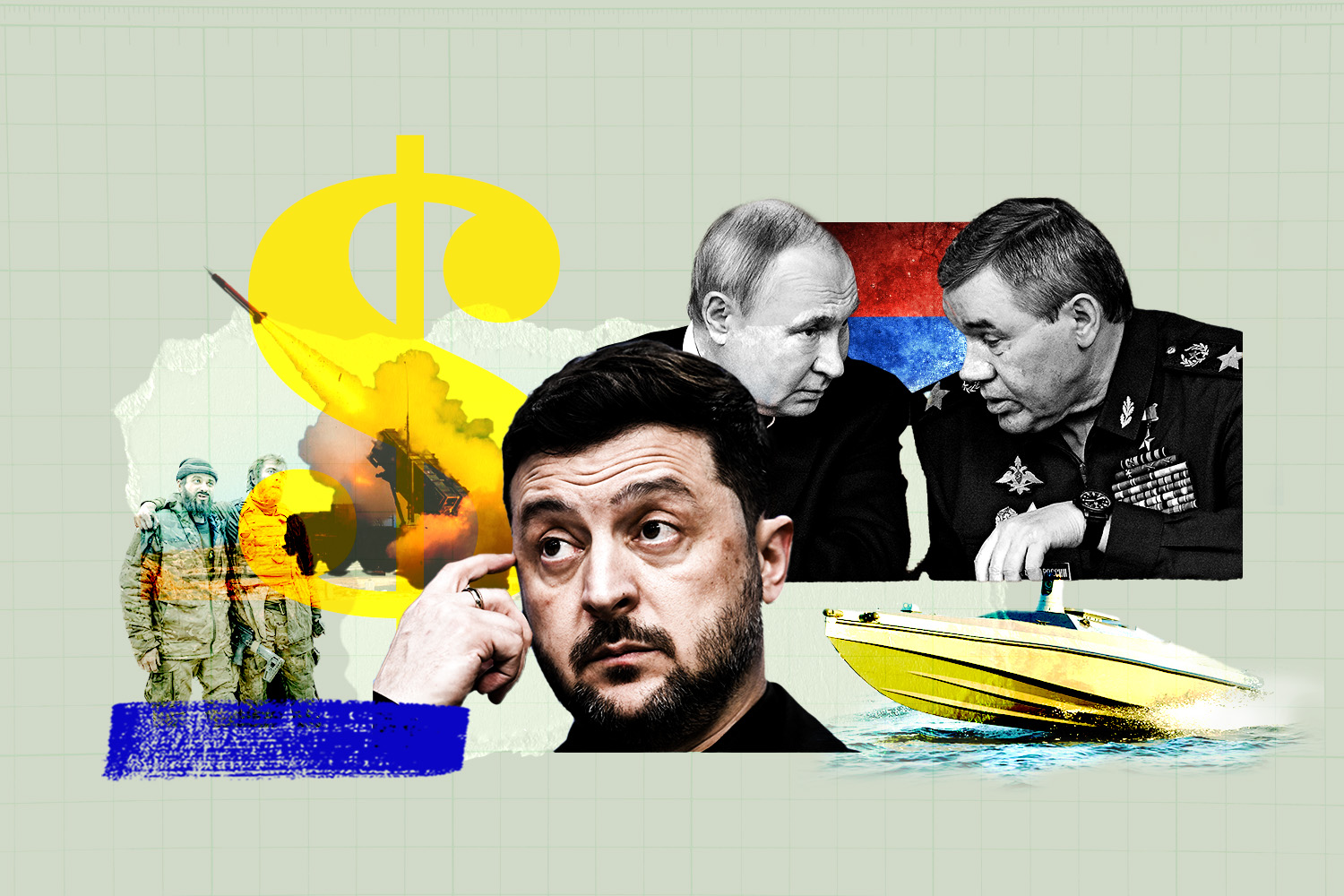
As European leaders agree to give Zelensky a €90bn interest-free loan, we examine what that would buy for Kyiv’s war effort.
• Read in full: How much does it cost Ukraine to keep fighting?
Putin has opened his press conference with a question about Ukraine’s intentions and how Russia can achieve the aims of its “special military operation”.
He says Ukraine is not ready for territorial concessions and refuses steps towards peace “but nonetheless, we feel certain signals, even from the Kyiv regime, about the fact they are ready for some kind of dialogue”.
He claims that Russia has always wanted peace.
Asked about the situation in the combat zone, Putin says that Russian forces are “advancing along the whole length of the front”.
“The enemy is in retreat,” he adds.
In preparation for Putin’s televised press conference, the hosts are speaking to journalists in the audience about the signs they are holding to attract the president’s attention.

The media gathers for Putin’s press conference
MIKHAIL METZEL/SPUTNIK/REUTERS
One woman has a cut-out of a fish with the name of her city, Astrakhan. She wants to ask about the use of natural resources.
A young man in a red bow tie is holding a sign saying “I want to get married!” He wants to ask about demographic politics. A young woman across the hall is holding a sign with the same words. The hosts suggest they could get together.
One of the hosts also sums up questions that have been sent online. “Who is better, Messi or Ronaldo?” is one of them.
President Putin of Russia is expected to address his appetite for war — or peace — in Ukraine at his annual marathon press conference which starts at noon in Moscow.
The highly choreographed event, with questions agreed in advance with the Kremlin, is a chance for Putin to speak off the cuff with little chance of interruption or follow-up from reporters.

A giant digital screen in Moscow promotes Putin’s annual press conference and phone-in
RAMIL SITDIKOV/REUTERS
“A press conference, like home improvements, can never be finished, it can only be halted,” Putin once joked about the event, which is attended by hundreds of accredited journalists and broadcast live on state television.
Putin usually begins with a blizzard of statistics about Russia’s economic performance before progressing to other domestic topics, then blasts of rhetoric about the perfidious West. The press conference is now combined with a citizens’ phone-in, which used to be a separate event.
Russia is gloating over the deal announced in Brussels. Kirill Dmitriev, President Putin’s special envoy for investment and economic co-operation, said on X that it was a “fatal blow to Ursula, Merz, Starmer and the warmongers.”
Please enable cookies and other technologies to view this content. You can update your cookies preferences any time using privacy manager.
Enable cookiesAllow cookies once
On Telegram, he wrote that “for the time being, the law and common sense have won a victory”.
European diplomats observed that Russian schadenfreude would not last. “For Putin the money has gone,” said one EU official. “The last laugh will be on us.”
The compromise was a win for Bart De Wever, the Belgian prime minister. “We remained united and avoided chaos and division,” he said, in a deal that meant “rationality has prevailed”.
“I think Ukraine has won. Europe has won, and financial stability has certainly won. This whole business was so risky, so dangerous, and raised so many questions — it was like a sinking ship, like the Titanic. The die are cast now and everyone is relieved.”
A widely-touted plan to use some of the €210 billion of Russian assets that are frozen in Europe, mostly in Belgium, fell through after opposition from some member states.
Despite trying to reassure Belgium that the EU would protect it from any Russian retaliation if it backed the “reparations loan” plan, the bloc eventually chose to borrow the money on capital markets.
Antonio Costa, president of the EU Council, said in a post on social media: “We have a deal. Decision to provide €90 billion euros ($106 billion) of support to Ukraine for 2026-27 approved. We committed, we delivered.”
President Zelensky of Ukraine backed the Brussels agreement, writing on X that the deal was “significant support that truly strengthens our resilience”.

He added: “It is important that Russian assets remain immobilised and that Ukraine has received a financial security guarantee for the coming years.”
Europe’s leaders have agreed to give Ukraine a €90 billion loan but, crucially, without using frozen Russian state assets after a marathon Brussels summit which lasted 15 hours and ended at 3am on Friday.

Mette Frederiksen, left, Denmark’s prime minister, Antonio Costa, European Council president and Ursula von der Leyen, European Commission president, celebrate the agreement at a summit in Brussels on Thursday
OLIVIER HOSLET/EPA
The deal was a compromise to fund Ukraine’s war effort with joint borrowing between 24 countries backed by the European Union budget.
Russian state assets will be left intact but remain immobilised until Moscow pays reparations to Kyiv, which will then be used to repay the interest-free loan.
The loan has long term implications and internal legal challenges are expected. In a sign of EU divisions, Hungary, the Czech Republic and Slovakia will not be part of the loan.