
On Dec. 18, at around 16:00, a Russian kamikaze drone struck the bridge over the Dnister River, near the village of Mayaki, on the M-15 Odesa-Reni highway.
The bridge was the only Ukrainian one left crossing the Dnister in the Odesa region, making it an essential route for travel to Moldova and onward to Romania. The other bridge, at Zatoka, which crosses farther south at the Dnister’s mouth, has been targeted by hundreds of attacks since the beginning of the full-scale invasion and has long been impassable.
Follow our coverage of the war on the @Kyivpost_official.
Traffic on the Odesa-Reni highway toward the Moldovan state border was temporarily blocked in both directions.
At first, the damage appeared limited – a hole in the roadway on the riverbank at the beginning of the bridge. Tragically, however, a car travelling across the bridge was hit by the explosion.
“There was a woman with three children in the car. The mother sustained severe injuries and, unfortunately, died in the ambulance. Her three children were taken to the hospital with injuries and a severe stress reaction. Doctors are providing all necessary assistance,” said Oleh Kiper, Head of the Odesa Regional Military Administration (OVA), in a Telegram post.
During the early morning of Dec. 19, at around 3:00 a.m., another drone struck the Mayaki Bridge, this time causing more serious structural damage.
Traffic on the Odesa-Reni highway has now been completely suspended. “As of this morning, people understand the complexity of the situation and that it will not be resolved quickly. That is why there is no traffic congestion near the site,” said Andriy Demchenko, spokesperson for the State Border Guard Service. “If we talk about traffic restrictions due to the damaged bridge, it is impossible to travel toward the border.”
Other Topics of Interest
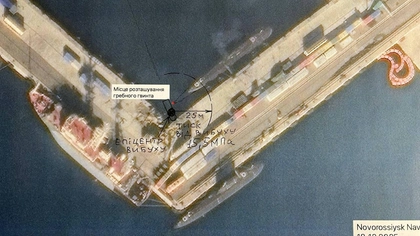
Satellite Pix: Russian Missile Sub Hit by Ukraine Undersea Drone Is Stationary, Leaking Oil
The Kremlin said Kyiv’s underwater drone attack into a Russian naval base left its Kilo-class sub “undamaged and fully mission-capable,” but evidence says something else.
Ukrainian and Moldovan border guards are advising travelers to use alternative exit routes from Ukraine via accessible checkpoints, particularly through the Vinnytsia region. While the journey between Odesa and Chișinău via the Odesa-Reni highway normally takes around 4 hours, the route via Vinnytsia requires approximately 11 hours of travel.
Four border crossings with Moldova remain operational: Palanka, Starokozache, Reni and Orlivka.
The objective of the Russian attacks is to cut off the western part of the Odesa region and prevent Ukraine from accessing Danube logistics routes. After the bridge at Zatoka was heavily bombed, Russian forces have now targeted the bridge at Mayaki, which became an indispensable logistic thoroughfare.
Ukraine can use ferry crossings, but these are highly vulnerable to drone attacks.
“Over the past week, the enemy has repeatedly attacked the bridges at Zatoka and Mayaki,” said Serhii “Flash” Beskrestnov, a specialist in communications, electronic warfare (EW) and intelligence, and chairman of the public organization Center for Radio Technologies.
On Dec. 14, Russian forces had attacked the Zatoka bridge with nearly 40 Shahed drones, around two dozen of which hit their targets.
Given the strategic importance of the Mayaki bridge for Ukraine’s logistics, questions have been raised as to why the Odesa Regional Military Administration (OVA) had not either provided air defense for the bridge, or prepared an alternative route to safeguard this strategic connection.