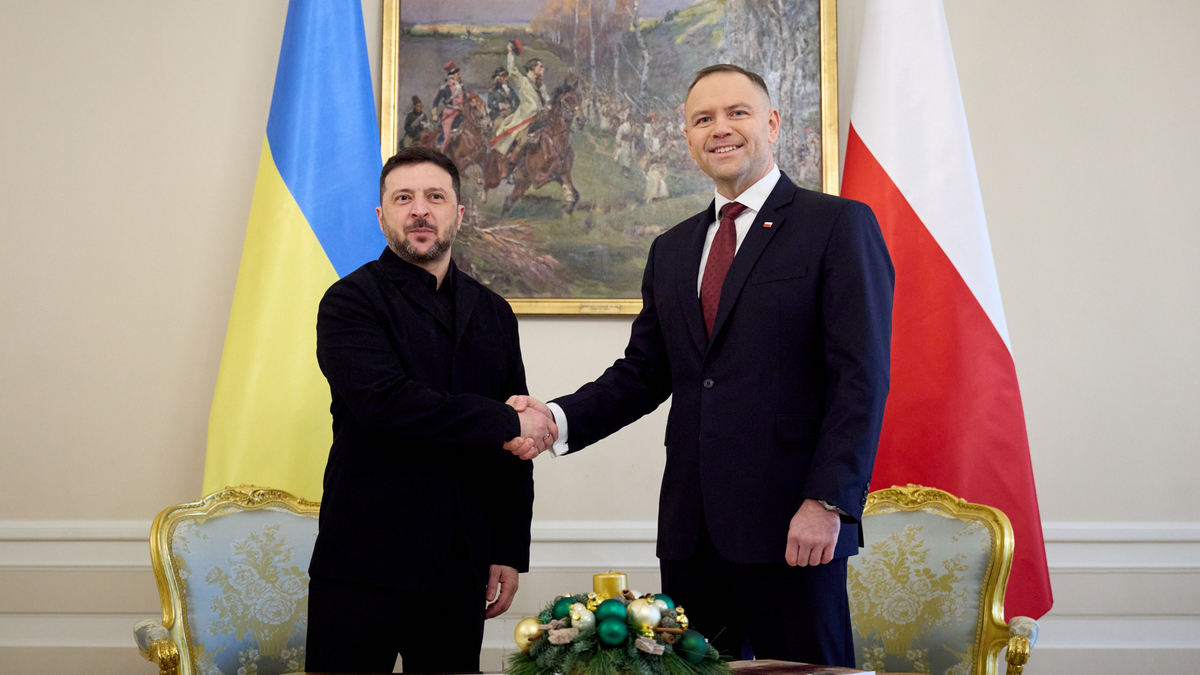
After initial tensions and fears of a potential clash, the meeting between Ukrainian President Volodymyr Zelensky and Polish President Karol Nawrocki went smoothly.
“President Zelensky’s visit is good news for Warsaw, Kyiv, and the entire region and bad news for Russia,” Nawrocki said at the opening of Friday’s joint press conference.
Follow our coverage of the war on the @Kyivpost_official.
Despite earlier speculation that Zelensky had been reluctant to come, the visit underscored Poland’s continued relevance for Ukraine. The meeting also sent a clear signal of unity at a time when Russia is actively trying to exploit divisions among its neighbors and within the EU.
“The Russian threat did not begin with the 2022 invasion,” Nawrocki said. “It started earlier, in Chechnya, in Georgia.” He also spoke at length about Russia’s ongoing hybrid operations against Europe. Nawrocki unequivocally reaffirmed Poland’s support for Ukraine, recalled the consistency of Polish policy on this issue, and emphasized its continuation – once again cutting short speculation that he might diverge from Warsaw’s longstanding pro-Ukrainian line.
Nawrocki stressed Poland’s role as a logistical hub and key supporter of Ukraine – an important point for domestic audiences. At the same time, he said he expected greater partnership and subjectivity from Ukraine.
This reflects a sentiment increasingly present in Polish society: The perception that Ukraine tends to marginalize Poland’s role. Zelensky, for his part, emphasized Ukraine’s gratitude to Poland, while also noting that Ukraine is paying the highest price in the war, measured in blood.
Other Topics of Interest
Russian Central Bank Cuts Key Interest Rate Amid Economic Slowdown
Earlier this month, Russia reported the steepest drop in annual inflation so far this year – in November it fell to 6.6 percent compared to 7.7 percent a month prior.
Zelensky thanked Nawrocki for the frank discussion and invitation, describing the talks as successful. He underlined Poland’s continuous support for Ukraine, not only since 2022, but since the very beginning of Ukraine’s independence in 1991. Zelensky encouraged Poland to join the so-called Coalition of the Willing, while both presidents highlighted the role of the US and President Donald Trump.
The two sides also announced cooperation in drone and counter-drone technologies. Zelensky emphasized Poland’s participation in meetings and talks on ending the war. Poland will also transfer MiG-29 fighter jets to Ukraine. Both leaders highlighted hybrid attacks carried out by Russia and Belarus against Poland and other EU and NATO states. Nawrocki added that Poland will do everything possible to avoid becoming directly involved in the war, while remaining fully aware of the threats it faces.
During his visit, Zelensky is also scheduled to address the Polish Sejm and meet Prime Minister Donald Tusk, who is returning later in the day from an EU summit.
Poland’s domestic political dispute
Nawrocki also addressed the Coalition of the Willing, noting that Poland is primarily represented there by Prime Minister Tusk, a political rival with whom the president remains in conflict.
In doing so, Nawrocki shifted responsibility for discussions about the potential deployment of Polish troops away from the presidency. This reflects Poland’s ongoing internal political struggle.
The same dispute affects the issue of MiG-29 aircraft. Poland may soon transfer more than a dozen jets to Ukraine. The conflict is not about whether to provide them, but about the flow of information between rival centers of power in Warsaw.
Volhynia and the historical dispute
Twenty-six applications for search and exhumation work submitted by Poland’s Institute of National Remembrance (IPN) should be approved, Nawrocki said. Representatives of the IPN from both countries took part in the meeting.
Zelensky said work is already underway and that first results have been achieved, announcing further cooperation between Polish and Ukrainian institutions.
Zelensky declared that Ukraine is meeting Polish expectations, an effort acknowledged and appreciated by Nawrocki, himself a historian and former head of the Polish IPN.
“A dignified burial of the victims of the Volhynia genocide is in the interest of both states,” Nawrocki said. He added that this issue, along with other historical distortions, is exploited by Russia, and that resolving it would deprive Moscow of an important political tool.
On the day of the presidential meeting, a group linked to the Polish-Ukrainian Reconciliation Association visited the Ukrainian village of Uhly, where exhumation work is planned. Representatives of the Polish IPN, the Pomeranian Medical University in Szczecin, and Ukrainian institutions were also present. The goal was to prepare the groundwork for search and exhumation efforts.
From the Polish perspective, the Volhynia issue remains fundamental to relations with Ukraine. Zelensky also spoke about the need for mutual respect for historical memory – even where interpretations differ.
Economy, Ukrainian minority in Poland
Both sides reiterated their invitations to Polish companies to participate in Ukraine’s reconstruction. Poland’s liquefied natural gas (LNG) terminal in Świnoujście was highlighted, with 15 percent of the gas currently handled there flowing to Ukraine. Poland aims to become a distribution hub for US gas in the region.
The situation of Ukrainians living in Poland was also discussed. Nawrocki assured that Ukrainian refugees are welcome in Poland and protected like any other minority. This was a carefully worded diplomatic statement at a time when public sentiment toward Ukrainians is deteriorating, and attacks against members of the Ukrainian minority have been reported.
Poland is currently Ukraine’s second-largest supplier of goods after China and the largest exporter among EU countries. Trade and services dominate economic relations, reflecting lower war-related risk compared to investment. Notably, Taras Kachka, Ukraine’s deputy prime minister for European and Euro-Atlantic Integration, attended the meeting, underscoring the economic dimension of Ukraine’s EU integration efforts.
Ukraine’s foreign minister, Andriy Sybiha, is also in Warsaw, where he met his Polish counterpart, Radosław Sikorski, to discuss the details of several deals. Rumors are circulating that Sybiha may become Ukraine’s next ambassador to Poland – possibly linked to anticipated changes in Ukraine’s Presidential Office following the resignation of Andriy Yermak.
Expectations surrounding Zelensky’s visit were high, as evidenced by its dominance in Polish media coverage. The first meeting between the Ukrainian and Polish presidents was particularly significant. It can be seen as an unexpected but positive reset in bilateral relations and an improvement in the political climate.
At the same time, the visit will inevitably be used in Poland’s domestic politics. Relations with Ukraine have been part of the internal political dispute since the 2023 parliamentary election campaign.
The presidents held their talks beneath Wojciech Kossak’s painting “The Battle of Racławice,” depicting Tadeusz Kościuszko leading an attack against Russian forces in 1794 – a highly symbolic setting, pointing clearly to a shared adversary.