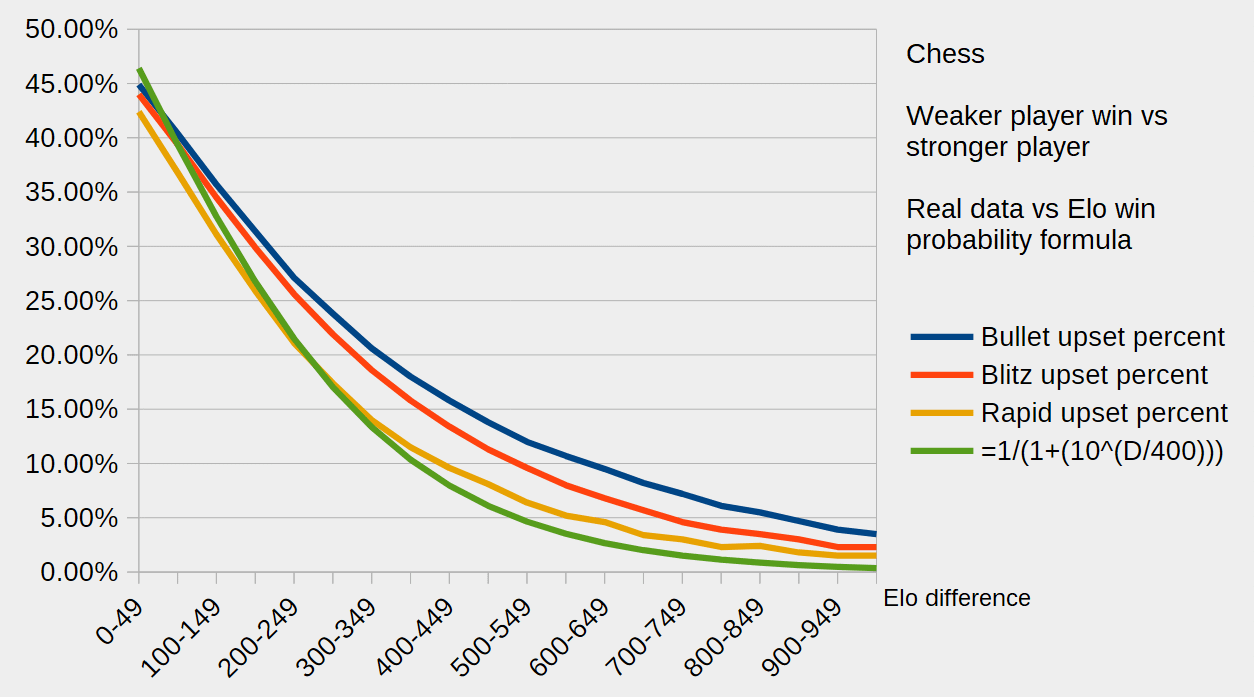
Original post, with more data: https://www.reddit.com/r/chess/comments/1pqhin6/how_often_does_upsets_happen_how_often_a_weaker/
Posted by hash11011
Original post, with more data: https://www.reddit.com/r/chess/comments/1pqhin6/how_often_does_upsets_happen_how_often_a_weaker/
Posted by hash11011
11 comments
The original post here: [https://www.reddit.com/r/chess/comments/1pqhin6/how_often_does_upsets_happen_how_often_a_weaker/](https://www.reddit.com/r/chess/comments/1pqhin6/how_often_does_upsets_happen_how_often_a_weaker/)
The original post linked, has more details on methods used, and more images of raw data, if still needed, i can upload more raw data and CSV files somewhere.
Does this mean that equally matched players have about a 5% chance of agreeing to a draw?
EDIT: Or drawing because of stalemate/ insufficient materials.
It’s kind of amazing that even with a 900 elo point difference, you’ve still got a 1 in 20 chance to win in bullet. 900 ELO is the difference between “decent chess player” and “someone who doesn’t know how the pieces move”
This could use a plot with a different Scale Factor, maybe 300?
Where did you get your data? Especially the ELO ranking?
Fermi-Dirac statistics? Is that you?
Never lie about your chess ability, it will be instantly apparent as soon as you play. Ditto with golf ability.
Despite popular opinion, there is a decent amount of luck involved in chess, especially at lower levels and shorter time formats. Not luck in the sense of a roll of the dice but in terms blunders and positions – you might accidentally have a position that defends a nasty tactic, you might blunder but due to some miraculous line you can still save it, your opponent might blunder at what happens to be a crucial spot in the game, your opponent might miss a blunder you make. It’s not uncommon to hear the top chess players in interviews talk about how they got lucky (especially the humble ones). I don’t think it’s too surprising that the longer the time format gets and the more time players have to think, the more the skill matters, the less room there is for luck due to blunders/oversights, and the more win rates will match the ELO formula.
Anyone kind enough to explain the difference of those 4 curves. Is it like the time one has per move or something? But then the naming is confusing
Have you accounted for white’s inherent win rate imbalance? A weaker opponent can much easily win against a stronger one playing white, and be completely unable to as black.
Beautiful indeed how theory matches reality.
So in cases where there is a negligible difference in rankings, one player only wins 46% of the time?
Is this accounting for draws/stalemates?
Comments are closed.