
What recourse are you left with when a government program simply stops doing the thing that is its primary purpose, and refuses to explain why? That’s what hundreds of parents, family members and legal guardians have presumably been wondering about the United States Office of Refugee Resettlement (ORR) in the last few months, given an explosive report published today by NPR affiliate KERA News, which alleges that ORR, the agency tasked with caring for “unaccompanied” minors and reuniting them with vetted sponsors, has more or less stopped doing that since early November. According to data gathered by The Texas Newsroom and The California Newsroom, accounts from immigration attorneys, and confidential sources inside ORR itself, the program was given verbal instruction at the beginning of November to abruptly cease returning migrant children to families … even when those sponsors have passed newly enhanced vetting requirements introduced by the Trump administration earlier this year. As a result, the pace of releases has basically stopped entirely.
The Office of Refugee Resettlement is a program within the United States Department of Health and Human Services, which is meant to give it some insulation from acting as an arm of immigration enforcement. Since the advent of the second Trump administration, though, that’s just what the ORR has increasingly become, according to former staffers. Notably, the infamous Project 2025 called for the government to relocate the program to the Department of Homeland Security, which would bring it closer to the orbit of ICE. And considering that migrants in the orbit of ICE have a worrying track record of simply vanishing off the face of the Earth, them getting involved in ORR’s business could spell disaster for a migrant child.
In the past, children who entered ORR custody, usually because they were apprehended at the border without a parent or legal guardian, or because they were separated from family during arrests by ICE, would be placed in an ORR shelter for a relatively short period of weeks, before a “sponsor” in the U.S., typically a family member or guardian, would be vetted and designated as the person that child would be released to. Roughly 2,400 kids are in ORR shelters of this sort at the moment, with the largest concentration of more than 800 in Texas. Since the introduction of more harsh vetting procedures, however, the length involved in these detainments has steadily grown, with kids now spending months rather than weeks in the system, unsure of when they will see their families again.
Still, up until November, kids were still being reunited with family members by ORR on a daily basis. According to ORR data obtained by The Texas Newsroom and California Newsroom, the program was averaging about four children per day released to sponsors throughout the month of October, for a total of a bit more than 100 kids in the month. However, the report claims that “over the last month and a half, ORR has released only four kids total to sponsors.” That links up exactly with when eight unnamed ORR officials quoted by KERA News, who asked not to be named in fear of losing their jobs, say that they were instructed by superiors to stop all family reunions, even if the sponsors had been cleared by the enhanced vetting program. Eight immigration attorneys contacted for the piece agreed, saying that starting in early November, ORR stopped responding to letters and communications demanding the release of children to qualified sponsors. Even when threatened with litigation, ORR hasn’t explained to these attorneys why the kids aren’t being released.
We have only this statement from ORR to The California Newsroom, in which the program acts as if absolutely nothing has changed: “ORR continues to discharge children to vetted sponsors when all statutory and safety requirements are fully met and when release is assessed to be appropriate given the child’s individual needs and circumstances. Each case is evaluated individually, and decisions are made based on child welfare best practices.”
Delving into the Office of Refugee Resettlement website, one can come across the agency’s own published data, which supports the KERA News report. By ORR’s own admission, it released a total of 106 children to sponsors in the month of October. For November, that number craters to a total of 16 according to ORR. December numbers, meanwhile, are not available, but what would cause such a sudden and sharp decline in releases, other than a directive to stop reuniting families? And if that wasn’t the case, why would ORR’s anonymous staffers be telling independent media it was?
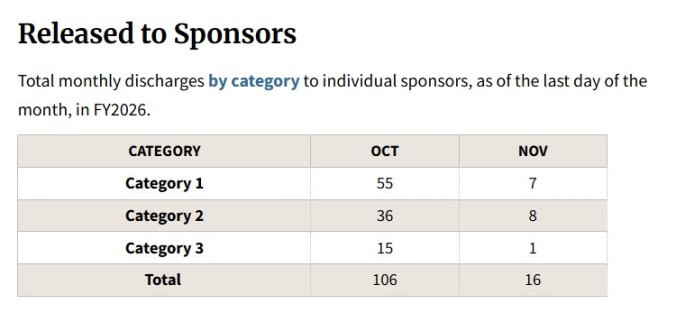
Screenshot, Office of Refugee Resettlement.
Congressional Republicans, ever adept at weaponizing “we must save the children” rhetoric in service of plans that are actively hurting children, have reasoned that ORR’s vetting procedures needed an intense overhaul in order to protect migrant kids. They’ve highlighted specific, fringe cases in which minors were turned over to sponsors who employed them in dangerous jobs, assaulted them or trafficked them–for example the case of a 15-year-old Guatemalan girl who was allegedly released in 2023 to a man claiming to be her brother, who went on to sexually abuse her. To this end, ORR now has former ICE officials in its command structure, and is holding on to children in detainment for longer than ever, something with a demonstrated strong adverse effect on mental health in minors. Attorneys are increasingly having to look into filing habeas corpus petitions, seeking the release of kids who by the government’s own protocols already should have been released.
It’s also impossible to look past the obvious implication: The Trump administration may simply be hoping that if it withholds kids from parents or guardians long enough, that one or both will choose deportation or to leave the country. That’s coupled with other punitive measures that have been aimed against these unaccompanied minors, such as hefty fines from the U.S. government levied on children for being caught crossing the border, or incentives such as the government telling kids that it will pay unaccompanied minors cash in order to leave. And when that fails, the U.S. isn’t above deporting unaccompanied minors to home countries where they may or may not have any remaining family waiting.
In Florida, a particular case illustrates how difficult it can be for family members to be reunited with a minor relative, even when the adult in question is a legal resident. Imelda Carreto (a legal U.S. resident) was the guardian of her 15-year-old nephew Carlos, a boy who had crossed into the U.S. from Guatemala as a 13-year-old in order to escape an abusive family situation there. He spent several weeks in ORR custody before being reunited with his aunt, but earlier this year was detained again during a traffic stop as a result of, I shit you not, a “cracked windshield.” Carlos was put back into Office of Refugee Resettlement custody, leaving Imelda Carreto to again apply for his release into her care. Only this time, the process dragged on and on, involving everything from DNA tests, criminal background checks, audits of her family’s finances, and even photos of the smoke detectors in the family’s home. It ultimately took two and a half months in order for Imelda Carreto to get her 15-year-old nephew back.
That was clearly prior to November, when ORR was still performing its function, albeit seemingly under protest. What about the kids who find themselves still languishing in its custody today? When will they be reunited with their families? If the program designed to facilitate reunions simply chooses not to do that any more, does any U.S. lawmaker or judge have the guts to do anything about it?