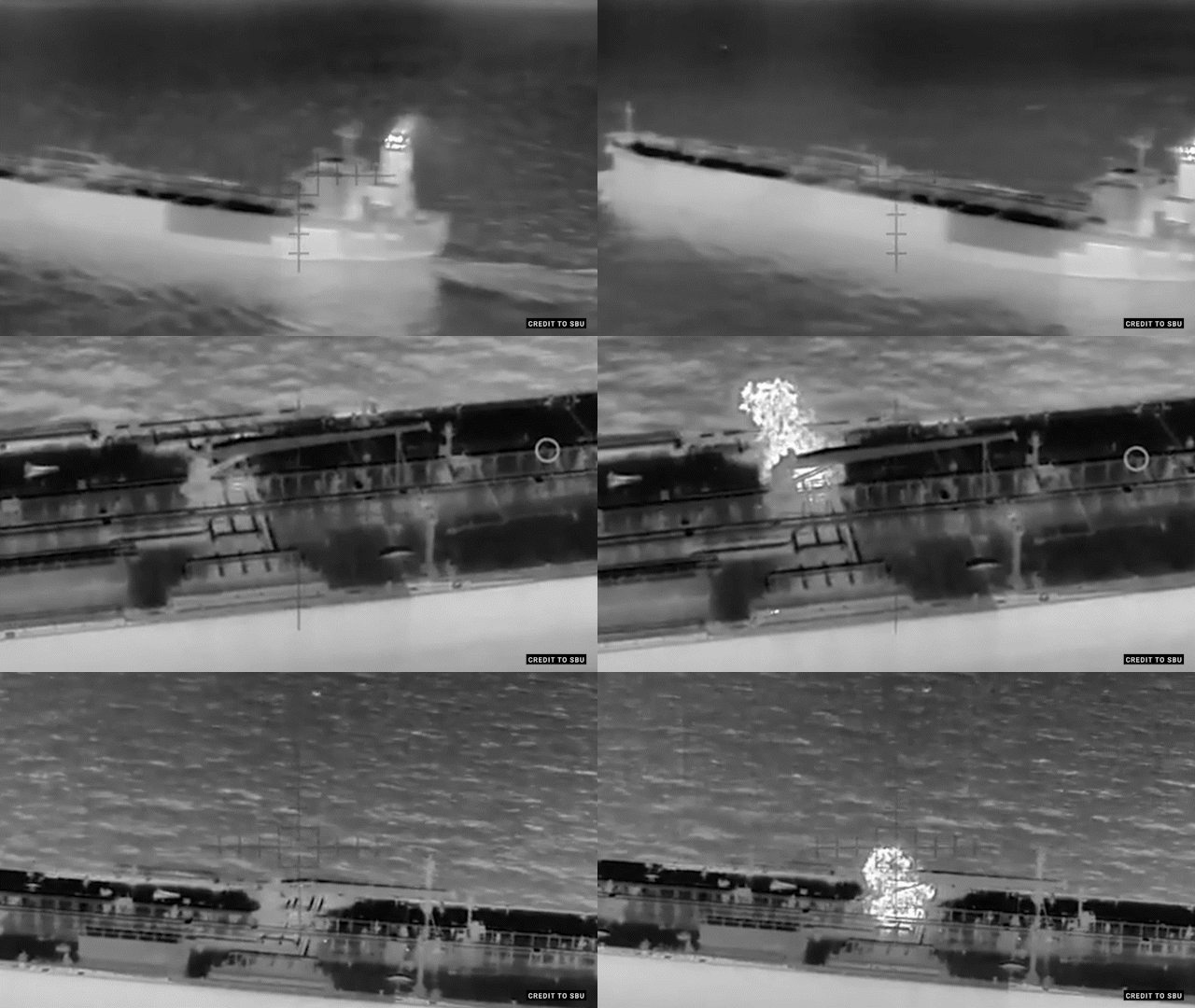
Ukrainian forces have carried out an audacious attack on a Russian “shadow fleet” oil tanker in the Mediterranean Sea, as Kyiv seeks to open up a new front in the war ahead of peace talks this weekend in Miami.
The SBU, Ukraine’s security service, said the vessel, the Qendil, suffered critical damage when it was hit by an aerial drone strike more than 2,000 kilometres (1,243 miles) from Ukraine.
Unconfirmed reports claimed the Russian intelligence chief who oversaw the Salisbury poisonings, was on board the ship at the time the tanker was struck and was killed.
It also coincided with a decision by European leaders to unlock €90 billion in loans for Ukraine borrowed against the EU’s budget.
The Russian leader insisted it would not disrupt Russian oil exports and warned that a “response from our country will follow”.
But he also expressed willingness to engage with US-led peace talks saying there were “certain signals, including from the Kyiv regime, that they are ready to engage in some kind of dialogue”.
“We would very much like to live in peace next year, free of any military conflicts,” he said. “We would very much like to strive to resolve all contentious issues through negotiations.”
• How much does it cost Ukraine to keep fighting?
Russian negotiators are due to meet President Trump’s special envoy for Ukraine, Steve Witkoff, and Jared Kushner, the President’s son-in-law, for talks in Miami this weekend.
Jonathan Powell, Britain’s national security adviser, was joined by his European counterparts and Ukrainian negotiators in Miami for talks with Witkoff and Kushner as the Americans attempt to bridge significant gaps between the sides on a twenty point peace plan that is being circulated.
Putin says Russia do not believe Ukraine is ready for peace
Ahead of the talks, the head of Kyiv’s delegation, Rustem Umerov, said they were committed to a “constructive process” and would report back to President Zelensky.
On Friday, a White House official said Witkoff and Kushner “are meeting with Secretary Umerov, as well as national security advisers from the United Kingdom, France, and Germany”. Those talks concluded on Friday night.
Putin also attempted to appease the Americans without offering any signs of Russian concessions.
“President Trump is making serious efforts to end this conflict,” he said, adding that the ball is “completely in the court” of Ukraine and “their European sponsors”.
Marco Rubio, the secretary of state, promised on Friday not to force Ukraine into any agreement to end the war. “There’s no peace deal unless Ukraine agrees to it,” Rubio told a news conference in Washington.
“This whole narrative that we’re trying to force something on Ukraine is silly,” he said. “We can’t force Ukraine to make a deal. We can’t force Russia to make a deal. They have to want to make a deal.”
The move came as European leaders agreed a plan to unlock €90 billion in loans for Ukraine borrowed against the EU’s budget, after a proposal to use immobilised Russian sovereign assets collapsed.
The agreement in Brussels is designed to provide a financial lifeline to Kyiv which is facing a €115 billion budget shortfall over the next two years if the conflict continues.
It is also designed to strengthen Zelensky’s hand in peace talks by demonstrating to the US and Russia that Ukraine has the financial resources to maintain its defensive capabilities for the foreseeable future.
• We’re under the guns — and in Putin’s sights
But the deal represents a climbdown by Friedrich Merz, the German chancellor, and Ursula von der Leyen, the European Commission president, who had championed using Russian assets rather than borrowing against the EU’s balance sheet.
They were forced to back down after Belgium, where the vast majority of the money is held, refused to agree to it being used amid fears it could be on the hook for repaying it in the future.
Afterwards António Costa, the European Council president, hailed the compromise saying: “We committed, we delivered.”
Emmanuel Macron, the French president, added: “The absence of a decision would have been a disaster.”
But the European move has left Downing Street and the Treasury scrabbling to respond.
The government had pledged that it would use £8 billion of Russian assets held in the UK as part of the package. Downing Street confirmed that as a result of the European decision, the UK would not act unilaterally in requisitioning the Russian assets, but would instead look at other means of trying to provide the money.
With rising taxes and record levels of government debt there are few good options available to Rachel Reeves to increase UK support of Ukraine.
The Treasury said that the UK would immediately bring forward an already pledged £2 billion world bank loan guarantee and highlighted the pre-existing plans to provide £3 billion of military support to Ukraine next year.
There was an acknowledgement from Reeves that more money would need to be found to ensure that Ukraine could cover the full extent of its budget deficit.
“I am pleased to see the agreement made today at the European Council to provide vital financial support for Ukraine,” she said.
“The UK’s support for Ukraine remains iron-clad. We will work with partners to urgently consider options to ensure that Ukraine gets the funding it needs.”
Experts said the attack on the Russian tanker was notable because it showed the extent of Kyiv’s ability to strike far away from its borders and also because it used aerial drones.

The Qendil was seen in Istanbul last month
YORUK ISIK/REUTERS
“This development reflects a stark expansion of Ukraine’s use of uncrewed aerial systems against maritime assets associated with Russia’s sanctioned oil export network,” British maritime risk-management group Vanguard said.
According to Vessel Finder, the tanker’s last port call was Suez, Egypt, on December 16.
It was sailing under the flag of Oman and had departed from Sikka in India for the Russian port of Ust-Luga, according to navigation data provided by Bloomberg. The tanker was built in 2006 and has a gross tonnage of 61,991 tonnes. It is reportedly sanctioned by the UK and EU.
A Russian channel on the Telegram messaging app suggested that General Andrey Averyanov, the commander of GRU’s Unit 29155, Putin’s notorious clandestine operations force, had been onboard at the time.
As well as the poisoning of the Russian double agent Sergei Skripal and his daughter Yulia in Salisbury, he was involved in the murder of Yevgeny Prigozhin, the former Wagner mercenary chief. However this claim has not been repeated by either Russian nor Ukrainian officials.