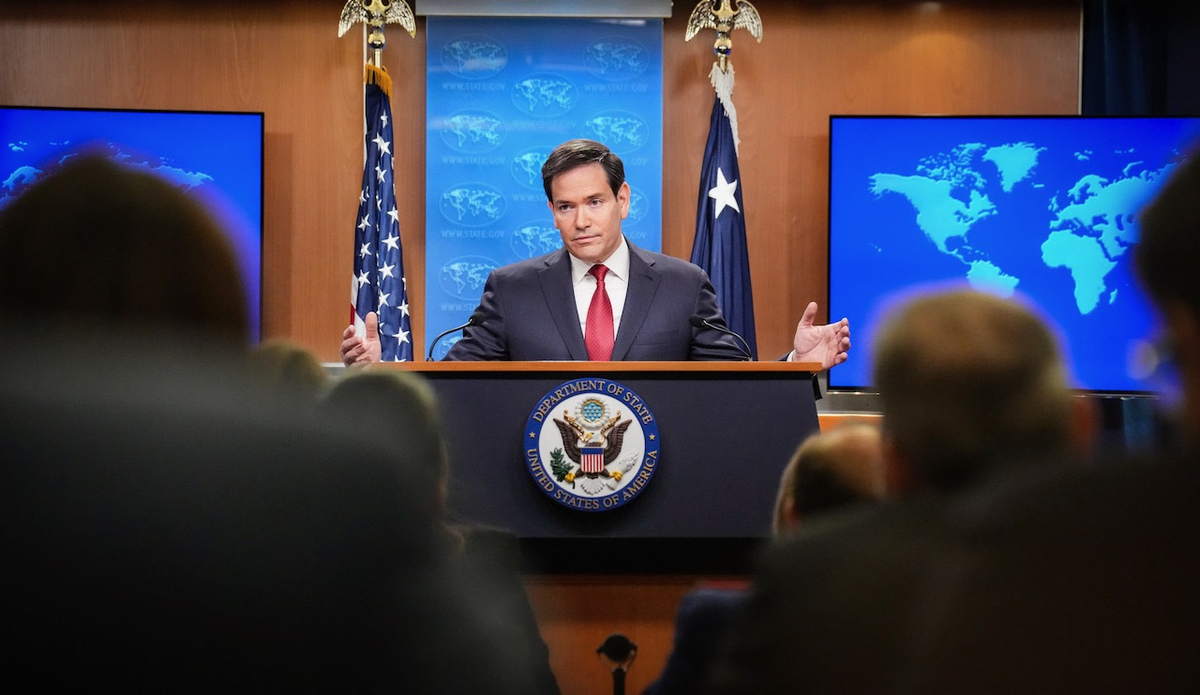
WASHINGTON DC – In a marathon, two-hour year-end press conference with over 50 journalists, US Secretary of State Marco Rubio on Friday offered the clearest statement yet of the foreign-policy doctrine shaping US President Donald Trump’s second term.
The message, conveyed with methodical discipline, was unmistakable: alliances still matter – but only to the extent that they advance clearly defined American interests.
Follow our coverage of the war on the @Kyivpost_official.
Rubio framed the administration’s worldview early, and returned to it repeatedly throughout the session.
US foreign policy, he said, must be guided by “decisions that make America safer, stronger, or more prosperous” – ideally all three, but at minimum one.
It was less a rhetorical flourish than a governing filter, and a warning to allies accustomed to US commitments justified by shared values rather than measurable returns.
For European capitals, the takeaway was stark: Washington is not retreating from the world – but it is renegotiating the terms of its leadership.
NATO: Reassurance, with conditions attached
Rubio went out of his way to insist that NATO remains central to US security strategy, repeatedly describing Article 5 as “the bedrock” of collective defense.
But that reassurance was paired with a sharper escalation of demands that many allies privately describe as destabilizing.
The secretary pressed NATO members to move well beyond the alliance’s longstanding two percent defense-spending benchmark, floating figures closer to five percent of GDP – a level even the US does not consistently meet.

Other Topics of Interest
Ukraine Hits Russian Warship in Caspian Sea, Opening New Drone Front
Ukraine’s General Staff said it carried out additional strikes on Friday night in the Caspian Sea – far from Ukraine’s borders – targeting a Russian vessel and oil facilities.
That framing has landed uneasily in Brussels, Berlin, and Paris.
“Washington isn’t abandoning NATO,” one European ambassador told Kyiv Post privately, adding, “But what Rubio now describes as commitment increasingly feels like a contract – with penalties for non-compliance.”
European officials say the concern is not merely financial, but conceptual. Rubio’s language suggests a shift away from NATO as a political and security community, toward a performance-based arrangement – one in which US guarantees are reaffirmed rhetorically but narrowed operationally.
Behind closed doors, diplomats describe a growing fear that reassurance is giving way to conditionality – and that deterrence itself may become transactional.
Ukraine: Broker, not belligerent
Nowhere was that recalibration clearer than in Rubio’s remarks on Ukraine.
He struck a careful, almost lawyerly tone: supportive of diplomacy, realistic about battlefield dynamics, and explicit that the war is unlikely to end through total victory by either side.
The US, he argued in response to Kyiv Post’s question, is uniquely positioned to explore a negotiated settlement – not to impose one, but to test what both Kyiv and Moscow might realistically accept.
“We’re not here to dictate outcomes,” Rubio said, emphasizing that peace requires understanding “what each side can live with.”
That framing marks a notable departure from earlier phases of US policy, when military assistance was often paired with the implicit assumption that sustained support would eventually yield a decisive Ukrainian advantage.
European diplomats say the shift is unmistakable.
“Rubio is repositioning Washington as a mediator rather than a permanent quartermaster,” said one senior Western official. “That forces Europe to decide whether it steps up – or accepts a different endgame.”
Rubio also signaled that US patience is finite. While he avoided explicit red lines, his repeated emphasis on compromise suggested that Washington increasingly views concessions – territorial, political, or security-related – as unavoidable if negotiations are to succeed.
For Kyiv, the message lands uncomfortably.
For Europe, it raises a more unsettling question: if the US moves from military engine to diplomatic broker, who carries the burden of sustaining the war in the interim?
Russia: Sanctions without escalation
On Russia, Rubio walked a narrow line between firmness and restraint.
He reaffirmed that sanctions would remain in place absent of meaningful changes in Kremlin behavior, while simultaneously downplaying fears of imminent escalation – even amid tensions in secondary theaters such as Venezuela and the Caribbean.
Asked about Moscow’s rhetorical and diplomatic support for Venezuelan President Nicolás Maduro, Rubio dismissed it as predictable posturing from a Russia already consumed by Ukraine.
The Trump administration, he suggested, sees little strategic value in inflating such gestures into broader confrontation.
That posture – pressure without provocation – reflects a form of strategic ambiguity that has unsettled European allies.
“They’re saying sanctions stay, escalation doesn’t,” one EU diplomat observed, telling Kyiv Post, “That leaves Europe wondering whether containment or coexistence is the endgame.”
Rubio’s approach points to an effort to compartmentalize Russia: isolate it economically, avoid direct military conflict, and preserve room for selective engagement if circumstances change.
It is classic realpolitik – but one that leaves allies uncertain about Washington’s tolerance for risk and its appetite for sustained confrontation.
Transactional worldview, globally applied
Beyond Europe, Rubio’s answers revealed a consistent throughline: US engagement is conditional, reciprocal, and explicitly interest-driven.
On Venezuela, he described the Maduro government as illegitimate and criminally networked, signaling a hardened posture in the Western Hemisphere.
On the Middle East, he framed ceasefire diplomacy primarily through the lens of regional stability and US security rather than humanitarian obligation.
On China, he acknowledged limited areas for cooperation – but only where US leverage is preserved.
The subtext was unmistakable: multilateralism remains a tool, not a principle.
Foreign Policy in recalibration
By the end of the session, a coherent – if unsettling – doctrine had emerged.
This administration views foreign policy as a balance sheet: costs weighed against returns, alliances evaluated by outputs, and commitments sustained only so long as they serve clearly articulated American interests.
For some partners, particularly those long frustrated by underfunded defense and ambiguous burden-sharing, the shift is overdue.
For others – especially in Europe and Ukraine – it signals a colder, more conditional United States, less inclined to underwrite stability for its own sake.
As one senior EU official put it after the briefing: “We still want American leadership. But we’re learning that leadership now comes with a receipt.”
Whether that recalibration ultimately strengthens US leverage – or slowly erodes the trust underpinning Western alliances – may define transatlantic politics in the year ahead.
And if Rubio’s year-end performance was meant as reassurance, Europe heard something else entirely: the terms are changing.