What are the two most crucial rules of money? Why is one pound in the future worth less than one pound today? How can gaming micropayments end up costing you much more than you think, and are the world’s richest people really happier than we are?
These are just some of the “money lessons” the great and the good of the financial world wish they had been taught at a younger age to help build valuable knowledge and avoid expensive mistakes.
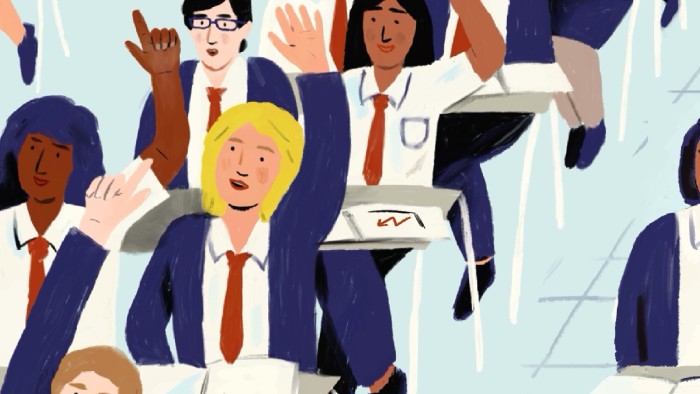
The Financial Times has led the campaign for every child to receive the benefit of financial education. Earlier this year, a long-awaited overhaul of the school curriculum in England proposed just that.
But as ministers work out their next moves, why wait to change lives? More than 900 UK schools are already using the award-winning financial curriculum designed by FLIC, the FT’s Financial Literacy and Inclusion Campaign (see below). Funded by the generosity of our readers, donations to this year’s seasonal appeal are being matched by Experian, and UK taxpayers can boost this even further with Gift Aid.
So enjoy these money lessons and share them with young people in your life — and thanks for giving the gift of financial education this Christmas.
Understand the rules of money Deborah Meaden
Money and finances were virtually absent from my learnings in school, which seemed such a missed opportunity. Basic lessons on cash flow and budgeting are useful for everybody, not just those running a business.
Being in control of your money relies entirely on understanding cash flow — how much you have coming in versus how much you have going out (and crucially, when). Learning how to budget and control your spending includes deciding how much cash you want to keep as a safety net for those surprises (good and bad) that will come up in the future.
Learning how to make plans and manage your cash is essential to avoid risking getting into debt and starting out with a bad relationship with money. Teaching the rules of money isn’t a nice-to-have, it is surely essential to help young people build themselves a secure life.
Deborah Meaden is a star of Dragons’ Den and author of ‘Deborah Meaden Talks Money’
What can we learn from the wealthiest?Damien Jordan
My lesson would start with lining up every student in the classroom by height. Some will be shorter, some taller, most clustered around the middle. Plot it on a graph and you get a bell curve, or what mathematicians call a “normal distribution”.
But money? That is different. Line people up by wealth and the bell curve vanishes. Instead, you get something called a power law, a shape so violently skewed it looks like a mistake. Most people cluster near zero while a tiny few (such as Elon Musk) stretch off the chart entirely. If height worked like wealth, the richest person would be five miles tall.
Of the 8bn people on Earth, about 3,000 are billionaires. So most of the world’s wealth is concentrated in the hands of a very small group of people. Why does this matter? Because once you understand that wealth follows different rules, you stop comparing yourself to billionaires in the same way you’d compare yourself to someone slightly taller than you.
The people at the top of the wealth pile didn’t get there because they are billions of times smarter than you. Some of them inherited their wealth. Many took huge risks that paid off, or owned stakes in companies that were successful, often because they had a product they could scale to millions of users. They also got a bit lucky along the way.
Learning more about money won’t just help you pass a maths exam. It will help you read the news, understand the economy, and make sense of your own finances without feeling needlessly bad about where you stand.
Damien Jordan runs the YouTube channel Damien Talks Money
Starting early pays dividends — but better late than never Jill Scott MBE
Growing up, talking about money was taboo, so I really wish we’d been taught more about it at school. When I retired from professional football at the age of 35, I thought I’d done all right, but I quickly realised I was way behind where I needed to be. I’d spent years planning for match day, but not for life after the final whistle. I had no savings and not much in my pension pots.
Since then, I’ve learned that it’s never too late to start. Even sticking a little bit away in investments here and there adds up. When you’re young, it doesn’t seem like much, but over time — just like training — it builds. Small steps make a massive difference. Honestly, I wish someone had shown me that back in maths class.
Jill Scott MBE is a former Lioness and ambassador for eToro
Making money is all about getting richer slowly Tim Harford 
The lesson I wish was more widely appreciated is that it’s not easy to get rich. We’re constantly shown images of rich people, from celebrities to business tycoons to TV characters who complain about money worries yet somehow live in fabulous Manhattan apartments — but we are rarely told where this money comes from. It can seem like magic, which makes people vulnerable to get-rich-quick scams.
The truth about making money is that there is no trick to it: you need valuable skills, hard work, some luck, and a willingness to save and invest sensibly. It’s not child’s play but it’s not complicated either. Work on your skills, and on your thriftiness, hope for a bit of luck — and when someone offers you an easy way to get rich, run.
Tim Harford is the FT’s Undercover Economist
The outsized cost of micropaymentsCarol Vorderman
Gen Z use micropayments all the time, especially for gaming. And there is a reason for this. Making payments for tiny amounts — but LOTS of them — makes it appear to the untrained brain as though you are spending less.
So how much a year could they be costing you? I would challenge teens to add up all the micropayments they have made to find this out, and I guarantee the total will be more than they think.
Let’s apply the same lesson to convenience food. Buying a supermarket meal deal on your way to school costs £3.80. Sounds cheap. But how much is that a year? £3.80 x 5 x 39 school weeks a year = £741 a year. But what if we take income tax into account? If your parents are on the average wage, they will have to earn around £1,000 a year to pay for this little luxury. Knowing this might encourage kids to be more entrepreneurial, make their own lunch more cheaply and keep the rest from their parents.
Carol Vorderman is a broadcaster and author of ‘How to be Good at Maths’
Recognise the power of compounding Jonathan Guthrie
Compounding is your superpower as a saver and investor — but your kryptonite as a borrower and payer of charges. Kids should get their heads round this as soon as they understand percentages. Positive compounding means that returns on your money earn more returns and so on, like infinity mirrors.
Let’s say you invest £100 with an annual return of 10 per cent. After one year, you’d have £110. But now you’re earning 10 per cent on a bigger amount. In year two, you’d have £121, and by year three, £133.
Granted, 10 per cent growth is pretty punchy (though it makes the mental arithmetic easier). But how much would you have in seven years?

The answer is £195, or nearly double your money. After 20 years, it would be more like £700. And after 30 years? You’d be getting close to £2,000.
Negative compounding, such as being charged interest on money you borrow, has the opposite impact. Borrow £3,000 on a credit card at the age of 21, and if you only made the minimum payment, you’d be nearly 50 by the time you paid it all back.
I did not twig this until I was older. As a result, I underestimated both the long-term gains I could make on lower-risk investments, and the cost of credit card debt over shorter periods. Play around with a free compound interest calculator online, and see the snowball effect in action for yourself.
Jonathan Guthrie is a writer and adviser
Investing isn’t just for rich peopleAbigail Foster
I wish someone had taught me that investing isn’t a luxury for the wealthy, it’s how anyone can build wealth. For years, I thought investing was for people in suits. So I left money in savings accounts, not realising I was watching it shrink in real terms while inflation ate away at it. Nobody told me I could start investing with £25 a month (sometimes less). Nobody explained that over time, invested money grows in ways savings never will.
If I could teach one lesson to teenagers, it would be this: start investing early, even with tiny amounts. Understand the magic of compound growth. Learn that the stock market isn’t a casino, it’s a tool that’s been building ordinary people’s futures for centuries.
Financial literacy isn’t just about understanding money, it’s about finding your voice around it. And that voice starts with believing you deserve a seat at the table, no matter how much money you’re starting with.
Abigail Foster is a financial educator and author of ‘The Money Manual’
Automate financial decisions where you canRobert Armstrong
Thinking about money is exhausting, because it involves maths and evokes strong emotions. Most of us find doing sums a drag, but desperately want more money. Combining those forms of stress wears us out.
The result is that we avoid thinking about money or aren’t at our smartest when we do. This effect is so powerful that it even applies to people who think about money for a living. People who write about or work in finance often mess up their own investments. I’ve made some big mistakes myself!
The solution is to turn yourself into a machine. Find a set of easy, repeatable steps, governed by the kind of rules others have mentioned in this article, and follow them. Financial apps make it easy to set up your accounts to take these steps automatically.
For example, siphoning off a fixed sum of money into a savings or investment account every time you get paid. And if you get a pay rise, increase the amounts that you’re contributing. Once the machine is running, you will feel so much better that the few decisions you do have to make about money — including spending it — will be much smarter.
Robert Armstrong is the writer of the FT’s Unhedged newsletter and podcast
Gamify your next shopping trip Steph McGovern
I’m a big believer in teaching kids about money from an early age. The virtual nature of finance means it’s trickier, but there are loads of things you can do with the young children in your life to help them get started.
Before we go food shopping, I get my six-year-old daughter to write our list. When we find the products we need she’ll note down the price next to the name. Then at home, we’ll add up the numbers together and check it matches the receipt. Of course we get thrown now and again by the various offers, but that also adds an element of jeopardy to our game. It’s a fun way to work on her literacy and numeracy, as well as making conversations about money and finance something that comes naturally to her.
Steph McGovern is a broadcaster and presenter of The Rest Is Money podcast
A taxing question about inflation Helen Miller
Most students will not experience the UK tax system until they enter the world of work and start paying tax on their wages. This often comes as a shock.
The personal allowance — the amount people can earn before they start to pay income tax — is £12,570 a year. It has been set at that level since 2021, and the government has just announced it will be frozen until 2031. To a class of teenagers, this may not sound like much of a big deal. But it represents a huge shift in the tax system that could ultimately raise an extra £65bn in tax revenues. How?
The answer is inflation. One pound in the future is worth less than one pound today. If we were to look up the price of a coffee, a hamburger or a chocolate bar 10 years ago, they would be much cheaper than today. By 2031, prices will almost certainly have “inflated” again. The wages that people are paid will have risen with inflation too — but if the point at which people start to pay income tax stays the same, millions more will be dragged into paying tax for the first time, or paying higher rates.
This stealthy tax rise is politically popular because few people realise it’s happening. Hence understanding inflation — and a few key features of our tax system — helps not only with personal financial decisions, but also with holding governments to account.
Helen Miller is a director of the Institute for Fiscal Studies
Why renting isn’t as bad as everyone saysStuart Kirk
Want to own a house? Of course you do! But buying a home is so expensive, few people can afford to do it. You may have been told that paying rent is a waste of money. But this is rubbish — even leaving aside property taxes, renovation costs and annual maintenance bills that homeowners rarely acknowledge.
If rent is a waste, what about the cost of interest? When you make a monthly mortgage payment, some of that money goes to reducing your debt, but the rest is interest you’re charged to borrow that money.
Let’s say you take out a £500,000 mortgage at 5 per cent interest for 20 years. In total you will end up handing over nearly £300,000 in interest — that’s more than half again of the amount you borrowed.
In simple terms, that’s only about £70,000 less overall than paying £1,500 per month in rent for 20 years. In other words, you’re only guaranteed to be better off buying if house prices increase. Recent experience has blinded us that they always do. But long-run charts show there are plenty of periods where house prices do nothing for decades. Rent has a bad rep. It shouldn’t.
Stuart Kirk is the FT’s Skin in the Game columnist
What I learned hanging out with the super-richJemima Kelly
One of the most fun things about my job at the FT is that I get to go inside the homes of some very interesting people, and sometimes some extraordinarily rich ones (those two things don’t always overlap). This has taught me a few things. First, very rich people tend to have very poor taste. It is surprisingly hard to know what to do with billions of dollars, and that having more Picassos than a top art gallery doesn’t make you happy.
Usually, what appears to bring these billionaires the most joy is the stuff they didn’t spend much money on, if any: the tree they have painstakingly watered and grown from a tiny seed, the dog they rescued from a local shelter, the bread they’ve recently learned how to make. Something to bear in mind when you feel envious of those who ostensibly have “more” than you, or when thinking about what you most want in life.
Jemima Kelly is an FT columnist
Asking questions about money is your superpower Katie Martin 
As a journalist at the FT, I ask questions about money for a living. But in my younger days, I wish I had asked more questions about financial products.
For example, when my partner and I were looking to buy our first home, we were initially put off by advice from our bank, which told us we could only borrow a measly amount. We didn’t think to go and ask another bank. We just spent months saving up more money.
After a phone call with a mortgage broker many months later, it turned out we could borrow more than we first thought. In the meantime, house prices had gone up a lot, so the initial bad advice cost us dearly. The lesson? Always have the confidence to ask questions, shop around and seek another opinion. And if someone tries to sell you a financial product you don’t understand, don’t sign on the dotted line until you’re confident that you do.
Katie Martin is the FT’s markets columnist and co-presenter of the Unhedged podcast
How money can make you more moneyRotimi Merriman-Johnson 
Something I wish I had learnt about at school is the difference between assets and liabilities.
Both are something you can own. But the key difference is that assets can appreciate in value and put more money in your pocket in future, whereas liabilities can go down in value or end up costing you money.
The classic example of a liability is a debt. Not only do you owe money, you have to pay interest on that debt until you’ve paid it off. There are some things that it might be worth getting into debt for, such as a university degree, or borrowing money to buy a home. But the same cannot be said for a lot of the things you might use a credit card to purchase.
As I began my financial literacy journey in adulthood, I also learned that you can buy assets — investments like stocks, bonds, property, gold or even some collectors items. Spend most of your surplus cash purchasing assets and you can become wealthy over time.
Had I learned about this at school, I would have started much earlier.
Rotimi Merriman-Johnson presents the Mr MoneyJar show
A job is about more than the salaryIsabel Berwick
Think of a job you would like to do in the future, and one of your first thoughts is likely to be how much money you could earn doing it. But a career package is like an iceberg. The salary is the part that’s visible on the surface, but what about more hidden perks and benefits?
For example, a career in public service or teaching might be less well paid than some other choices, but the value of the pension you’d receive in retirement is still very generous for new entrants compared with workers in the private sector. Even if you work in the private sector, some employers are much more generous with pensions and parental leave than others.
Private medical insurance is another valuable benefit. Your workplace package might include free or subsidised Gen Z-friendly items such as sports physiotherapy and mental health counselling, plus speedy access to a private GP.
Some London law firms offer their staff really extravagant perks, such as free saunas and hair salons in the office. But in return, they will expect you to spend most of your waking hours inside it, toiling away.
Other firms offer to fund education or training. For example, Amazon’s career choice programme will pay up to £3,000 per year, and many graduate employers — especially in financial services and consultancy — will fund a business school course or MBA. What kind of promotion and pay rise could that net you?
Isabel Berwick is the FT’s Working It editor and author of ‘The Future-Proof Career’
Learn to speak the language of financeGillian Tett
Forty years ago, I thought of myself as someone who disliked economics and finance. I felt ill-equipped to know or care about money — either in my own life or the wider world. What changed my attitude, however, was realising this crucial point: my hostility towards the world of finance had been driven by fear, as much as anything else, since it was a “language” I did not understand.
So I sat down to learn this language, much as I might have taught myself French. I realised that it was not nearly as difficult as I had feared. Then I discovered something else: if you understand how money goes around the world, you can understand power, and gain it in your own life.
Finance is like electricity: it enables everything else to happen. So if you want to make sense of our world, and navigate it, it pays to invest a little time in learning the basics of this language to become empowered — and especially if you don’t think of yourself as a “money” person.
Gillian Tett is an FT columnist and Provost of King’s College, Cambridge
As adults, we might look back wistfully and wish we had understood the power of compounding at an earlier age, or spent less on credit cards in our twenties. But the reality for today’s young people is very different. They undoubtedly need these skills, but they need so much more besides.
Financial literacy needs a reboot for the modern world — and that’s what the FLIC curriculum offers students in Years 7 to 13 and their teachers. Funded by readers, built by FT experts and developed by FLIC’s experienced in-house teachers, our ready-made lessons aren’t just modern in their content — they speak the language of younger learners.
The video content FLIC has developed explains currency exchange using Fifa gaming points, and shows how get-rich-quick schemes on social media use affiliate marketing to make you buy the product.
We teach students how to understand risk and make informed financial decisions; the benefits of budgeting; how to navigate student finance and how the world of work is changing, upskilling students and teachers alike.
Following a lesson on cryptocurrencies and pump-and-dump scams, Gracie from John Kyrle High School, Herefordshire, said: “I thought this was a really boring topic . . . but FLIC brought it into much more of a Gen Z world by using Kim Kardashian and social media.”
So thank you, FT readers, for making this all possible — your donations will make even more of a positive impact in 2026 and beyond.
Aimée Allam is the executive director of FLIC
This article is part of the FT Financial Literacy & Inclusion Campaign’s seasonal appeal. The appeal is supported by lead partner Experian, which is generously match-funding other donations.