Facebook
Twitter
LinkedIn
Pinterest
Reddit
Email
Print
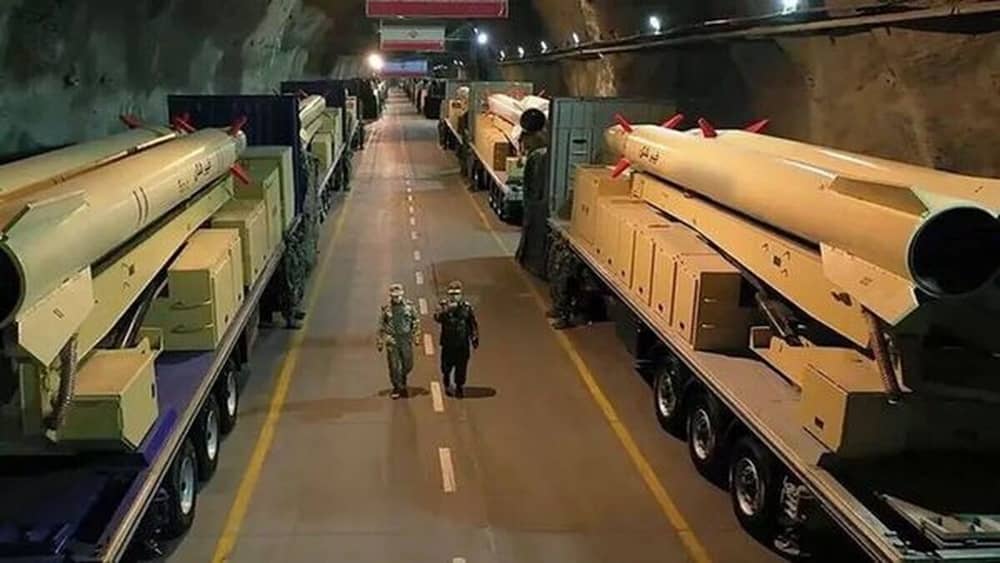 IRGC aero-space personnel walk past transporter-erector-launchers carrying ballistic missiles inside an underground tunnel facility
Three-minute read
A surge of belligerence rhetoric from Iranian officials—ranging from blunt talk about nuclear-weapons capability to promises of uninterrupted missile production—has collided with a growing sense of strain inside the country, where economic deterioration and social pressure are increasingly difficult for the state to contain.
In one of the starkest public statements on December 19, 2025, Behrouz Kamalvandi, spokesman for Iran’s Atomic Energy Organization, argued that building a nuclear weapon would be “the simplest” task compared with the engineering challenges of running a nuclear power plant—language that analysts say reads less like technical commentary than a political signal. In the same remarks, Kamalvandi claimed Iran had reached a point where it had essentially mastered the nuclear file, describing the program as having arrived at the “edge of power.”
Days earlier, Mohammad Eslami, the head of the regime’s atomic agency, struck a similarly defiant tone, saying the program would press ahead across multiple advanced fields and would not be deterred by war, sabotage, or political pressure—comments delivered on December 11, 2025. Iranian officials have long framed the nuclear program as sovereign and irreversible; what is new is the increasingly undisguised suggestion that weapons capability is technically within reach.
#Iran’s Permanent Emergency: How the Regime Governs for the Next Uprisinghttps://t.co/tQsb4PopTG
— NCRI-FAC (@iran_policy) November 19, 2025
Tehran’s belligerent posture has not been limited to nuclear signaling. Abolfazl Shekarchi, spokesman for the Armed Forces General Staff, said on December 17, 2025, that Iran’s missile production line continued without interruption following what Iranian and foreign reporting has described as a 12-day war with Israel.
The missile issue is also increasingly tied to international supply chains and enforcement actions. Washington has sanctioned entities involved in transfers of missile-related chemicals and precursors in 2025, reflecting U.S. intent to disrupt inputs needed for solid-fuel production. At the same time, multiple reports in 2025 have described Iranian efforts to secure dual-use materials and industrial inputs—often pointing to complex procurement networks rather than overt arms deliveries.
Diplomatically, the regime’s foreign ministry has paired military messaging with outright rejection of international oversight mechanisms. On December 14, 2025, foreign ministry spokesman Esmaeil Baghaei dismissed the relevance of UN Security Council Resolution 2231—the framework that endorsed the 2015 nuclear deal—claiming it had “ended” from Iran’s perspective and brushing off calls by IAEA Director General Rafael Grossi for restored inspection access as repetitive talking points. Those remarks came as international attention remained fixed on the trajectory of Iran’s enriched-uranium stockpiles and the status of verification.
#Iran Faces Mounting Crisis: Snapback Mechanism Threats, Nationwide Military Alert, and Fear of Uprisinghttps://t.co/RM2d5Gbltz
— NCRI-FAC (@iran_policy) August 26, 2025
The hardening tone abroad is unfolding alongside compounding pressures at home. Reporting in late 2025 described the rial sliding to fresh lows, with sanctions—reimposed through snapback dynamics and amplified by U.S. “maximum pressure” measures—tightening access to funds and trade. The result, AP reported, has been sharper food inflation and a public mood increasingly shaped by both economic insecurity and fear of renewed conflict. European governments, for their part, have argued that Iran’s nuclear advances left them little room but to pursue snapback pathways, even as Tehran rejects the legitimacy of those steps.
Regionally, Iran is also encountering more overt resistance to its influence. In Lebanon, Reuters reported that Foreign Minister Youssef Rajji declined to place the credentials of Iran’s incoming ambassador on the cabinet agenda and withheld steps typically required to advance accreditation—moves that Lebanese officials framed as a response to Tehran’s destabilizing role in Lebanese and regional politics. The episode underscores the degree to which the regime’s regional posture—built for years around proxy networks and political leverage—now carries higher diplomatic costs.
Inside Iran, the authorities’ response to external pressure has increasingly blurred into internal securitization. State media reporting suggest a post-war climate in which officials portray dissent and social unrest not as governance failures but as extensions of foreign confrontation—an approach that can justify tighter policing and harsher penalties.
#Tehran‘s Nuclear Gambit: A Cornered Regime’s Threats Expose Deep-Seated Fearhttps://t.co/QWQmY9bUrU
— NCRI-FAC (@iran_policy) August 14, 2025
Taken together, the regime’s nuclear and missile bravado reads less like confident deterrence than political cover for deep domestic weakness. While officials boast that building a nuclear bomb is “easy,” claim Iran has reached the “edge of power,” dismiss UN Resolution 2231 as effectively “finished,” and tout uninterrupted missile production, the state remains trapped by converging socio-economic crises it cannot credibly fix: currency collapse, high inflation, shortages, and widening social strain.
This posture targets two audiences. Abroad, it aims to raise the perceived cost of pressure through escalation signaling. At home, it is meant to project control at a moment of growing vulnerability and social fatigue, including erosion of morale even among loyalists. In short, the regime is trying to look strong because it feels weak—substituting coercive leverage and defiance for crisis relief, and hoping external confrontation will buy time against internal decay.