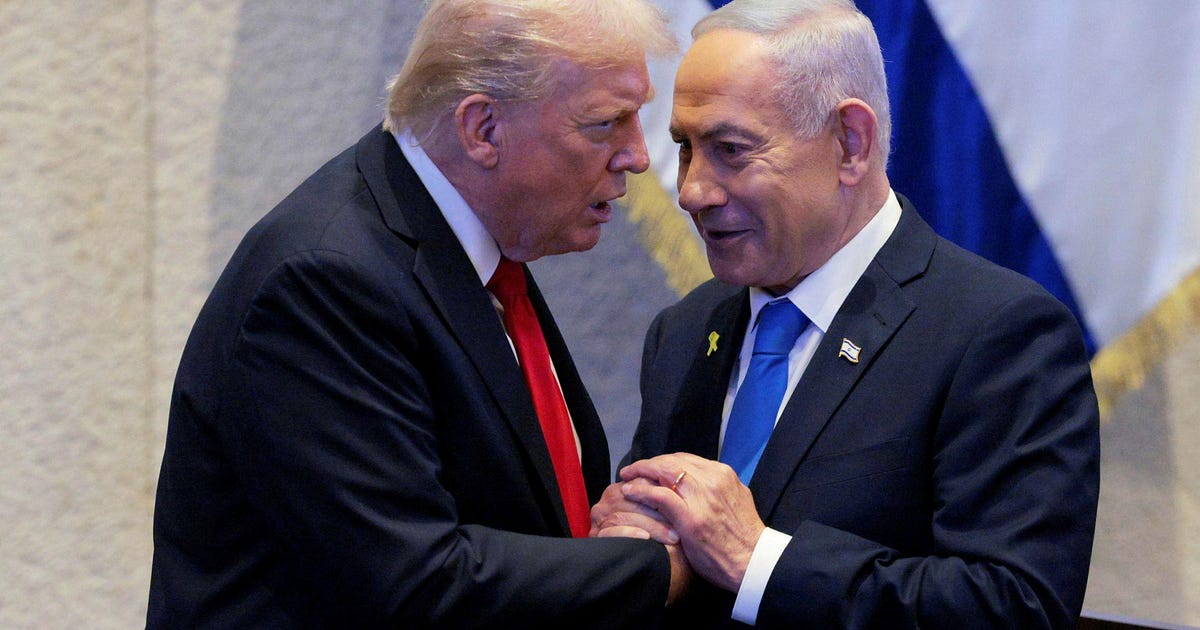
Prime Minister Benjamin Netanyahu is expected to attempt to persuade U.S. President Donald Trump to greenlight new military action against Iran, NBC News reported Saturday, citing a person with direct knowledge of the Israeli plans and four former U.S. officials.
The two leaders are expected to meet later this month at Trump’s Mar-a-Lago club in Miami, Florida, with December 29 being discussed as the meeting date. “We haven’t set it up formally, but he’d like to see me,” Trump told reporters.
Netanyahu is reportedly pushing for renewed strikes due to Tehran’s expansion of its ballistic missile program.
Related Articles
According to the sources cited by NBC News, Israel is concerned about Iran’s reconstruction of its nuclear enrichment sites, but Tehran’s ballistic missiles and air defenses are a more immediate priority.
“The nuclear weapons program is very concerning. There’s an attempt to reconstitute,” an Israeli source with knowledge of the plans reportedly told the channel, adding that, “It’s not that immediate.”
According to two former Israeli officials who spoke with NBC News, Trump may be less receptive to Netanyahu’s efforts to persuade him if the sides remain in disagreement about Netanyahu’s approach to the cease-fire.
 Close
Close
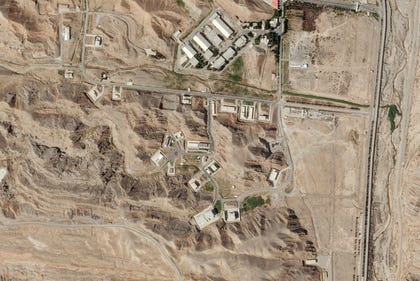
This satellite photo from Planet Labs PBC shows Iran’s Parchin military base outside of Tehran, Iran, in September. Credit: Planet Labs PBC via AP
This satellite photo from Planet Labs PBC shows Iran’s Parchin military base outside of Tehran, Iran, in September. Credit: Planet Labs PBC via AP
Tehran will be able to produce up to 3,000 ballistic missiles per month if its reconstruction of the production facilities goes unchecked, the Israeli official privy to the Iran plans, and former U.S. officials briefed on them, reportedly said.
“There is no real question after the last conflict that we can gain aerial superiority and can do far more damage to Iran than Iran can do to Israel,” a former Israeli official said, according to the channel.
“But the threat of the missiles is very real, and we weren’t able to prevent them all last time.” Iran’s ballistic missiles and the number of missiles it can use in each attack reportedly remain Israel’s key concern.
Haaretz Weekly‘Schindler for the animals’: How a Jewish oligarch rescued 5,000 zoo animals from the front lines of the Russia-Ukraine war
play
Haaretz Weekly
‘Schindler for the animals’: How a Jewish oligarch rescued 5,000 zoo animals from the front lines of the Russia-Ukraine war
Volume: 0.5
1X
total– : –time0:00
fast forward15
play
rewind15
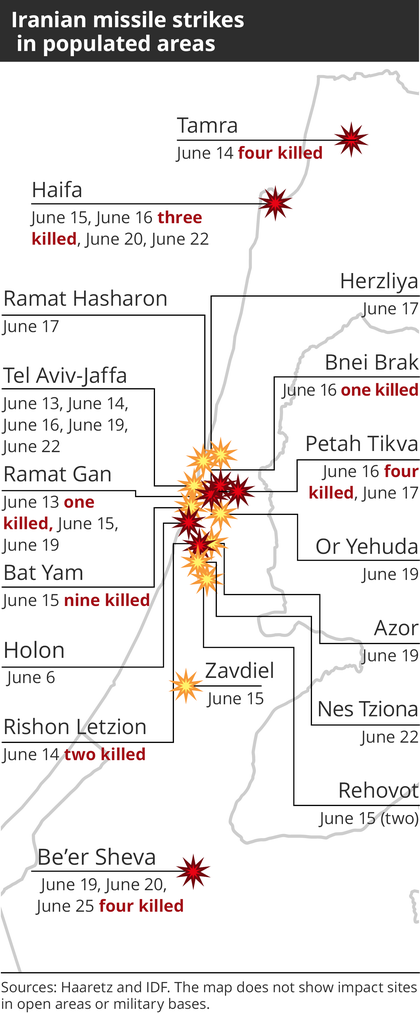
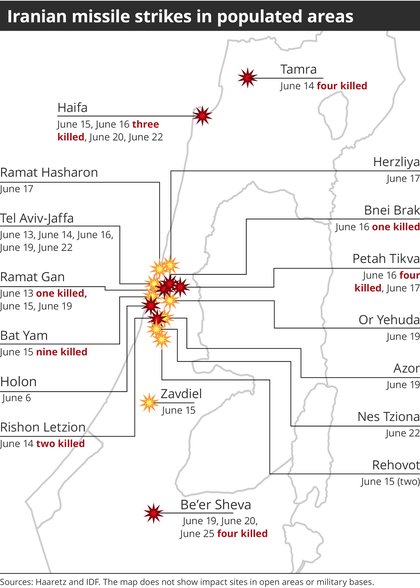
The IDF reported that, over the 12-day conflict, 36 Iranian missiles struck built environments, while air defense systems achieved an interception rate of 86 percent.
Data compiled by Haaretz from IDF reports over the course of the war shows that Iran carried out 42 missile barrages, firing roughly 530 ballistic missiles at Israel.
Israel and the United States used around 200 missile interceptors, which came at an estimated cost of 5 billion shekels (nearly $1.5 billion).
 Close
CloseAccording to a July report by the British Telegraph, Iranian missiles directly hit five Israeli military bases during the 12-day war.
Satellite data analyzed by researchers at the University of Oregon reportedly indicates that six missiles struck bases in the central, northern, and southern parts of the country, including the Tel Nof Air Force Base and the Glilot Camp, which houses the main base of the IDF’s elite 8200 intelligence unit.
Several days after the report, an Israeli military official acknowledged the Iranian strikes to Reuters.
The official, speaking on condition of anonymity in accordance with military briefing rules, said that “very few” sites had been hit and that they remained functional.
Reuters contributed to this story.