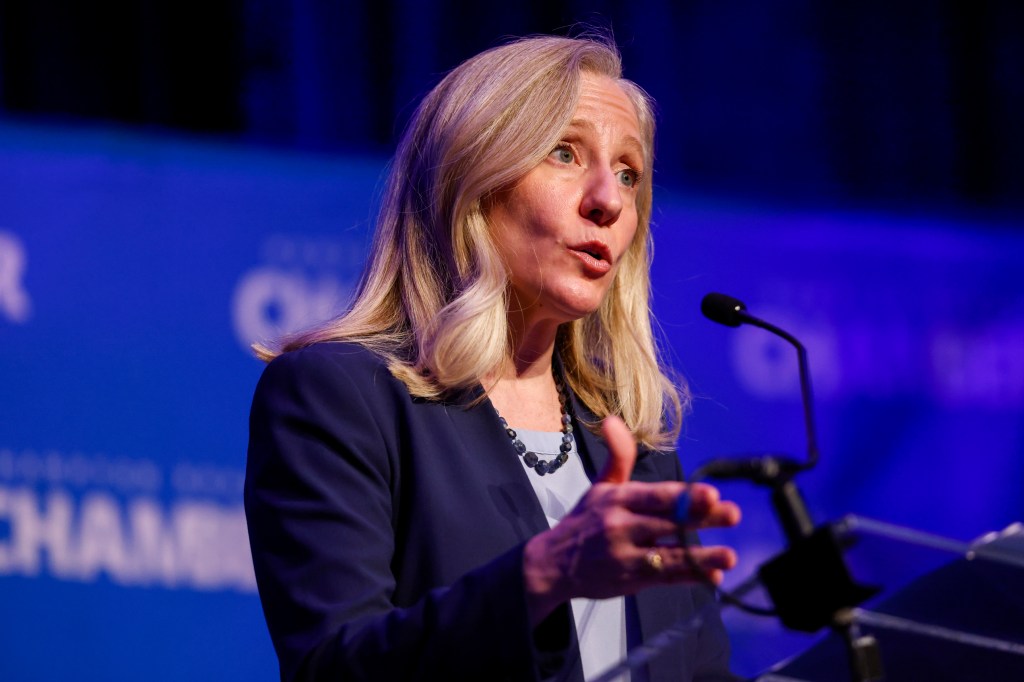
Gov.-elect Abigail Spanberger is moving energy issues to the top of her agenda by creating a new position within her Cabinet to focus on meeting electricity demand, keeping prices low and maintaining Virginia’s commitment to meeting clean energy goals.
A source with close knowledge of the Spanberger transition said the governor-elect intends to name a chief energy officer to work on policies to reduce soaring energy prices and improve access to the strained regional electrical grid as the state confronts data centers’ and artificial intelligence technologies’ demand for power.
The new “energy czar” will not require the General Assembly to create a separate energy secretariat, but will work within Spanberger’s Cabinet to coordinate energy policy with the governor’s office, the secretary of Commerce and Trade, and the Department of Energy within the secretariat. The new officer would be required to develop a statewide energy strategy and ensure that Virginia has adequate supply of affordable energy to meet the new governor’s economic development goals, the source said.
The arrangement would be similar to the role the chief transformation officer played within Gov. Glenn Youngkin’s Cabinet, which the Republican governor used to reorganize state agencies, as well as that of Director of Energy Glenn Davis, a former state delegate from Virginia Beach.
Spanberger already has spotlighted energy as part of the affordability agenda she rolled out on Thursday with Democratic General Assembly leaders. Her initial legislative push addresses energy availability and cost primarily through Democratic priorities, such as development of battery storage for electricity generated by renewable sources of energy, helping residents reduce their costs by using energy more efficiently and promoting use of portable solar power generators.
SCC’s role in power forecasts
Her initial legislative package also would rely on the State Corporation Commission, a constitutionally independent regulatory agency, to oversee improvement of utility forecasts of future power use. The idea is to avoid overestimates that require construction of power generation that might unnecessarily add to the cost of monthly electric bills. She wants the SCC to “review and validate” utility estimates of power use and future needs.
Spanberger also wants the SCC to establish a new process to make use of the electric distribution grid more efficient to avoid “the need for expensive new transmission” capacity.
The new chief energy officer, whom the governor-elect has not yet appointed, will work directly with PJM, the Pennsylvania-based regional transmission office that oversees the availability of wholesale electric supplies for Virginia and a dozen other states from the Mid-Atlantic through the Midwest. PJM has come under increasing political pressure from Youngkin, Pennsylvania Gov. Josh Shapiro and other elected leaders in the region for failing to develop adequate power supplies to meet the soaring demand for electricity by data centers and other big users.
The new officer’s mission will focus on reducing the cost of wholesale power capacity, which already is driving up utility rates for customers of Dominion Energy and Northern Virginia Electric Cooperative in the heart of the global data center industry in eastern Loudoun County and Prince William County.
Spanberger also wants the new energy officer to work with PJM to reduce the long wait times for connecting energy generating projects onto the regional power grid, the source said. She wants to ensure that data centers and other big energy users aren’t driving up electricity costs for other captive customers, as the SCC already has directed as part of a new, separate rate for data centers and other big users.
The “energy czar” also will work with members of the General Assembly to develop legislation to address energy demand and affordability, the source said.
Clean Economy Act
The biggest challenge Spanberger and the new energy officer face will be developing new sources of electricity that are reliable and readily available to meet the demands of big industrial customers, including those that the new governor wants to recruit to move to Virginia or expand existing operations here.
Republicans want to scrap the Virginia Clean Economy Act, which a Democratic-controlled legislature adopted in 2020. The law requires the elimination of fossil fuel power plants by 2045 for Dominion and 2050 for Appalachian Power Co.
Democrats, who will control the governor’s office and both chambers of the assembly, have no intention of repealing the law or backing away from those mandates. But Dominion says it can’t meet that deadline without building new power generation fueled by natural gas, at least until small modular nuclear reactors become readily available.
Spanberger, in an August interview with Inside Climate News during the governor’s race, did not rule out natural gas as a continuing source of electric power.
“At this juncture, natural gas is going to be part of the energy mix into the future,” she told the news outlet.
“However, I think when it comes to new natural gas infrastructure, that’s where we really need to be focused and sort of thinking carefully about the lifespan of those projects and whether indeed they are the most cost-effective solution,” she said.
© 2025 Richmond Times-Dispatch, Va.. Visit www.timesdispatch.com. Distributed by Tribune Content Agency, LLC.