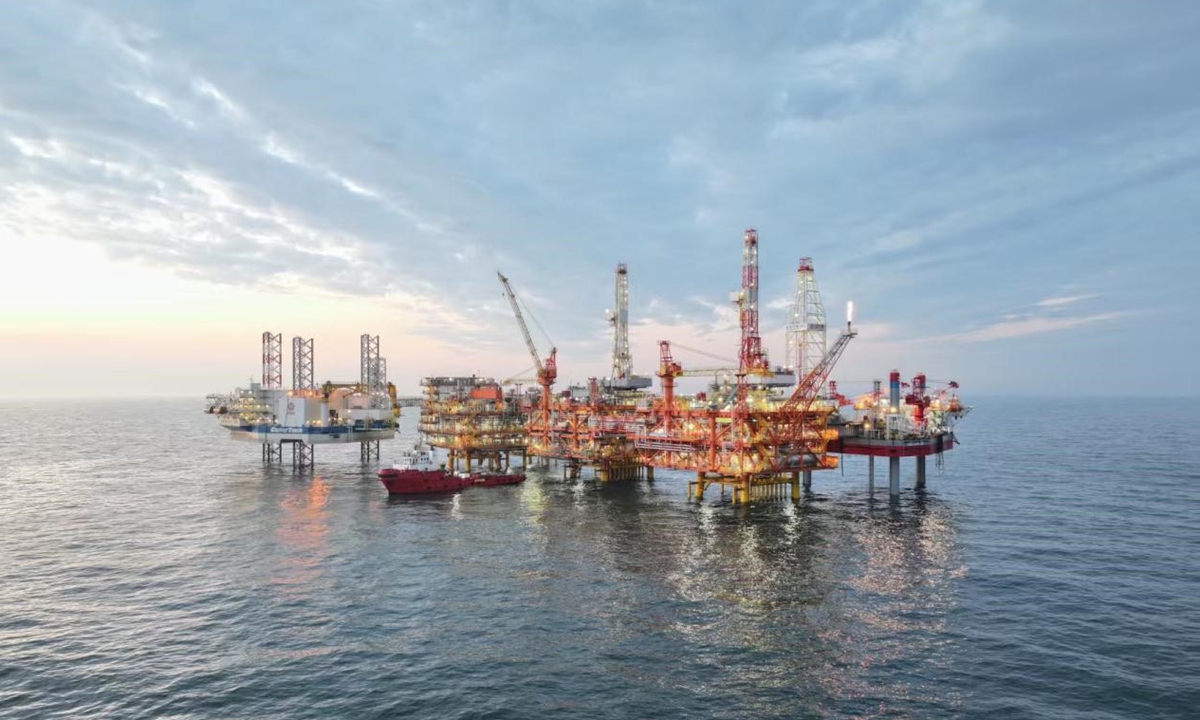
A CNOOC offshore oil platform in the Bohai Sea. File photo: Courtesy of CNOOC
China National Offshore Oil Corporation (CNOOC) on Sunday announced cumulative output from the offshore oil and gas at the Bohai Oilfield, China’s largest crude oil production base, has exceeded 40 million tons, setting a new record and providing solid support for national energy security and high-quality economic and social development.
Bohai Oilfield is China’s largest and most productive offshore oilfield. Since the beginning of the year, the oilfield has comprehensively strengthened its production capacity, promoted intelligent drilling and completion processes and the standardized upgrading of engineering systems, and many new projects have been rapidly completed and put into operation. The oilfield’s conventional production areas have contributed more than 32 million tons of crude oil annually.
By tapping technological breakthroughs, the company’s large-scale offshore heavy thermal recovery operations secured an annual output of 2 million tons, according to a CNOOC release sent to the Global Times.
Established in 1965, the Bohai Oilfield is the cradle of China’s offshore petroleum industry. It currently boasts over 60 operational oil and gas fields and more than 200 production facilities. In the past five years, it has maintained an average annual oil and gas production growth rate of 5 percent, accounting for nearly 40 percent of the national increase in crude oil production, becoming a core force supporting the ramp-up of domestic oil and gas reserves and output.
CNOOC’s Bohai Oilfield has contributed over 600 million tons of crude oil and has developed into China’s largest offshore oil and gas production base integrating exploration, development, engineering construction, and production operation.
According to data from the National Energy Administration, China’s oil and gas production is expected to reach a new high in 2025, with crude oil production potentially reaching 215 million tons, the highest level in history. Natural gas production, meanwhile, could reach 260 billion cubic meters, further consolidating China’s position as the world’s fourth-largest natural gas producer.
China’s record-high oil and gas production can be attributed to three factors. First, there has been a significant rise in investment in oil and gas exploration and development. During the 14th Five-Year Plan (2021-25) period, China’s investment in upstream oil and gas exploration and development continued to increase, with an average annual investment about 48 percent higher than that during the 13th Five-Year Plan period, resulting in a significant increase in investment intensity, Luo Liangcai, an industry expert with CNPC Economic & Technology Research Institute, told the Global Times at the 2025 International Energy Executive Forum, held in Beijing earlier this month.
The success in tapping ultra-deep, offshore and unconventional oil and gas resources, as well as scientific innovation and technological upgrades were the other two factors, Luo said.
Global Times