
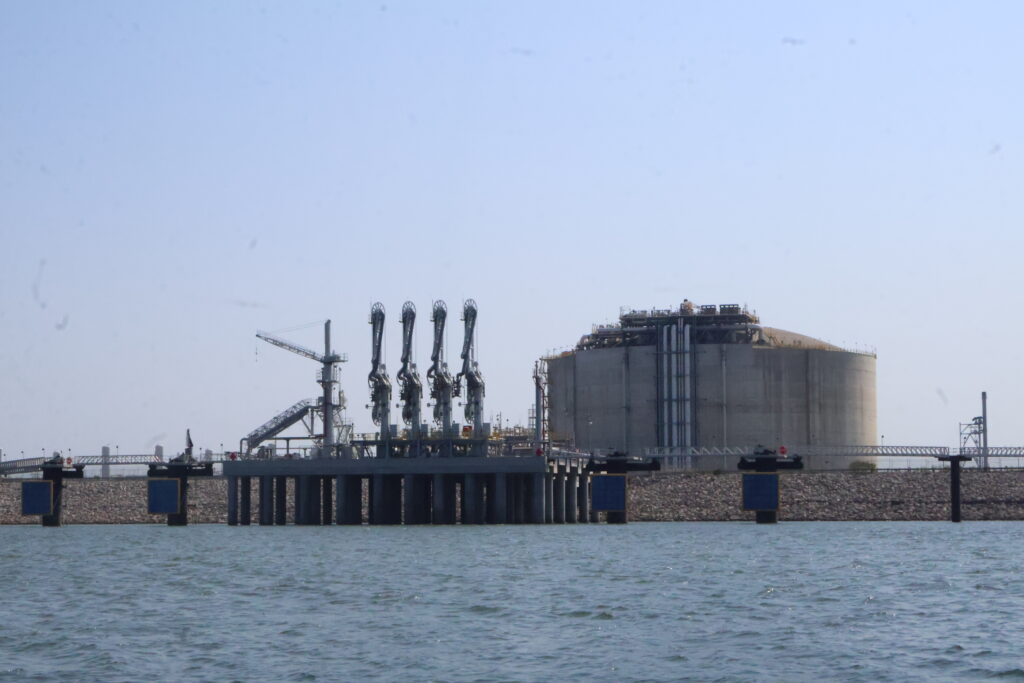
An LNG export terminal on the coast of Louisiana’s Cameron Parish. (Elise Plunk/Louisiana Illuminator)
Prices have steadily risen for natural gas throughout 2025, for residents and industry alike, and Louisiana finds itself at the center of the boom. A nation-leading three liquified natural gas export facilities operate along its coast, and five more are in the construction or planning phases.
But more LNG exports will mean higher domestic utility prices, according to a new report from the consumer advocacy group, Public Citizen.
Public Citizen analyzed documents from the Federal Energy Regulatory Commission and determined natural gas prices are increasing for American households as gas companies in the U.S. export more of the commodity to meet global demand.
From January through September, Americans paid $12 billion more for natural gas than the same period last year. That comes to about $124 per family in higher utility bills, a 22% increase directly related to higher natural gas prices, the report notes.
Natural gas prices for consumers are expected to increase another 16% in 2026, according to Public Citizen, which cited U.S. Energy Information Administration predictions.
Analysts attribute growing global demand for natural gas to political, industrial and environmental factors.
Russia’s invasion of Ukraine has led other countries, mostly European, to seek other sources of the fuel, which is widely preferred as a cleaner alternative to coal.
The rise of artificial intelligence has caused a surge in the construction of data centers that require vast amounts of electricity that is most likely to come from power plants that run on natural gas.
An LSU Center for Energy Studies outlook for 2026 credits much of the state’s growth in natural gas exports to executive orders from the Trump administration that lifted a Biden-era moratorium on expansion of LNG export facilities.
The United States exported 11.9 billion cubic feet per day of LNG around the globe in 2024, according to the U.S. Energy Information Administration. Louisiana handled around 61% of those shipments.
LNG exports are expected to “more than double by 2037, with nearly all new export capacity located on the Gulf Coast,” according to the LSU report’s analysis of Energy Information Administration predictions.
“As we continue to see more production, more capacity for exports, particularly in the LNG space, that’s going to mean more jobs,” said Tommy Faucheux, president of the Louisiana Mid-Continent Oil and Gas Association. “Somebody is going to supply that gas. Louisiana gets to benefit from the investments in the export capacity.”
But with increased exports comes the tradeoff of higher domestic prices for residents, according to the Public Citizen report.
The majority of Louisiana’s electricity, around 70%, is generated from natural gas, according to the most recent numbers from the Energy Information Administration. It costs about 12 cents per kilowatt hour of electricity for residential, natural gas-fueled power in Louisiana, compared with the 18-cent national average.
Utilities pass along the increased cost of electricity generation to their customers, often through what’s called a fuel adjustment charge on their utility bills. They also include charges to recoup the costs of any losses or investments such as new power lines or infrastructure upgrades. Although Louisiana has low rates for its electricity, it hasn’t translated to low power bills because of these pass-along costs to customers.
“Whatever amount of gas they’re using to generate the electricity that’s being used in your home, the cost of that gas is being charged directly to you,” said Jesse George, policy lead for the Alliance for Affordable Energy.
In some areas such as New Orleans, an area with older, less energy-efficient homes, residents will feel the higher prices in 2026, George said.
Colder temperatures create more power demand, and natural gas prices tend to increase when utilities need more fuel to increase their generation. The Energy Information Administration predicts a 22% increase in natural gas prices for the winter heating season that runs through March.
Though heightened winter electricity demand in Louisiana typically ends by March, customers could see additional fuel surcharges on their utility bills for months if there is a severe cold snap. The same situation arises during intense summer heat,
“About 20% of households cannot pay their utility bills already,” George said, citing the most recent numbers available from Entergy New Orleans’ disconnection rates. “Couple that with these increased fuel prices, and that certainly will only exacerbate the problems and the challenges that people are facing already.”