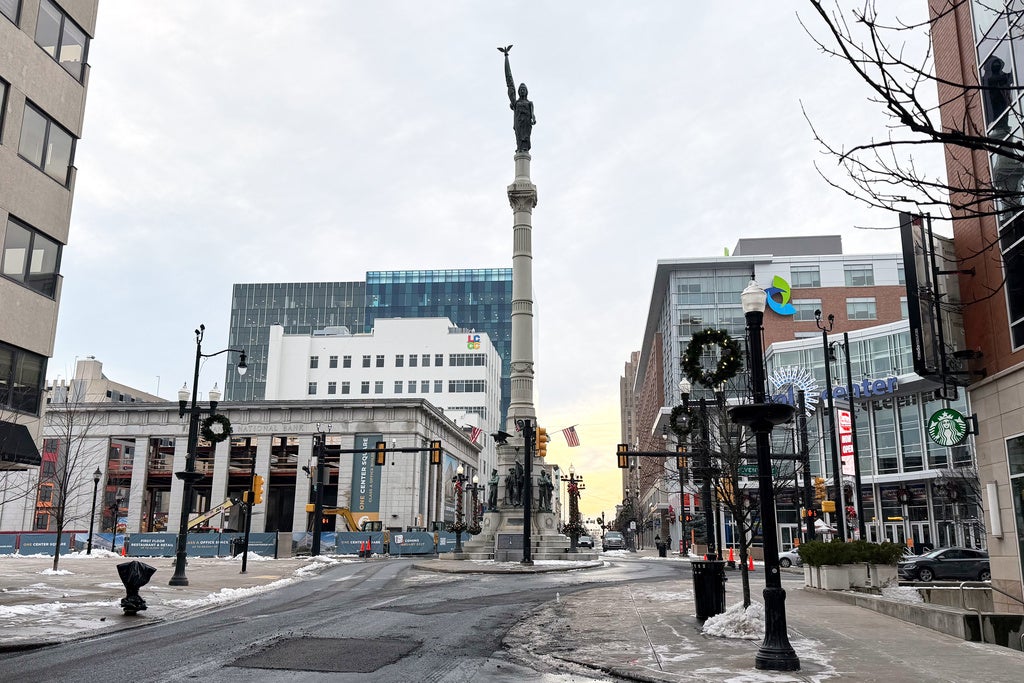
When Idalia Bisbal moved to this Pennsylvania city synonymous with America’s working class, she hoped for a cheaper, easier life than the one she was leaving behind in her hometown of New York City.
About three years later, she is deeply disappointed.
“It’s worse than ever,” the 67-year-old retiree, who relies on Social Security, said when asked about the economy. “The prices are high. Everything is going up. You can’t afford food because you can’t afford rent. Utilities are too high. Gas is too expensive. Everything is too expensive.”
Bisbal was sipping an afternoon coffee at the Hamilton Family Restaurant not long after Vice President JD Vance rallied Republicans in a nearby suburb. In the Trump administration’s second high-profile trip to Pennsylvania in a week, Vance acknowledged the affordability crisis, blamed it on the Biden administration and insisted better times were ahead. He later served food to men experiencing homelessness in Allentown.
The visit, on top of several recent speeches from President Donald Trump, reflects an increasingly urgent White House effort to respond to the economic anxiety that is gripping both parties. Those worries are a vulnerability for Republicans in competitive congressional districts like the one that includes Allentown, which could decide control of the U.S. House in next year’s midterms.
But in confronting the challenge, there are risks of appearing out of touch.
Only 31% of U.S. adults now approve of how Trump is handling the economy, down from 40% in March, according to a poll from The Associated Press-NORC Center for Public Affairs Research. Yet Trump has called affordability concerns a “ hoax ” and gave the economy under his administration a grade of “A+++++.” Vance reiterated that assessment during his rally, prompting Bisbal to scoff.
“In his world,” Bisbal, a self-described “straight-up Democrat,” responded. “In the rich man’s world. In our world, trust me, it’s not an ‘A.’ To me, it’s an ‘F,’ ‘F,’ ‘F,’ ‘F,’ ‘F,’ ‘F.’”
Agreement that prices are too high
With a population of roughly 125,000 people, Allentown anchors the Lehigh Valley, which is Pennsylvania’s third-largest metro area. In a dozen interviews this week with local officials, business leaders and residents of both parties, there was agreement on one thing: Prices are too high. Some pointed to gas prices while others said they felt the shock more at the grocery store or in their cost of health care or housing.
Few shared Trump’s unbridled boosterism about the economy.
Tony Iannelli, the president and CEO of the Greater Lehigh Valley Chamber of Commerce, called Trump’s grade a “stretch,” saying “we have a strong economy but I think it’s not yet gone to the next stage of what I would call robust.”
Tom Groves, who started a health and benefits consulting firm more than two decades ago, said the economy was at a “B+” as he blamed the Affordable Care Act, widely known as “Obamacare,” for contributing to higher health costs and he noted stock and labor market volatility. Joe Vichot, the chairman of the Lehigh County Republican Committee, referred to Trump’s grade as a “colloquialism.”
Far removed from Washington’s political theater, there was little consensus on who was responsible for the high prices or what should be done about it. There was, however, an acute sense of exhaustion at the seemingly endless political combat.
Pat Gallagher was finishing lunch a few booths down from Bisbal as she recalled meeting her late husband when they both worked at Bethlehem Steel, the manufacturing giant that closed in 2003. Now retired, she, too, relies on Social Security benefits and lives with her daughter, which helps keep costs down. She said she noticed the rising price of groceries and was becoming exasperated with the political climate.
“I get so frustrated with hearing about the politics,” she said.