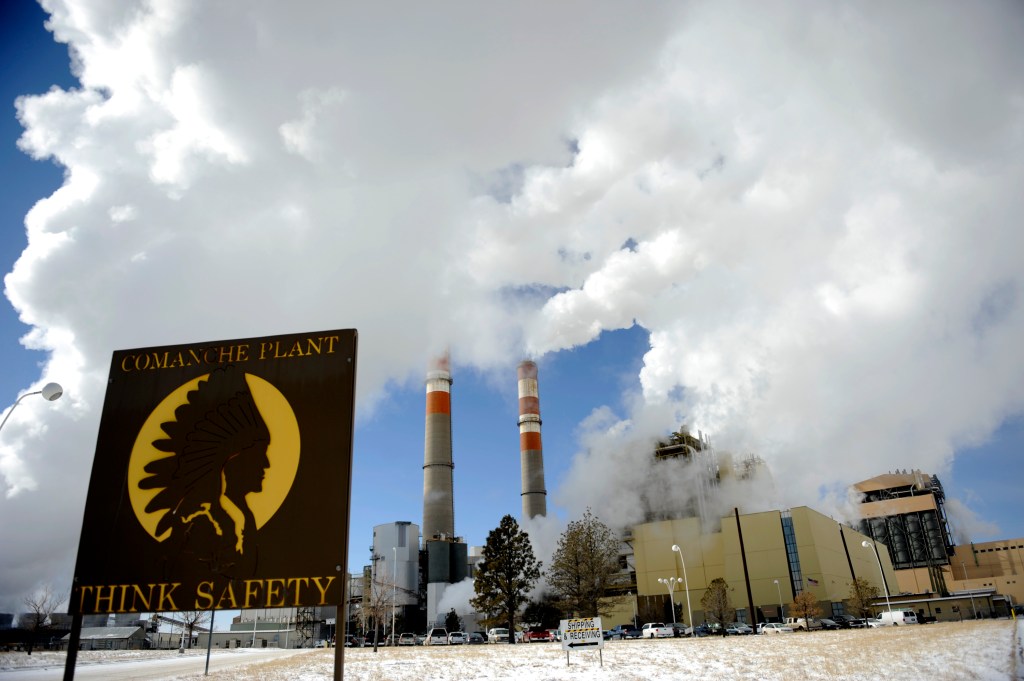
In August 2010, I traveled to Pueblo to tour Comanche 3. The coal unit, Colorado’s largest, with 750 megawatts of generating capacity, had begun producing electricity a few weeks before.
“The beast has risen,” said a sign along my tour.
It had been a difficult birth. Problems had delayed completion by a year. Troubles continued. The unit was down an average 91.5 days annually in its first 11 years. In August, the unit went down again. This time, Xcel Energy, its operator and primary owner, expects the unit to be down until next June.
The Colorado Public Utilities Commission, which regulates Xcel on behalf of the monopoly’s 1.6 million electrical customers in Colorado, must decide whether to allow Xcel to spend perhaps tens of millions of dollars to get the coal-burning unit operating again. Retirement had been planned for December 2030. In the final years, it is to be operated at only 60% of capacity.
To ensure the lights — and especially the air conditioners next summer — stay on, Xcel and the administration of Gov. Jared Polis wanted to delay the retirement of Comanche 2, a neighboring coal-burning unit, for a year beyond its scheduled retirement in December. Older and smaller, Comanche 2 began producing electricity in 1975 with a maximum capacity of 335 megawatts, less than half that of Comanche 3. It has, however, been far more reliable.
PUC commissioners have approved the delayed retirement of Comanche 2 until December 2026, but are skeptical of plowing more money into Comanche 3. So are environmental groups, organizations representing ratepayers, and others.
“Ratepayers continue to bear the consequences of (Xcel subsidiary) Public Service’s failings when it comes to Comanche 3,” said the City of Boulder in its PUC filing. “At some point, the bleeding must stop.”
Electricity from Comanche 3 as of 2021 had cost $66.25 per megawatt-hour as compared to the projected $45.70 per megawatt-hour, according to a PUC staff report.
Some see parallels to the St. Vrain nuclear plant. That nuclear plant along the South Platte River near Greeley operated from 1976 to 1989. Like Comanche 3, it had problem after problem. Finally, operations ceased. The bleeding continued long after. Customers of the utility now operated by Xcel paid $2 a month from 1993 until 2005 to cover the $125 million cost of decommissioning St. Vrain. The utility then spent $250 million to retrofit it into a natural gas plant.
Why has Comanche 3 been such a lemon? Xcel frowns on that word. The evidence is clear. The 2021 PUC staff report said “poor maintenance practices likely contributed” to the 374-day outage that had then recently ended and other short-comings in Xcel’s operation. A jury ordered Xcel pay CORE Electrical Cooperative, the Sedalia-based cooperative that owns 8% of the unit, $26 million because of the year-long outage.
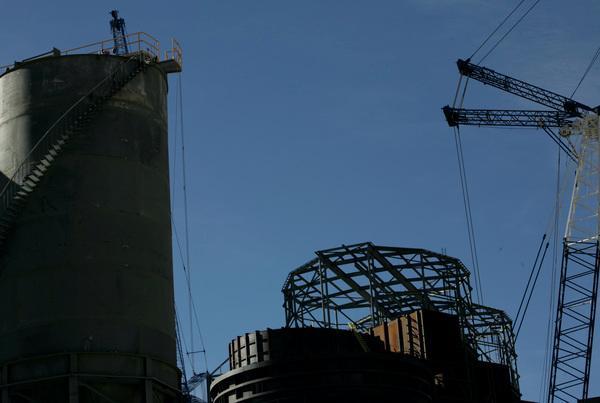 The Comanche 3 power plant under construction by Xcel in Pueblo, Colorado on Monday, Nov. 19, 2007. Denver Post File Photo
While approving Xcel’s plan to delay Comanche 2’s retirement, the PUC commissioners made it clear that repairing Comanche 3 cannot be assumed.
“Any such expenditures are likely to face significant scrutiny,” said Megan Gilman, a commissioner. To ensure this scrutiny, the PUC insists upon detailed monthly reports, not a bill delivered afterward.
“Mind-boggling” was how Tom Plant, another commissioner, described Xcel’s proposal. “I do find it a little bizarre that the company can come forward and say, ‘Yeah, we know what needs to be fixed, and we’re going to have it fixed by June, and oh yeah, we have no idea what those costs are.” Xcel, he added, must look to alternatives, such as demand-response programs.
Related to Comanche 3 is the concern expressed loudly by Xcel about resource adequacy. Does the company have the generating capacity it needs to keep the lights on and meet growing demand from electric cars and buildings. Data centers the far larger story. How real is this projected demand. Nobody seems to know for sure.
Meanwhile, data centers will likely be a focus of at least two bills before Colorado legislators in 2026. Data center developers want more financial incentives, while wary environmental groups want guardrails.
Craig provides another element of the evolving coal-burning story in Colorado. Tri-State Generation and Transmission Association has been planning for nearly a decade to close one of its three coal-burning units there this December. Tri-State now expects to get orders from the U.S. Department of Energy to keep the coal unit operating into 2026. Xcel had been expecting the same for Comanche 2, and U.S. Rep. Jeff Hurd has been calling for Trump administration orders.
Now, Comanche 2 will stay operating by state orders instead. A few years ago, Colorado was triumphantly easing out of coal generation in orderly fashion. The narrative has shifted, this energy transition — what I call the big pivot — has gotten more complex.
Allen Best can be found at BigPivots.com, where he chronicles Colorado’s energy and water transitions.
Sign up for Sound Off to get a weekly roundup of our columns, editorials and more.
To send a letter to the editor about this article, submit online or check out our guidelines for how to submit by email or mail.