
LNG shipping rates in full-year 2025 were at their historic lows, with those for TFDE carriers down 48% YoY and those for XDF/MEGI down 35% YoY, despite the picture changing unexpectedly, which saw rates surging over $100,000pd in October and November due to the advent of winter.
The year started on a weak note: US–China tensions and evolving trade patterns added to the shipping woes
Several downside risks, such as ample vessel availability, lower Asian demand (down 5% YoY), milder weather and trade uncertainties (caused by trade frictions, volatile tariffs and geopolitical hindrances), weighed on the positives in the form of higher European imports in 2025 (up 25% YoY), increased global supply (up 6% YoY) and record-breaking scrapping (up 88% YoY).
The USTR announcement, slow FID pace in 1H25 and US tariff rollouts prompted participants to exercise caution which kept the ordering muted, with only 20 LNGC orders placed in 2025 (as on 10 December), compared to 76 in 2024. While orders were down, deliveries remained robust, with over 68 LNGCs added to the fleet as of the end of November and over 20 LNGCs scheduled for the remaining weeks of the year.
The recent rate spike remains an anomaly, and we expect the LNG market to return to its predictable course, as the ongoing surge has been triggered by a seasonal uptick in Europe rather than strong, persistent demand, especially in Asia. Meanwhile, over 20+ modern two-stroke carriers are to be added by the end of this year.
The prolonged trade tensions and tariff tussle between the US and China negatively impacted LNG shipping demand, resulting in a loss of approximately 45 billion tonne-miles in 2025. The increased intra-basin trade also dented the overall shipping demand, resulting from further deepening of geopolitical nuances, as Europe further distanced itself from Russia, while China maintained its pause on US LNG imports.
Geopolitics-led trade changes, juxtaposed with overall shipping demand, resulted in lower utilisation in 2025 than in 2023 and 2024. Some improvement in LNGC transits in early 2025 via the Panama Canal, was reversed as higher European demand was increasingly met by US LNG, expanding the intra-basin trade that overtook the US–Asia trade, offsetting any gains expected from extended voyages (via COGH).
In the Far East, higher scrutiny of Russian LNG by the West led to the emergence of the LNG dark fleet. While the operations at Arctic LNG 2 remain under restrictions, China is reportedly estimated to have received more than a dozen LNG cargoes from this project, with China and Russia defying Western sanctions on Russia’s LNG exports.
Apart from LNG, China also increased piped gas imports from Russia, which reduced the former’s overall LNG shipping imports (down 9% YoY in 2025). Meanwhile, the revived discussions over Power of Siberia 2 (36 million tonnes) also raised concerns about China’s long-term LNG demand. As we retain our cautious outlook for this deal, any significant impact on LNG shipping seems unlikely (at least until 2030).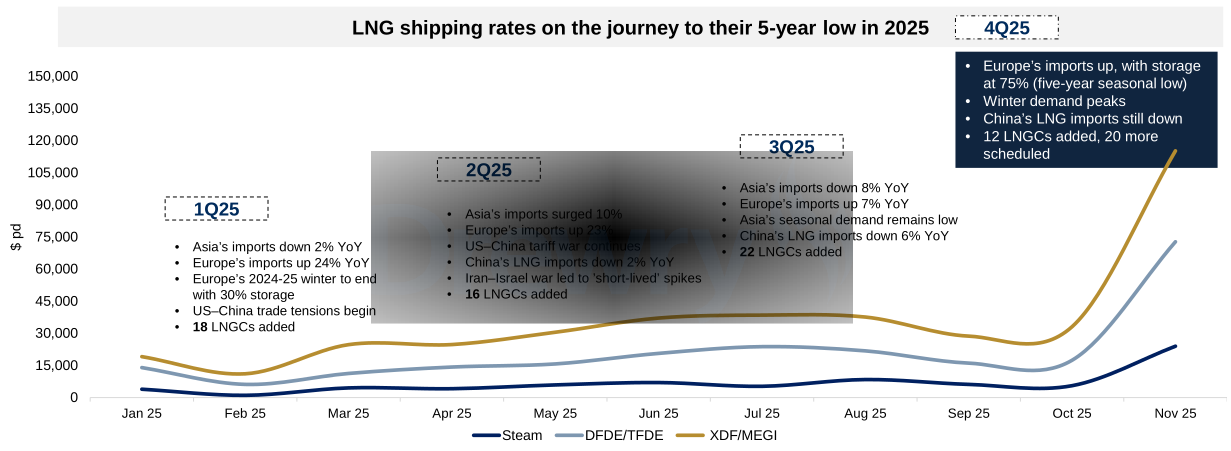
Low rates and USTR policies affect ordering, with new orders down 50% YoY
The rate crash, oversupply and geopolitics-led uncertainty kept shipowners on the back foot, with new orders down 50% YoY in 2025. Meanwhile, as LNG shipping continued to grapple with vessel surplus amid robust deliveries, the number of idled and laid-up vessels doubled, from around 30 at the start of the year to 59 (so far in 2025).
Although USTR policies had a limited impact on LNG shipping in terms of vessel repositioning, it did affect shipowners’ decision, with no LNGC ordered at Chinese shipyards in 2025, compared to 28 in 2024. However, orders for LNGBVs triumphed, with 23 LNGBVs ordered so far this year, making 2025 a record year for LNGBV orders. With rates continuing to trend downwards and environmental scrutiny increasing, steam carriers became redundant, which accelerated scrapping to over 15 LNGCs in 2025 (so far this year) compared to 8 last year.
1H25: Tariffs, trade tensions and the Iran–Israel war spooked market uncertainty
LNG shipping rates for TFDE and XDF/MEGI carriers were down 65% YoY and 55% YoY, respectively, in 1H25. Macroeconomic weakness, along with unpredictable tariffs, fears over potential recession and trade frictions, dampened demand fundamentals. Meanwhile, geopolitics-led supply risks provided temporary relief to rates as market sentiments remained fragile. The spikes were ‘short-lived’ as seen in the case of the Iran–Israel war in June.
Lower gas demand in Asia, decelerated industrial output and economic headwinds kept regional demand largely subdued. While key importers such as China, India and South Korea recorded a decline in 1H25, Taiwan (China) appeared to be the bright spot due to the increasing role of LNG in its energy mix as the country became completely ‘nuclear-free’.
On the bright side, European imports surged 40% YoY in 1H25, with Spain, Italy, the Netherlands and Belgium being the top buyers. While the continent’s demand strengthened, it was unable to boost the overall tonne-mile demand as Europe aggressively sourced more from the US. In contrast, imports from other countries remained steady or even fell (as was the case with Russia). The long-haul trade, predominantly concentrated in the Atlantic, was cut into shorter lanes.
3Q25 failed to revive rates amid low seasonal demand
The expected fragile recovery in rates in 3Q25 failed to materialise due to Asia’s seasonally low LNG demand, coupled with high vessel availability in both basins. Meanwhile, higher LNG prices, averaging $12.5 per MMBtu in 2025 (compared to $11.0 per MMBtu in 2024), kept buying muted in price-sensitive countries. Low industrial activity, cheaper domestic gas, increased pipeline imports, milder temperatures and trade tensions with the US kept China’s LNG imports subdued.
Despite robust trade in the Atlantic Basin, rates failed to improve, as the ample supply of prompt vessels met spot demand and competition with Asia remained low (in terms of LNG cargo and modern vessels). Meanwhile, steam carriers continued to come off their long-term charters, exacerbating the vessel oversupply condition, with some of them being laid up. Meanwhile, the US’ tariff hits and pauses, along with policy shifts (USTR and China’s reciprocal port fee), kept market participants on edge, adding to market uncertainty.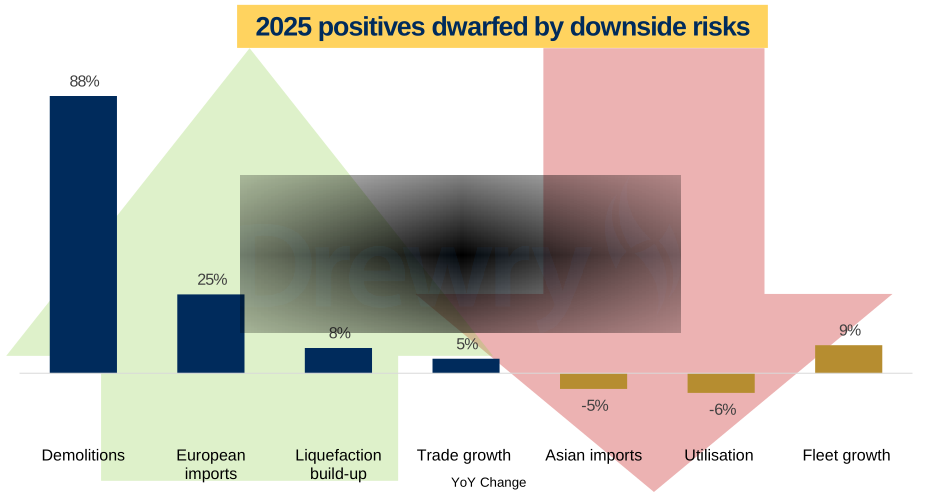
Winter arrived with a bang!
LNG shipping rates hit six digits at the end of October and November, with rates for XDF/MEGI carriers surpassing $100,000pd on account of higher LNG demand in Europe, vessel tightening in the Atlantic, demand woes in Egypt and increased trade on US–Europe. Higher European demand coincided with improved US supplies, which kept the Atlantic busy. Meanwhile, surging US–Europe trade absorbed the ample prompt vessel supply, with a corresponding rise in winter coverage and requirement of vessels until the end of December.
On the contrary, rates in the Pacific failed to increase at the same pace, as Asian demand remained subdued. Weak regional demand kept US–Asia trade lower, with most of the US LNG being exported to Europe. We expect rates in the West to maintain their premium over those in the East, with the majority of the prompt DFDE and steam carriers available in the latter. Higher environmental scrutiny is strengthening demand and increasing the preference for modern LNGCs (XDF/MEGI) in the West. This is also resulting in market fragmentation, with more two-stroke carriers being deployed and demanded in the Atlantic, while four-stroke and steam carriers are repositioning towards the Pacific.
Europe’s first winter without Russian gas, with storage at 75% full as of end-November (five-year seasonal low), led to the ongoing surge in European LNG imports. Higher withdrawals will continue to sustain imports flowing into the region, but the spike seen in 4Q25 is expected to ease towards 1Q26 as winter cargo requirements are being managed. Meanwhile, any surge in Asian demand during winter (specifically, Northeast Asia) is unlikely to significantly alter the ongoing trade patterns, with Europe comfortably securing its winter coverage. However, rising Henry Hub prices (at $4.50 per MMBtu) could lead to some alterations, with more cargoes from other countries, such as Qatar, Russia, Africa, reaching Europe.
Long-term rates remained steady despite short-term headwinds
While spot rates and short-term rates bore the brunt of vessel surplus, long-term rates held steady, signalling robust LNG demand in the long run. According to Drewry’s orderbook data, approximately 75% of the LNGC orders are on long-term charters, which account for 13% of the orderbook with coverage of less than three years, while some remain structurally open.
Additionally, the positive outlook for LNG demand stems from the FID wave in 2H25, with over 60 mtpa of planned volumes securing FID, and more than 90 mtpa of supply deals signed to date. Meanwhile, more than 150 mtpa volumes are under construction and about 200 mtpa are planned, requiring more LNGCs in the future.
What’s next?
As we are nearing the end of 2025, we believe the current surge in rates is likely to ease in the near term, with 2026 starting on a softer note, especially, if demand fails to maintain the same pace. While 20 new modern LNGCs are scheduled to be added in December 2025, another 40 LNGCs are expected to join the fleet in 1Q26, providing respite to the current vessel crunch in the West.
However, possible drivers that could support rates in 1Q26 include:
• Weather conditions: 1Q26 winter will dictate the dynamics—an expected harsh winter in Europe and Asia could increase import demand. Meanwhile, extreme weather in Northeast Asia, with lower renewable/nuclear output, could also boost LNG demand.
• China’s winter buying activity: A surge in China’s winter buying would increase its spot demand, which has remained largely absent in 2025.
• US LNG export volumes and trade policy shifts: The US’ trade re-negotiations with China and the latter’s U-turn to the former could resume the trade between them, reviving the lost tonne-mile demand.
• Pipeline supply: Any hindrances to Europe’s pipeline imports from Azerbaijan, Norway and Algeria could further increase the region’s reliance on LNG shipping imports.
Source: Drewry