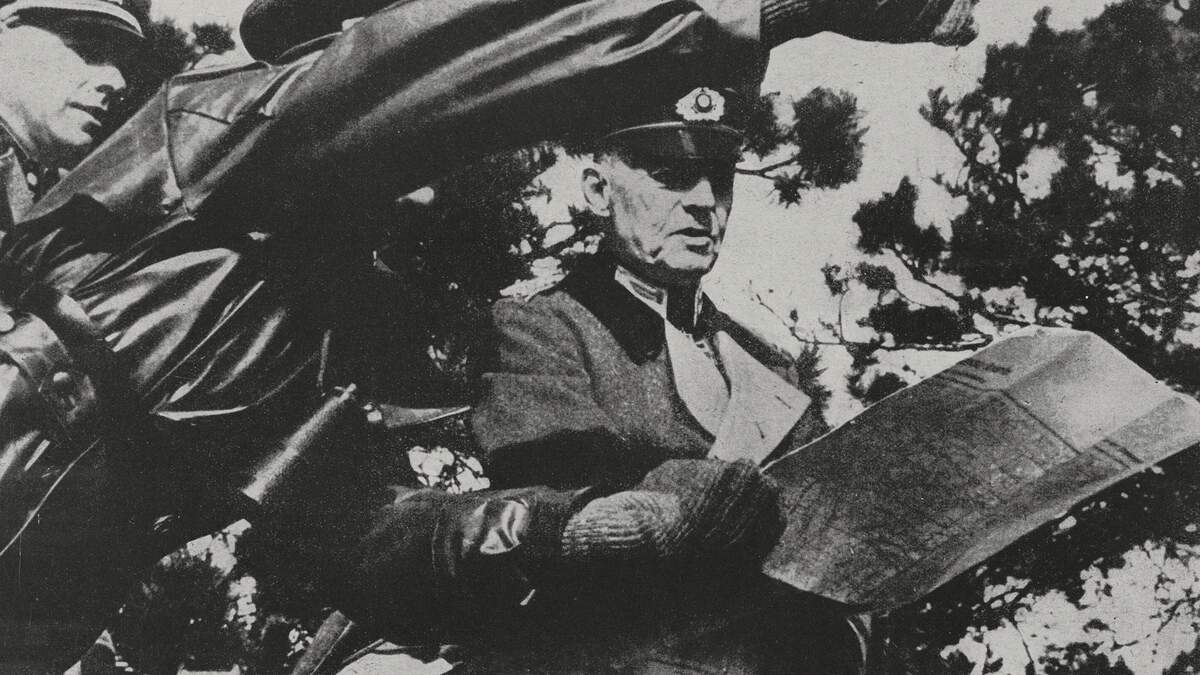
Although Gerd von Rundstedt may not count among the most infamous German generals of the Second World War, his name remains highly recognisable in Luxembourg, where he is known for his role in the Battle of the Bulge.
The Prussian aristocrat, born on 12 December 1875 in Aschersleben, belonged to the elite of the Wehrmacht and was closely involved in the invasion plans of Poland (1939), France (1940) and Russia (1941).
However, in Luxembourg, the term “Rundstedt Offensive” to describe his role in the Battle of the Bulge on 16 December 1944 is not entirely accurate, as the general himself distanced himself from this last stand by Nazi Germany, which ended in failure but unfortunately left behind considerable damage, particularly in the north of the Grand Duchy.
At the age of just 12, the boy, who was steeped in Prussian virtues, attended the cadet school in Oranienstein. His next step was the renowned Royal Prussian Main Cadet Academy in Groß-Lichterfelde, near Berlin.
In March 1892, the young von Rundstedt was assigned to the 83rd Infantry Regiment von Wittich. Finally, on 17 June 1893, he was able to take the oath as a second lieutenant and thus joined the officer corps.
Another step in his career was his appointment as battalion adjutant in October 1896. His outstanding qualities were friendliness, moral virtues and horsemanship. He also studied French.
He was admitted to the War Academy on 1 October 1903. At the age of 33, von Rundstedt rose to the rank of captain and distinguished himself as commander of the 6th Company through his discipline and orderliness.
The First World War and its consequences
On 1 August 1914, Germany declared war on Tsarist Russia. Two days later, the same step was taken against France and, on August 4, Belgium.
On the same date, Great Britain entered the war against Germany. Captain von Rundstedt, replacing General Riemann, distinguished himself in the fighting against the French on the Montyon plateau near Paris. His promotion to major on 28 November was a natural consequence of his efforts.
Also read:Keeping the memory alive: how Luxembourg remembers the Battle of the Bulge
From January to March 1915, the Russians increasingly intervened in the war. In February 1917, however, Tsar Nicholas II was forced to abdicate.
After von Rundstedt succeeded in bringing the largest Russian harbour, Rewel (now Tallinn), under his control in July 1917, he was awarded the Iron Cross First Class and the Gallipoli Star. With the Treaty of Brest-Litovsk, signed on 3 March 1918, the Russians brought an end to the war on the eastern flank.
From 11 November 1918, arms were also laid down in the west after a war that lasted 51 months and 11 days. Around 34,000 officers, who were still celebrated as “demigods” in the Reich newspapers as recently as September, had to return to civilian life after the German defeat and some even found themselves unemployed.
German Field Marshal Gerd von Rundstedt (centre) on his arrival at the headquarters of the 7th Army, together with General F. B. Prickett (left) and his son Lieutenant Hans von Rundstedt, after their capture during the Second World War, in Bavaria, May 1945. © Photo credit: Getty Images
Kaiser Wilhelm abdicated, and the Republic was proclaimed in Germany. In March 1919, a provisional Reichswehr of 350,000 volunteers was established, but on 7 May, at the behest of the Allies, it was limited to seven divisions.
Compulsory military service was abolished, and the German arms industry was placed under Allied control. The Treaty of Versailles, signed on 28 June 1919, unintentionally paved the way for Adolf Hitler to seize power.
The Supreme Army Command and the War Ministry ceased their operations on 3 July. However, a putsch against the Weimar Republic, named after the Kapp-Lüttwitz group and named after its instigators, failed on 12 March 1920.
Meanwhile, von Rundstedt continued to climb the rungs of the military, becoming chief of staff of the 3rd Cavalry Division in Weimar on 1 May 1920, and a colonel on 1 March 1923.
In the legislative elections of 31 July 1932, the National Socialist German Workers’ Party (NSDAP) emerged as the strongest party.
Due to his loyalty to President Hindenburg and the Papen-Schleicher government, von Rundstedt was promoted to commander-in-chief of Group Command I. The Weimar Republic was meanwhile nearing its end, and Hitler assumed the post of chancellor on 30 January 1933.
During the Night of the Long Knives, between 30 June and 2 July, he did not hesitate to have inconvenient SA officers in his inner circle, such as the officer Ernst Röhm, murdered.
The Ministry of Defence was renamed the Ministry of War – the current US President Trump took this same step this year – and on 21 May 1935, the Reichswehr was replaced by the Wehrmacht.
Also read:Schumannseck: The fierce battle at the heart of the Battle of the Bulge
However, a request for a pension made by von Rundstedt to Hindenburg was rejected by the Reich President. On 5 June 1937, Hitler, who demanded absolute obedience from the army high command, informed his subordinates that they had to be ready for the expansion of the Lebensraum, a concept which envisaged more land or “living space” for German-speaking people.
Von Rundstedt’s promotion to colonel general is dated 1 March 1938, and 12 days later, the Wehrmacht invaded Austria. The Anschluss (union) took place without resistance and the country was elevated to the eighth Gau (district).
Hitler also seized Czechoslovakia without any difficulties on 15 March 1939, after Édouard Daladier and Neville Chamberlain had already given him the go-ahead for the Sudetenland in Munich on 29 September 1938.
‘Case Yellow’: Attack on France
Von Rundstedt was finally able to retire on 1 November. But just six months later, he rejoined the Wehrmacht. He worked closely with General Erich von Manstein in particular.
Both were to play a key role in the invasion of Poland on 1 September 1939. Around 1.5 million Wehrmacht soldiers were deployed. Two days later, Great Britain and France declared war on Germany.
Von Rundstedt, who was always respected by Hitler throughout his life, believed that another world war was inevitable. During the campaign against Poland, von Rundstedt was said to have played a passive role in leadership matters, content to simply follow the recommendations of his chief of staff.
On 9 May 1940, after 29 planned attacks, the “Fall Gelb” (Case Yellow) offensive against France was finally launched, whereby Luxembourg was to be invaded alongside Belgium and the Netherlands. Nine days later, von Rundstedt’s 7th Armoured Division reached Cambrai.
The general always insisted on having infantry alongside his tanks. Incidentally, the General Command, including von Manstein, stayed overnight from 16 to 17 May at the Abbey of Clervaux and the Hotel Koener.
21 May marked the division of France. One week later, Belgium capitulated. The British withdrew their expeditionary force from Dunkirk. An order issued by von Rundstedt to halt the attack against France was cancelled and implemented by Field Marshal Walther von Brauchitsch.
Over the course of three weeks, the Germans had taken over one million people as prisoners. Finally, France’s Marshal Pétain signed an armistice agreement in the forest of Compiègne on 22 June.
Italy also took an active part in the war from 10 June. The battle against Great Britain broke out on 5 August. After Stalin had annexed Bessarabia, Polesia, Volhynia and a large part of Bukovina, he also seized the Baltic states in August. Romania, Slovakia and Hungary joined the Rome-Berlin-Tokyo military pact on 27 September 1940.
Portrait of Gerd von Rundstedt. © Photo credit: Getty Images
Von Rundstedt’s relations with the Army High Command (OKH) deteriorated. On 22 June 1941, the invasion against Russia began under the code name “Barbarossa”. The atrocities subsequently committed by the Wehrmacht did not go down well with the general.
The non-aggression pact between Russia and Germany, signed for 10 years, did not survive even two years. Von Rundstedt, who was suffering from breathing problems and rheumatic difficulties, led the front from Tarnow, which stretched as far as Lublin. However, he encountered strong Russian opposition.
Also read:Dangerous relics keep resurfacing after Battle of the Bulge
The information he received about Russia also turned out to be false. Furthermore, the soldiers had to fight in temperatures as low as -35 degrees Celsius.
Against Hitler’s wishes, von Rundstedt’s troops began to retreat along the River Mius. He was relieved of his duties on 1 December 1941, but was reappointed by Hitler as Commander-in-Chief West on 15 March 1942.
In the meantime, Germany had also declared war on the United States. On 31 January 1942, the German 6th Army surrendered at Stalingrad. And after Benito Mussolini was deposed in Italy in July 1943, the Rome-Berlin axis collapsed.
Finally, the landing of the Allies, codenamed “Overlord”, in Normandy on 6 June 1944, heralded the end of the Nazi regime. Von Rundstedt spoke out in favour of a withdrawal of the troops in Normandy.
General Erwin Rommel, who later took his own life on Hitler’s orders, supported this proposal. An assassination attempt against Hitler on 20 July failed. The Führer then appointed von Rundstedt as chairman of a military court of honour to judge the accused officers.
In April 1933, Field Marshal von Rundstedt inspects the young naval sportsmen at the Army Sports School in Wünsdorf. © Photo credit: Getty Images
Although the Allies were increasingly harassing the Wehrmacht and the Siegfried Line had collapsed, Hitler hatched a new plan with the Battle of the Bulge.
Although this battle was doomed to failure and the Wehrmacht lost around 200,000 soldiers, Hitler launched a second attack in Alsace. He then replaced von Rundstedt at the head of the Western Command. The battles of the operation entitled Wacht am Rhein (Watch on the Rhine) lasted until 25 January 1945. The war was lost and Nazi Germany surrendered on 8 May 1945.
Due to the massive bombing of the major German cities, Kassel no longer offered the von Rundstedt family sufficient security. Rundstedt was captured by Lieutenant Joseph Burke in the Bad Tölz sanatorium on 1 May and taken to Spa via Mondorf.
Handed over to the British by the Americans in June 1945, von Rundstedt – or prisoner number 816209 as he was known – was ordered to serve a prison sentence at Island Farm in England. He was accused of serious war crimes, such as the massacre of Jews in the Soviet Union, the killing of Polish soldiers and the killing of British prisoners in 1942.
German General Gerd von Rundstedt (1875-1953) at the reopening of the Louvre Museum in Paris, October 1940. © Photo credit: Getty Images
The retired general spent the last years of his life in rather modest circumstances. In October 1949, the ailing von Rundstedt had neither income nor savings. His bank account had been frozen by the denazification laws and the Americans had confiscated his property in Kassel.
His status as a war criminal meant that he was not entitled to a pension. However, in July 1950, the charges against him were definitively dropped.
After a prolonged stay in a hospice for the destitute in Oppershausen, he and his wife were able to settle in Hanover in the summer of 1951. However, his return to the freedom of the young Federal Republic of Germany was marked by his physical and cognitive decline.
The field marshal, who was described as possessing attributes such as a strong sense of duty, natural authority and modesty, died of a heart attack on 24 February 1953, in a modest apartment above a shoe store.
Bibliography:
Schang Laurent, Von Rundstedt, Perrin, 2020, Paris
Töppel Roman, Manstein, Brill Schöningh, 2025, Paderborn
(This article was originally published by the Luxemburger Wort. Machine translated using AI, with editing and adaptation by John Monaghan.)