When Russian forces occupied the Ukrainian port city of Berdyansk in March 2022, they moved quickly to consolidate their control. Ukrainian flags were removed from public buildings, independent media shut down and residents were pressured to get a Russian passport. Schools adopted Russian curricula. Security services established a visible presence.
Religious life was also reorganised. Churches were instructed to re-register with the occupying authorities. The clergy were subjected to interrogation. The rules approved for public prayers outdoors drew scrutiny.
Nearly three years later, Berdyansk remains under Russian occupation. Ukrainian institutions no longer operate openly. For clergy associated with Ukrainian identity, continued ministry carries risk.
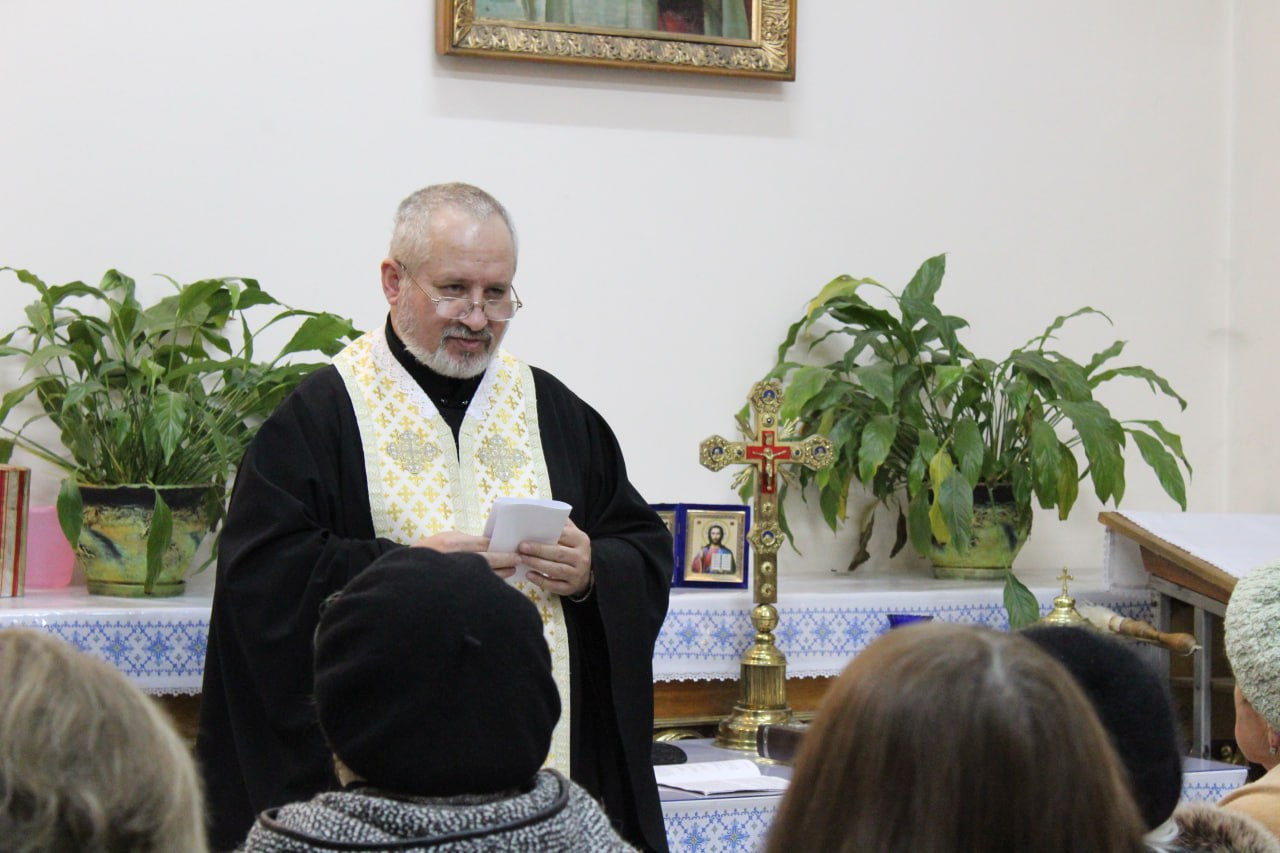
“It was clear from the beginning that they would not tolerate anything Ukrainian”, says Father Bohdan Geleta, a Ukrainian Greek Catholic priest who served in Berdyansk until his arrest in November 2022.
Geleta and another priest, Father Ivan Levitsky, are members of the Redemptorist order. They were among the few Ukrainian Greek Catholic priests to remain in the city after the Russian full-scale invasion in February 2022. Both were arrested by Russian security forces and held in detention for over a year and a half before being released in a prisoner exchange in June 2024.
A long history of repression
This case highlights a broader pattern of religious repression in Russian-occupied parts of Ukraine, where authorities have sought to subordinate religious communities to state control while marginalising or eliminating those perceived as politically disloyal.
The Ukrainian Greek Catholic Church occupies a distinct position in Ukraine’s religious landscape. It follows the Byzantine rite while maintaining communion with the Church of Rome. Historically concentrated in western Ukraine, it has long been associated with Ukrainian language, culture and national consciousness.
This bond made it a target during the Soviet era. In 1946, Soviet authorities formally banned the Church, transferred its property to the Russian Orthodox Church and imprisoned or exiled its clergy. For more than four decades, the Church survived underground, conducting secret liturgies. It emerged from illegality only after the Soviet Union collapsed.
“This memory is very important for us”, says Father Volodymyr Boreiko, provincial superior of the Redemptorists in Ukraine. “We recognise the mechanisms when they appear again”.
Today, in the occupied Ukrainian territories, as Boreiko explains, Russian authorities are re-establishing systems designed to control religious life. Occupation administrations have created “departments of religious organisations” tasked with monitoring clergy, forcing re-registration and restricting denominations outside the Moscow Patriarchate.
“The purpose is not to regulate”, says Boreiko, “but to stifle independence”.
Staying in Berdyansk
Before the invasion, the Greek Catholic parish in Berdyansk was small, serving dozens of families in a city with more than 100,000 inhabitants. After Russian forces seised the city, many residents fled. Others remained, unable or unwilling to leave.
Geleta and Levitsky chose to stay.
“We stayed because people were coming to us”, says Geleta. “Leaving would have meant abandoning them”.
They continued celebrating liturgy, distributing aid and assisting civilians fleeing from nearby Mariupol. They also provided pastoral care to Roman Catholics after their priest left the city.
Geleta says they were aware they were being watched.
“We heard stories every day”, says Geleta. “People disappeared. Homes were searched. Someone was beaten. Someone was taken away. We heard many stories of loss”.
Despite that, recalls Geleta, they tried to maintain normal parish life.
“We did not do anything political. We prayed”.
On 16 November, 2022, Russian security forces detained both priests. Geleta was arrested in the church while preparing for liturgy.
“There were no parishioners, just me in my vestments”.
Levitsky was taken earlier the same day. Both were transferred to a pretrial detention center in Berdyansk.
Months later, during interrogation, as Geleta explains, investigators accused him of possessing weapons and explosives and of participating in subversive activities against Russia. He says he was also accused of organising prayers in support of Ukraine.
“They asked me to sign documents stating weapons were found in the monastery. I told them I could not sign something I never saw”.
Geleta says that the prayer cited by investigators was a rosary prayed publicly for peace. For the priest, “even mentioning Ukraine was dangerous”.
Detention
For months, neither families nor church authorities knew where the priests were being held. Boreiko says information was inconsistent and often contradictory.
“There were moments when we did not know if they were alive”.
Geleta says detention conditions were designed to exert constant psychological pressure. In Berdyansk, his cell was located next to a torture room.
“I heard screaming every day. Sometimes for hours”.
Music was played loudly to prevent rest. Silence, recalls Geleta, was deliberately denied. Later, both priests were transferred to a detention colony in Horlivka, in the Russian-occupied part of Donetsk region.
“In Horlivka, there was physical violence”, says Geleta.
Religious activity was prohibited. “We could not celebrate liturgies. We prayed privately, and even that had to be hidden”.
Despite the risks, Geleta says other prisoners sought spiritual support.
“People wanted to confess. We had a few minutes when we were outside for short walks, and we managed to exchange words and prayers”, explains the priest.
In early 2024, the priests were transferred again, this time through Russian territory. They were flown through Moscow, briefly held in a high-security facility and then transported toward Belarus.
“We thought it was another transfer”, says Geleta. “We did not know it was an exchange”.
Only after crossing into Ukrainian-controlled territory he realised they were free. Their release in June 2024 came as part of a negotiated prisoner exchange involving Ukrainian and Russian authorities, with the mediation of several international actors, including the Holy See.
Berdyansk remains under occupation. Ukrainian churches there operate under pressure or do not operate at all. Clergy associated with Ukrainian institutions continue to face surveillance, detention and expulsion.

Father Geleta with his work group – Private archive photo
After Captivity
Since returning, Geleta has focused on practical recovery and future ministry. He has requested permission to work with former prisoners, families of missing persons and military units.
“There are many people returning from captivity. They need concrete help”, says Geleta. “This is not about priests. Thousands of civilians are still there”.
For Boreiko, the case underscores a broader reality. “If you remove the clergy, communities become easier to control. That has always been the logic”.
For Geleta, the pattern is unmistakable. “This is not only about religion. Russia persecutes faith because faith is freedom”, says the priest, adding that anything outside the Russian state control is treated as a threat.
“If you are Ukrainian, speak Ukrainian, pray in Ukrainian, or remember Ukrainian history – you are marked. They are not trying to convince you. They are trying to remove you”.