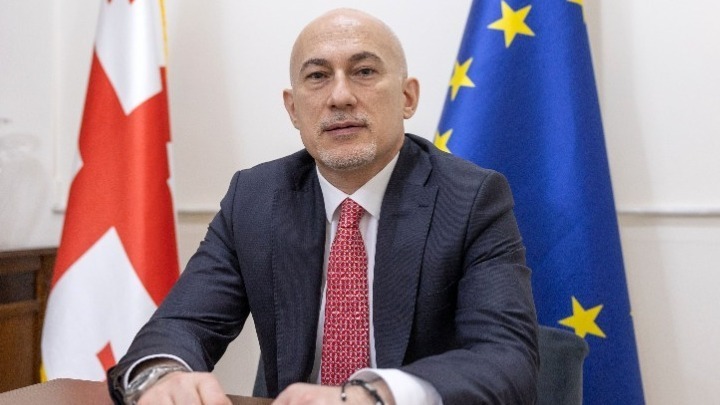
Georgia is expected to have fulfilled more than 90 percent of its obligations under the EU Association Agenda and the Deep and Comprehensive Free Trade Agreement by 2028, a development that would make the country practically ready for European Union membership, according to Gela Japaridze, Consul General of Georgia in Thessaloniki. He underlined that Greece has been a consistent and strong supporter of Georgia’s European course.
In an interview with the Athens–Macedonian News Agency (ANA-MPA), Mr. Japaridze highlighted the multi-layered relationship between Georgia and Greece, stressing that the ties between the two nations extend far beyond diplomacy and geopolitics, drawing deeply from shared history, culture, and Orthodox spirituality.
He noted that although diplomatic relations were formally established in 1992, the bonds between Georgians and Greeks date back to antiquity. He recalled the ancient Kingdom of Colchis, known from Greek mythology as the land of King Aeëtes and Medea, and described the voyage of Jason and the Argonauts as a foundational narrative linking the two peoples. He also referred to Maria of Alania, the Georgian-born Byzantine Empress of the 11th century, whom he described as one of the most influential women of her era.
Mr. Japaridze emphasized the important role played by Pontic Greeks, who settled in various regions of Georgia during the 19th and 20th centuries. He said Georgia had welcomed them as its own people and, in turn, expressed gratitude to Greece for supporting tens of thousands of migrants from Georgia during the difficult economic period of the early 1990s. He described this mutual support as a living testament to the friendship between the two nations.
Turning to present-day relations, he said that Georgia and Greece continue to walk together on a path of peace, cooperation, and mutual respect. He stressed that Greece had been among the most active supporters of Georgia’s EU candidacy, which was officially granted on December 14, 2023. He added that cooperation also extends to regional security issues, parliamentary diplomacy, and multilateral forums.
Special reference was made to cultural and educational cooperation. Mr. Japaridze said that a bilateral cultural agreement signed in 2021 had opened the way for joint archaeological projects, monument restoration, and collaboration between orchestras and music schools. He also highlighted the active Georgian diaspora in Greece, with cultural centers, libraries, Sunday schools, and traditional dance and music groups serving as living bridges between the two societies.
At the heart of the relationship, he stressed, lies the shared Orthodox faith. He said that the friendly and longstanding ties between the Orthodox Churches of Georgia and Greece contribute significantly to the closeness of the two peoples. He noted the great respect shown by the Church of Greece toward Catholicos-Patriarch Ilia II of Georgia, and pointed out that exchanges of high-ranking clergy are frequent, including visits to Greece and Mount Athos.
Mr. Japaridze described Mount Athos as playing a particularly crucial role in deepening the spiritual and historical bonds between Georgia and Greece. He recalled that as early as 965, Saint John the Iberian arrived on the Holy Mountain with his son Ekvtime and other disciples, leading to the founding of the Monastery of Iviron. He said the monastery became, for centuries, a center of Georgian spirituality, culture, and manuscript preservation. He expressed gratitude to the current abbot and brotherhood for safeguarding Georgia’s spiritual heritage within the monastery.
He also referred to the historical figure of Tornike Eristavi, a Georgian general who became a monk on Mount Athos and lived at the Great Lavra of Saint Athanasius. According to Mr. Japaridze, Tornike played a decisive role in suppressing a major rebellion against the Byzantine throne in 979, an act that further strengthened Georgian–Byzantine relations.
Also, he highlighted Saint George Karslidis, born in Georgia and buried in northern Greece, who was canonized by the Church of Greece in 2008. He said the saint’s tomb attracts thousands of Georgian pilgrims every year and symbolizes the enduring unity of faith between the two nations.
Mr. Japaridze underlined that history, culture, and especially shared spirituality continue to function as a powerful bridge of friendship between Georgia and Greece, with Mount Athos standing as one of the most enduring symbols of this centuries-old bond.
Source: ANA-MPA, Translated by: Konstantinos Menyktas