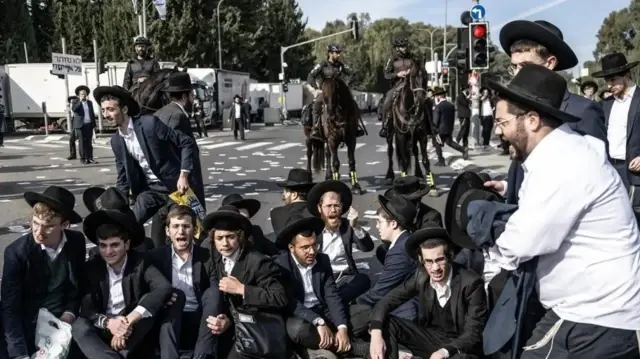
Ultra-Orthodox Jewish protesters, known as Haredim, blocked a key highway near Tel Aviv on Monday evening in a dramatic demonstration against Israel’s mandatory military draft. The protest, which disrupted traffic on Highway 4, was triggered by the arrest of a young Haredi man for evading conscription, according to Israeli media reports that described a chaotic scene where protesters overturned a police vehicle.
A Deep-Rooted Exemption Under Mounting Pressure
The protest underscores one of Israel’s most contentious and enduring domestic conflicts: the exemption of most ultra-Orthodox men from compulsory military service. For decades, Haredi men have received automatic deferments to study in religious seminaries (yeshivas) until they reach the official exemption age, currently 26. This long-standing arrangement, rooted in political agreements, has allowed the community to maintain its insular identity, built around full-time Torah study. However, with Israel engaged in a prolonged, manpower-intensive war and facing a supreme court order to draft Haredim, this status quo is under unprecedented pressure.
Religious Identity Versus National Service
The Haredi community, which comprises roughly 13% of Israel’s population, argues that military service poses an existential threat to its religious traditions and communal structure. Prominent rabbis have urged their followers to reject the draft entirely, with some instructing them to “tear up enlistment orders.” The community’s leadership maintains that the preservation of Torah scholarship is a supreme national value that justifies the exemption. This clash pits the secular principle of universal civic duty against the Haredi worldview that prioritizes religious study as their primary contribution to the Jewish state.
A Broader Political and Social Crisis
Monday’s highway blockade is a flashpoint in a much larger societal crisis. The government’s recent efforts to pass a new conscription law that would gradually increase Haredi enlistment have met with fierce resistance, both from the ultra-Orthodox political parties and from within the community itself. The incident reflects the growing anger and mobilization among Haredim who see state coercion as an attack on their way of life. As Israel’s war effort continues to strain its military and economy, this fundamental debate over equality, religion, and state is reaching a boiling point, with protests like these signaling potential for further civil strife.