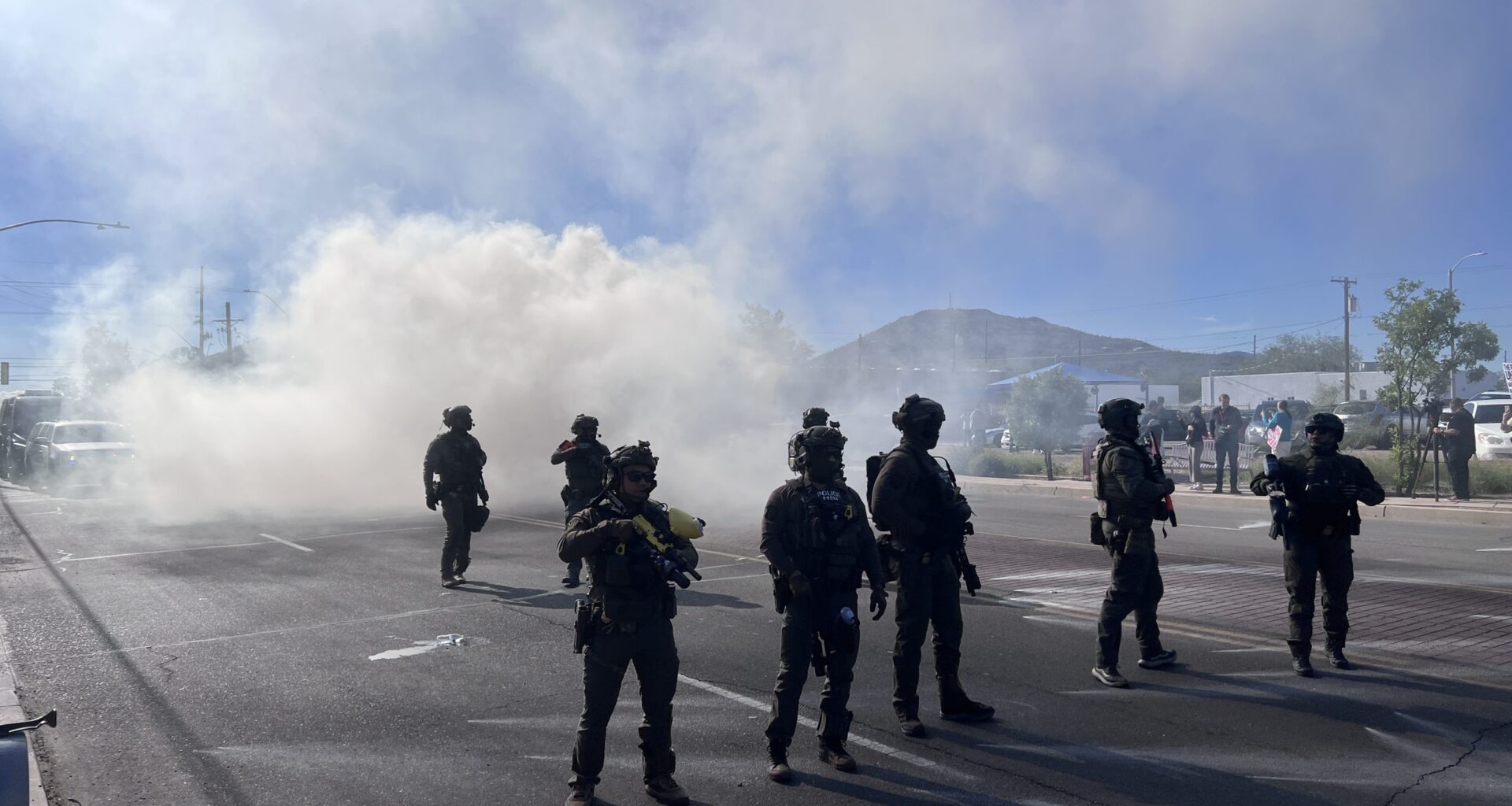
When federal officers pepper sprayed protesters, including Democratic Rep. Adelita Grijalva, after an immigration raid at a west-side Tucson restaurant, it echoed months of similar scenes in Chicago, Los Angeles and other communities.
The incident raised urgent questions for Tucson residents: How can people stay safe during protests? What rights do they have if arrested? And how can communities respond when immigration enforcement escalates?
This guide offers a starting place for Southern Arizona residents navigating those questions, drawing on advice from street medics, immigration attorneys and local rapid-response groups..
If you’re at a protest
As well as the right to protest, people present at a demonstration have the right to record and document any incident in plain view in a public space. On private property, an owner may set rules related to photography and video.
Strong digital security is key in general, and in particular for protesters who may have their phones taken by law enforcement if arrested. The Electronic Frontier Foundation has a digital security guide for anyone attending a protest.
If a protest escalates and chemicals are used, Tucson street medic Isabel Schwartz, a licensed EMT who volunteers with a local mutual aid group, recommends the following safety supplies with a goal to minimize skin contact with pepper spray or tear gas:
Goggles
Face covering (mask is ideal, wet bandana will work)
Long sleeves and pants
Neck bandana
Hat
What helps after exposure:
Saline or eye wash is better than water for eyes
Dawn dish soap or baby soap
Baby wipes
Baking soda and water for tear gas
Another key element for anyone who has been pepper sprayed is, after treating the immediate need, to leave the area to minimize the amount of pepper spray in the air.
When home, street medics suggest showering in this order: washing your body with de-greasing soap and while wearing a shower cap, then washing your hair in the sink or horizontally while kneeling to minimize additional pepper spray residue on your face.
If you are arrested
River Feldmann, a local movement lawyer who shared legal information regarding protest and arrest safety with Arizona Luminaria, noted that while non-citizens generally have the same constitutional rights to free speech as citizens on paper for political speech, that can look different in practice. Attorneys say that for non-citizens, deciding whether and how to engage in physical protest or political speech requires a personal risk assessment and carries heightened risk of retaliation in the current climate.
During an arrest you have the right to ask if you are free to leave, and ask an arresting officer why you are being arrested.
Beyond that, attorneys say it is important to remember the following rights: the right to remain silent to minimize what you say being used against you in a legal case. You must explicitly and clearly invoke the Fifth Amendment right against self-incrimination; simply remaining silent isn’t enough and can be used against you in court. You can say: “I choose to remain silent and would like to speak to a lawyer.”
You also have the right to: state your U.S. citizenship, not sign any documents without legal advice, and the right to refuse warrantless searches or those that do not appear to have probable cause. Again, those who want to invoke the latter should explicitly state as much. You can say: “I do not consent to this search.”
After an arrest, you should have a right to a phone call. If you are speaking to a lawyer, authorities are not allowed to listen. Any other phone call could be recorded and shared with prosecutors.
Attorneys suggest not discussing any specific facts of ongoing cases in settings where you may be overheard, including with friends, family or other community members.
If you are arrested and facing a state or federal criminal proceeding and can prove that you can’t afford an attorney, you have the right to a public defender, which is a free government-appointed lawyer. You can also hire a private defense attorney. The financial bar is low and most people do qualify for free counsel, said Feldmann.
Public defenders will also be automatically present at your first appearance in front of a judge post-arrest — your bond will likely be set at this first appearance if you are still in jail. This initial appearance typically happens within 24 to 48 hours from the arrest.
If you want to support others
At a time of concern over how immigrant communities will be impacted by increased enforcement, people working on the ground say staying connected to networks that share information and support community members is key.
A group called Tucson Community Rapid Response runs a hotline that will send rapid response observers to the location of an immigration enforcement action. The red card shared by the group includes a list of their rights in both Spanish and English that can be stated or given to officers.
Their number, which can be called in the case of an immigration visit or sighting, is 520-221-4077.
Here are a few of the groups working on immigration issues in the region:
Longtime immigrant rights organization Derechos Humanos has continued to organize in this moment, and meets weekly as well as sustains a range of working groups who target particular support for immigrant communities. Learn more here.
An organization called Pima Resists ICE (PRICE) is organizing against an immigration detention facility in Marana. You can follow their work here.
The Party for Socialism and Liberation has been door-knocking in heavily immigrant communities to share know-your-rights information.
For people who have an appointment in immigration court, Tucson Accompaniment Group will attend court as a source of support and witness. TAG is a group of community members supporting immigrants in immigration court. Your family can go with you, or you can have a trained community member attend court with you for support,” they say. “They can help observe what happens and take notes.” To request accompaniment in immigration court, call the Rapid Response Hotline, 520-221-4077.
Contact reporter Yana Kunichoff at ykunichoff@azluminaria.org to suggest additions to the resource list.
Related
Republish This Story
