
①Starlink, the satellite internet business under Elon Musk, announced that its global number of active users has surpassed 9 million;
②Notably, the time required to achieve each new milestone in user growth continues to shorten, with the latest 1 million users added in just 47 days. ③Musk remarked on the difficulty of this achievement but also emphasized that the next phase of significant growth is imminent.
Several hours ago, Starlink, the satellite internet business of tech billionaire Elon Musk, announced that its number of active users worldwide has surpassed the 9 million mark.

 (Source: X)
Compared to the figure of 9 million itself, the growth rate of the user base is the more critical piece of information.
According to statistics from previous posts by Starlink, the company announced on November 5 that the number of active users had exceeded 8 million. This followed the milestone of surpassing 7 million users on August 28. The 6 million mark was reached on June 9, and 5 million users were achieved on the last day of February this year. Prior to that, surpassing 4 million users occurred as far back as the end of September last year.
Sawyer Merritt, a well-known Tesla investor and Musk enthusiast, shared statistics showing that it took Starlink a full 730 days to reach the first 1 million users. The second and third million both took about half a year (274 days and 240 days, respectively), but by this year, the pace of user growth began to accelerate significantly, with the latest 1 million increase taking only 47 days.

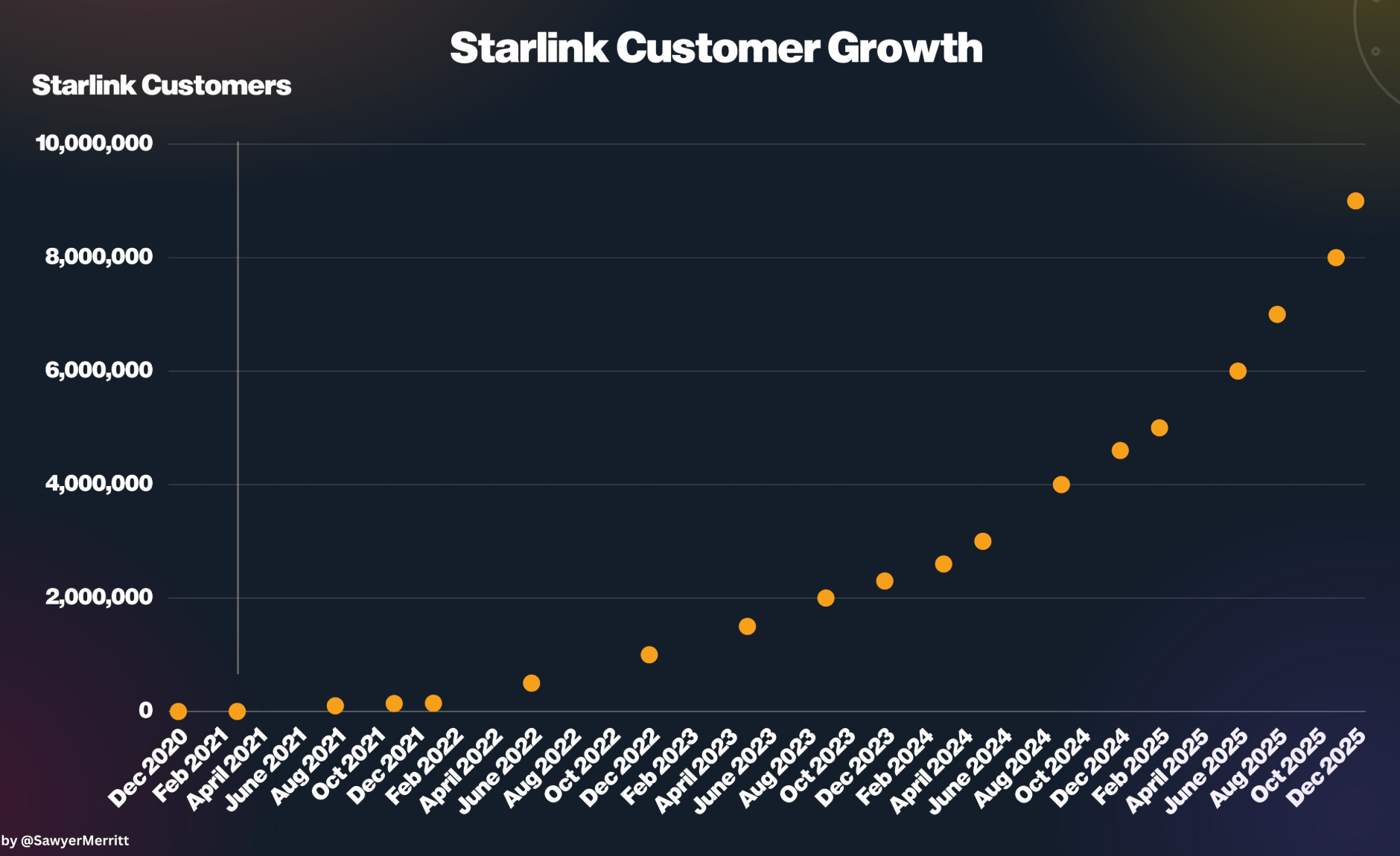
(Source: Sawyer Merritt)
At this growth rate, Starlink could celebrate surpassing 10 million users as early as the end of January next year.
The steep rise in the trajectory of business expansion also signifies that Musk’s highly anticipated satellite internet service has achieved a commercial closed loop and is beginning to reap the benefits of scale. Meanwhile, there remains no competitor on Earth capable of threatening its market position. In October this year, SpaceX announced the successful deployment of the 10,000th Starlink satellite in low Earth orbit. Accounting for attrition, approximately 9,300 satellites are currently operational in orbit.
In light of these developments, Musk praised the Starlink team for their excellent work and remarked that ‘rebuilding the entire internet in space is not easy.’

Musk also responded to Merritt, stating that once the giant carrier rocket ‘Starship’ and the next-generation Starlink satellites (Starlink V3) are deployed, this business will experience another major leap forward.
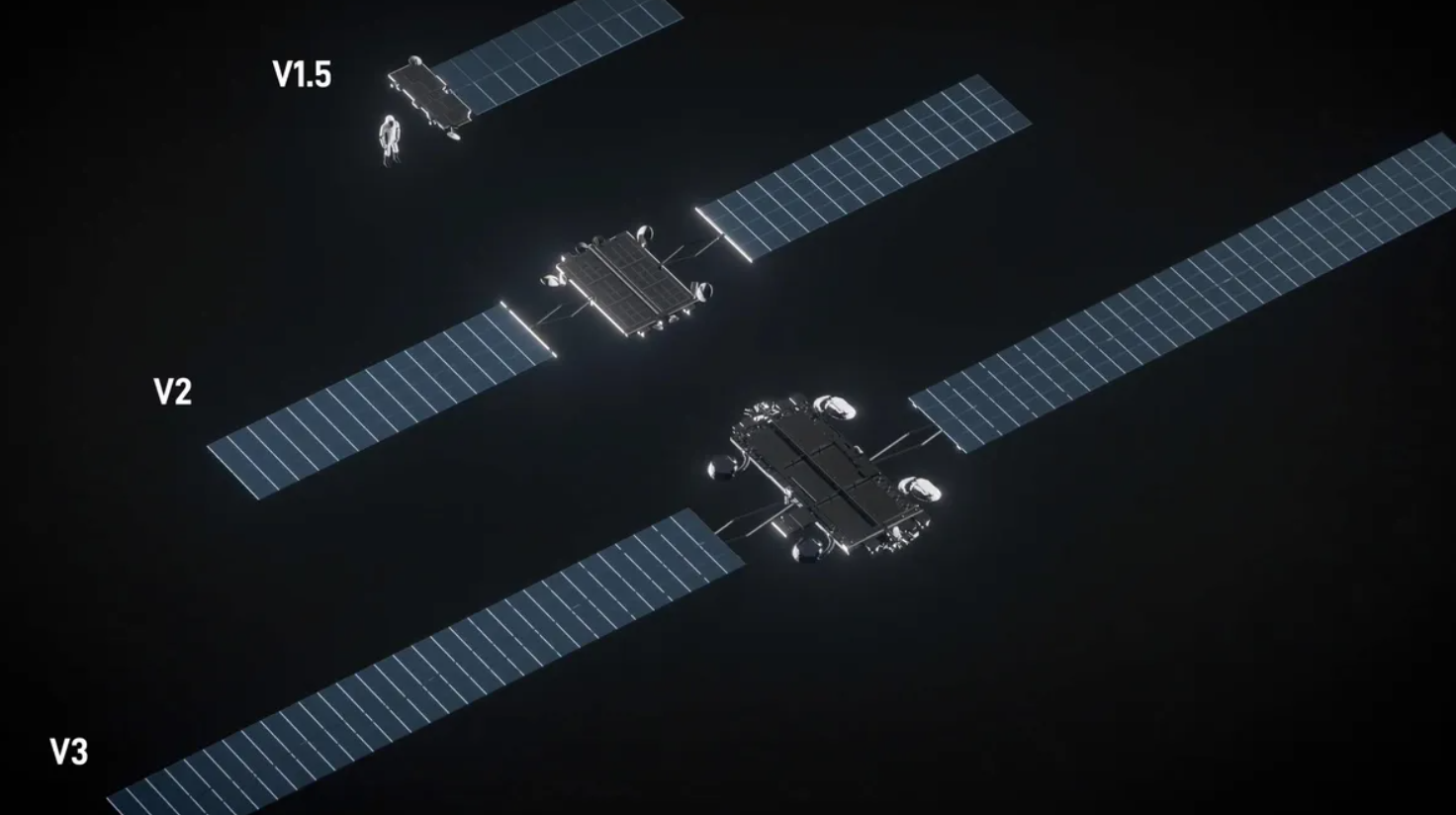
(Illustration of Starlink V3 satellite, source: SpaceX)
Earlier this month, when Musk discussed the concept of a ‘space data center,’ he also mentioned that Starlink V3 might see large-scale deployment by the fourth quarter of next year. However, as is well known, Musk’s timelines often change, and it is also possible that the company might experimentally deploy some of the new satellites earlier in the year.
SpaceX has stated that the goal for the next-generation satellites is to provide gigabit-level satellite internet connection speeds. Currently, the speed of ‘Starlink’ connections ranges from approximately 100Mbps to 300Mbps.
Of course, this plan also faces competition from the vision of an ‘AI space data center.’ Musk noted that converting the V3 satellites into units equipped with AI GPUs and capable of receiving up to 150 kilowatts of solar power would not be difficult for SpaceX; in fact, it might even be simpler than merely developing the V3 satellites.
Editor/melody