By Masood Abdali
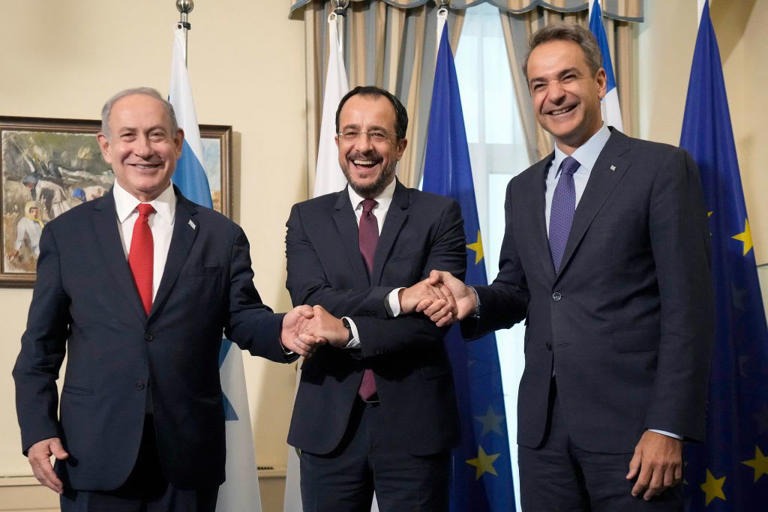
HOUSTON(USA): Against the backdrop of Turkey’s regional role and military presence in the Eastern Mediterranean, the leaders of Israel, Greece, and (Greek) Cyprus held a trilateral meeting in Jerusalem on December 22. On this occasion, Israeli Prime Minister Benjamin Netanyahu, clearly alluding to Turkey, remarked: “Those who dream of reviving past empires should put such notions out of their minds.” While framed as a historical reference, the statement was an unmistakable signal aimed at President Recep Tayyip Erdoğan and claims associated with the Ottoman legacy.
The Israeli prime minister’s speech made it evident that the trilateral meeting was not merely a diplomatic encounter but an announcement of a new alignment in the Eastern Mediterranean. The reference to “dreams of reviving empires” was a direct message to Turkey, which Israel now appears to view not only through the lens of Gaza or Palestine, but increasingly as an emerging regional rival. Netanyahu’s remarks suggested that this gathering went beyond diplomacy and marked the beginning of a new military and strategic configuration in the region.
Invoking the Ottoman Empire and turning history into a political weapon is an easy but misleading tactic. The reality is that the current tensions in the Eastern Mediterranean are not the result of any dream of restoring an empire, but rather stem from colonial legacies, disputed maritime boundaries, energy resources, and the proxy politics of global powers. Gas fields, maritime zones, and sea routes constitute today’s real battlegrounds—not the revival of a caliphate or an empire.
In this context, Greece’s role is particularly significant. Historically, Greece has supported the Palestinian liberation movement, and in recent months large-scale protests against the ongoing genocide in Gaza have been witnessed in Greek cities. This contradiction highlights the fact that public conscience and state policy often do not move in the same direction. Governments form alignments based on strategic interests, even when public opinion runs counter to those choices.
For Israel, the core concern is Turkey’s moral and diplomatic presence, which challenges Israel’s narrative of dominance over the Gaza blockade, civilian casualties, and control of Mediterranean gas resources. In response to this challenge, new military partnerships are being forged under the banners of defence, maritime security, and energy cooperation.
By stoking fears of a resurgent Ottoman Empire, Israel seeks to create an environment in which Turkey—after Gaza, Lebanon, Syria, and Iran—can also be portrayed as a “potential enemy.” In this way, the trilateral meeting appears less about regional cooperation or sustainable peace, and more as a continuation of a strategy rooted in permanent confrontation and militarization.
By entangling a region already scorched by the flames of prejudice and racism in debates over the return or collapse of empires, Netanyahu is pushing the Eastern Mediterranean toward a new confrontation—one whose cost will ultimately be borne by ordinary people.