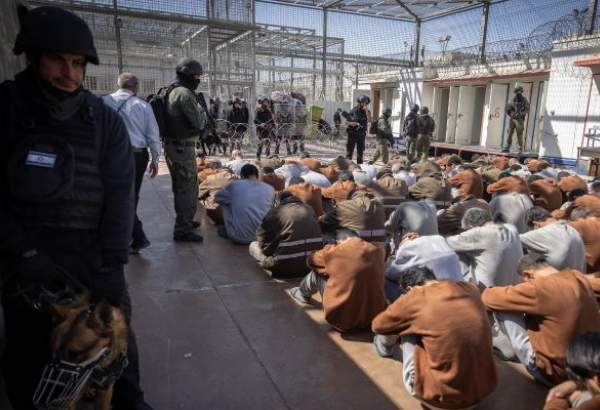
Israel’s National Security Minister Itamar Ben-Gvir has reportedly suggested establishing a detention center for Palestinian prisoners that would be surrounded by crocodiles as a deterrent against escape attempts.
According to Channel 13, the idea was raised during a recent briefing with the head of the Israel Prison Service, Kobi Yaakobi, and is currently being reviewed.
The proposal surfaces as the Knesset prepares to vote on Ben-Gvir’s proposed legislation to impose the death penalty on Palestinians accused of involvement in attacks on Israel.
Human rights groups report that Israel currently holds more than 9,300 Palestinian prisoners, including minors and women, amid allegations of severe abuse and worsening detention conditions.
Palestinian prisoners in Israel already face horrific conditions, with a rights group documenting the deaths of at least 94 of them in the past two years, and the rape of prisoners caught on camera.
The far-right minister has proudly declared that conditions have gotten harsher for Palestinian prisoners under his watch. And in late October, he stood over Palestinian prisoners forced to lie face-down on the floor as he called for the death penalty to be introduced for those he termed Palestinian “terrorists”.

In early November, the Israeli parliament passed the first reading of a bill that would introduce the death penalty for those convicted of killing Israelis if they had, what it calls as “racist” motives.
The bill clearly targets Palestinians, even as Israelis carry out deadly attacks against Palestinians in the occupied West Bank, and Israel continues its killing of Palestinians in Gaza.
The reaction has been stark among Palestinians. What they hear is not just another legislative measure, but a signal that Israel is planning to formalize a system of lethal punishment.
“This law practically aims to execute prisoners simply for their struggle for their people’s freedom and their right to self-determination,” said Farid al-Atrash, the director of the Independent Commission for Human Rights in the occupied West Bank.
Alarm is widespread among Palestinian lawyers and activists. They claim that the law fundamentally undermines judicial safeguards, and warn that it seeks to erase the status of Palestinian detainees as protected under international law.
Under the draft legislation, Israeli courts – both civil and military – would gain expanded power to impose mandatory death sentences on Palestinians convicted of killing Israelis, when such acts are deemed to have been motivated by nationalistic, racist or hate-based reasons, or intended to harm the Israeli regime or settlers.
It would also remove the authority for a government or president to pardon anyone who has been sentenced to death for those crimes, and it does not require a panel of judges in a given case to reach a unanimous decision on the sentence.
Palestinian advocates warn that the framework eliminates the safeguards that previously existed for Palestinian defendants.
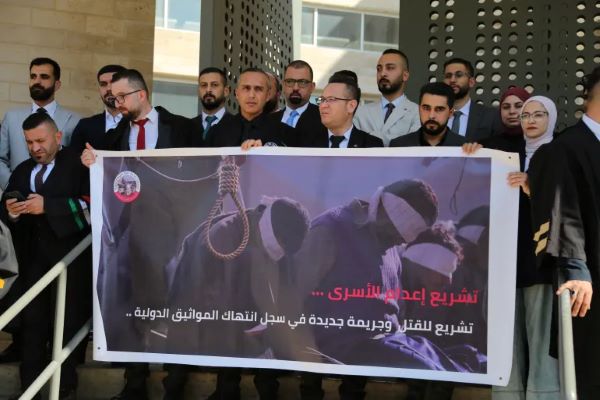
Al-Atrash placed the proposed law in stark contrast to the treatment of Israelis in cases dealing with violence against Palestinians, in which they are often acquitted.
Critics say that the move to legalese the death penalty is part of a broader effort to strip Palestinians of their protections under international humanitarian law as an occupied people with a right to resistance.
“The Knesset dominated by the far-right, is working to turn killing into official legislation,” said Hassan Breijieh, who is the head of the Bethlehem office of the Wall and Settlements Resistance Commission. “[The proposed law] is an attempt to erase international recognition of the Palestinian fighter … and turn him into a criminal defendant.”
Amjad al-Najjar, of the Palestinian Prisoners’ Club, agreed that the proposed law was an effort to take away the rights of the Palestinian people.
“It is a double crime. It is a racist law targeting Palestinians, specifically, and also a clear violation of international law,” said al-Najjar.
Saeed al-Awiwi, a Palestinian lawyer and former judge, framed the proposed law as the latest clampdown on Palestinian legal rights.
Al-Awiwi noted that even previously permissible access to detainees in Israeli prisons has been revoked, leaving many prisoners with no meaningful legal representation, especially inside military courts.
He argued that, even before the bill, many Palestinians died inside prisoners without trial, sentencing, or any due process. If the death penalty becomes codified, the actions that caused those deaths – torture, medical neglect, and arbitrary detention – will gain official standing.
“The move towards legal execution legalizes actions already practiced by the [Israeli] occupation, but without accountability,” al-Awiwi said.
Israel’s National Security Committee claims that “its purpose is to cut off terrorism at its root and create a heavy deterrent”.
But human rights organizations such as Amnesty International have condemned the bill as a form of institutionalized discrimination targeting Palestinians.
Under the Geneva Conventions and international humanitarian law, the execution of prisoners of war or protected persons – including those under occupation – is prohibited. The proposed law would contravene that rule.
Experts said that it was part of a wider shift, from a system in which death – through torture, neglect, or violence – was an extrajudicial byproduct of occupation, to a system where death becomes a lawful sentence.
“When the occupation criminalizes the act of resistance, it is not only prosecuting the prisoner, but prosecuting the very idea of freedom itself,” said Breijieh.
For Palestinians, the bill is therefore more than just a piece of legislation, but a benchmark in how occupied people are treated, and whether existing norms of international humanitarian law survive or collapse.
“The law means the collapse of the international system,” said al-Najjar. “The occupation has no legal, moral, or political right to issue death sentences against an occupied people.”
https://taghribnews.com/vdcf1mdetw6dx0a.r7iw.html
taghribnews.com/vdcf1mdetw6dx0a.r7iw.html