Most of you a’re not strong enough to do it though
It is legal in English, too, just not as productive: The word “council meeting” is technically a compound, people get confused by the fact it has a space in between, but that’s just writing convention (in German that would be “Kommunalversammlung”)
People are just jealous because its easy and makes total sense
Words are funny because linguistically they don’t exist. There is no consensus on what the definition of a word is.
The English do it too, they just pretend they don’t so they can keep their self imagined illusion alive that they’re somehow not historically and culturally linked to the continent
Tbh, I’ve always admire the capacity of English language to make adjectives out of onomatopoeias.
Actually we do often have a separate word for it but yes. Compound words are a thing in many languages. We just use them more often to cut down on descriptions and lengthy workarounds. While you use lots of „of“ „the“ „on“ „for“ etc…
For example you would say „the hat for the captain of the ship that fairs on Rhein-Main-Donau channel with his dream boat“ we‘d simply say Rhein-Main-Donaudampfschiffahrtskapitänsmütze and that’s beautiful.
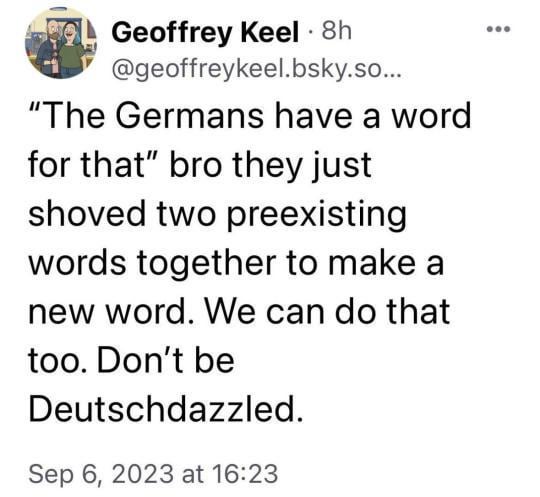
Wouldn’t that be “deutsch dazzled”?
That “grief-bacon” word is pretty great though.
The secret is to always have a word for everything.
In Greek you don’t need to ask permission to compound words, you can just do it and it’s correct. It’s impossible to list Greek compound words as the combos are limitless.
#Substantivverbundneiddebatte
But call it a preposition (pre position), and it’s fine?
Brits:
“Yeah I absolutely have no idea what this box with moving picture from afar is, let’s steal the word ‘television’ from Greek and be done with it.”
Germans:
“Far-see-er”
*
Start to speak Old English again. Sounds way cooler than modern English and it used to have a lot of compound words as well.
ǣfentīd = evening time = evening
ǣtġiefa = food giver = provider
dæġweorc = day work
ēastende = east end, eastern part
flōdweġ = sea way
folcland = folk land = country
Sure, one-trick-pony, but the audience is still dazzled all the time, so…
>[Compound word, Greek]
>Aww you’re sweet
>[Compound word, German]
>Hello, human resources?
Though the English are missing one of the most important and versatile words ever: Doch!
It still baffles me how a language can exist without this.
[removed]
Just put “de, da, do” between both words, make it easy
Europeans will put “…tschd…” in a word like sorry sir I do not speak the black tongue
28 comments
Be Deutschdazzled and respect the superiority of a modular language.
We do the same thing, it is an amazing feature. English technically has it too, but they decided to stop doing it in most cases for some reason.
Pretty sure the Brits, in all their incomprehensible ‘wisdom’, just took apart a bunch of perfectly functional compound words.
Take it easy. We can remove spaces between words too, carajaula!
We can do better, like Deutchcockguzzler
The English do that too it’s just more rare. Don’t blame us because you suck at the game.
Let’s talk about the economics, but in German.
https://www.reddit.com/r/funny/comments/6c2n0n/the_german_language/
Most of you a’re not strong enough to do it though
It is legal in English, too, just not as productive: The word “council meeting” is technically a compound, people get confused by the fact it has a space in between, but that’s just writing convention (in German that would be “Kommunalversammlung”)
People are just jealous because its easy and makes total sense
Words are funny because linguistically they don’t exist. There is no consensus on what the definition of a word is.
The English do it too, they just pretend they don’t so they can keep their self imagined illusion alive that they’re somehow not historically and culturally linked to the continent
Tbh, I’ve always admire the capacity of English language to make adjectives out of onomatopoeias.
Actually we do often have a separate word for it but yes. Compound words are a thing in many languages. We just use them more often to cut down on descriptions and lengthy workarounds. While you use lots of „of“ „the“ „on“ „for“ etc…
For example you would say „the hat for the captain of the ship that fairs on Rhein-Main-Donau channel with his dream boat“ we‘d simply say Rhein-Main-Donaudampfschiffahrtskapitänsmütze and that’s beautiful.
Wouldn’t that be “deutsch dazzled”?
That “grief-bacon” word is pretty great though.
The secret is to always have a word for everything.
In Greek you don’t need to ask permission to compound words, you can just do it and it’s correct. It’s impossible to list Greek compound words as the combos are limitless.
#Substantivverbundneiddebatte
But call it a preposition (pre position), and it’s fine?
Brits:
“Yeah I absolutely have no idea what this box with moving picture from afar is, let’s steal the word ‘television’ from Greek and be done with it.”
Germans:
“Far-see-er”
*
Start to speak Old English again. Sounds way cooler than modern English and it used to have a lot of compound words as well.
ǣfentīd = evening time = evening
ǣtġiefa = food giver = provider
dæġweorc = day work
ēastende = east end, eastern part
flōdweġ = sea way
folcland = folk land = country
Sure, one-trick-pony, but the audience is still dazzled all the time, so…
>[Compound word, Greek]
>Aww you’re sweet
>[Compound word, German]
>Hello, human resources?
Though the English are missing one of the most important and versatile words ever: Doch!
It still baffles me how a language can exist without this.
[removed]
Just put “de, da, do” between both words, make it easy
Europeans will put “…tschd…” in a word like sorry sir I do not speak the black tongue
Comments are closed.