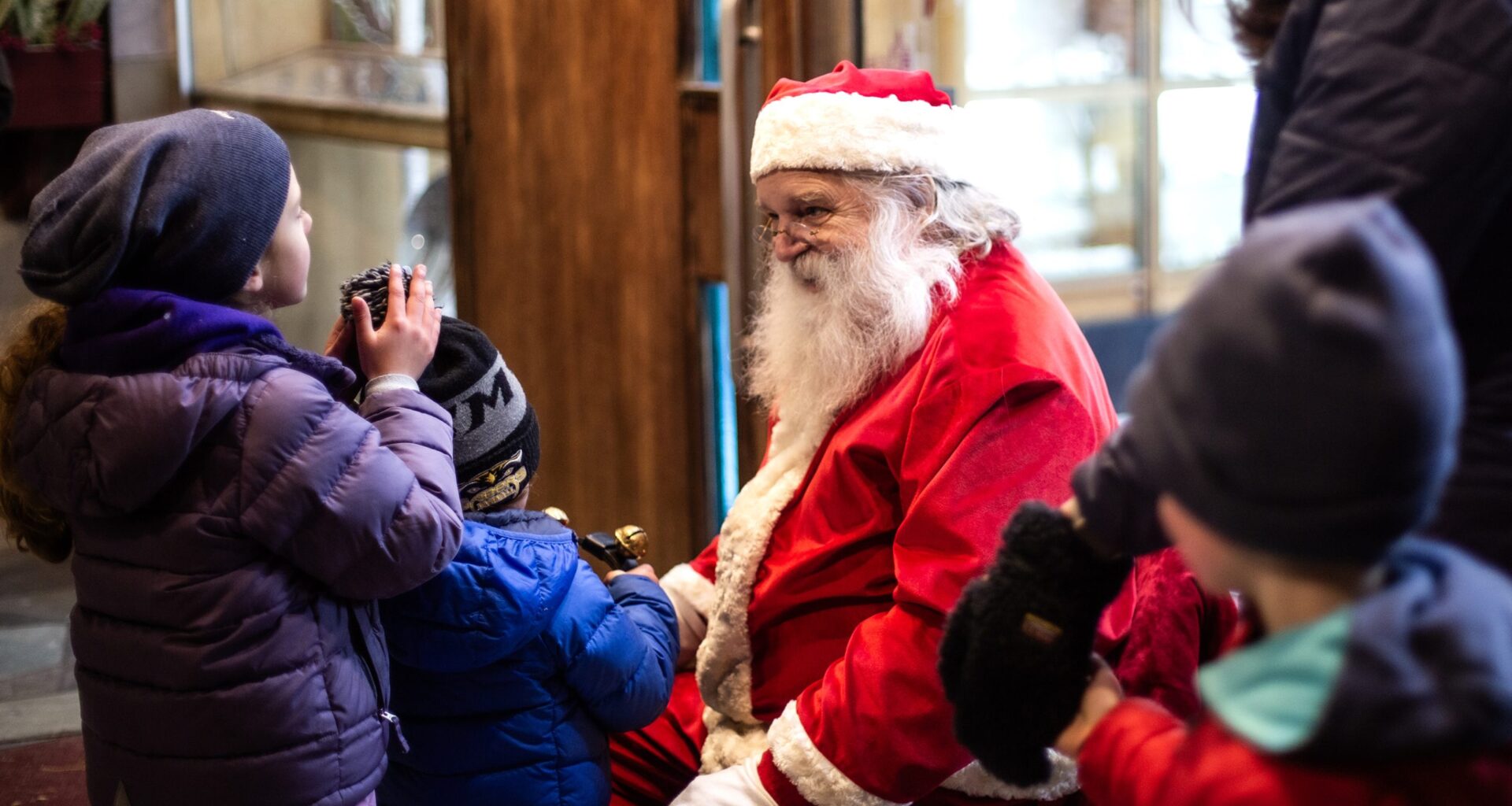
Santa Claus has spent centuries building a global data collection, logistics and distribution network, so you know he’s not shy about making use of the latest technologies. I assume he’s got a whole elfish department fiddling with A.I. to see if it can make his once-a-year operation more efficient.
I’m an A.I. skeptic but I think it could help solve his biggest problem: planning a route.
Visiting a billion or so homes in a single night is a challenge. It’s a moral challenge (how are we to say what is naughty and what is nice?) and a physical challenge (I’ve estimated that Kris Kringle’s sled has to travel 15 billion miles going 95% the speed of light, led by Rudolph the Red-Shift Reindeer) but it’s also a mathematical challenge.
Deciding the best route to travel in order to hit every house but minimize total distance is the Traveling Salesman Problem of mathematics fame. Actually, it’s more than that: It is Traveling Salesman With Time Constraints, since the sleigh has to finish up each area before darkness moves away as night travels around the spinning globe.
Wheeler Ruml, a professor of computer science at UNH, explained to me a while back that mathematics has proved there’s no general solution to TSWTC, if I may call it that, but we can tackle it.
“Finding a provably optimal solution to a problem of Santa’s size is beyond our capabilities. But there are families of algorithms called approximation algorithms that will let you get a solution guaranteed to be close to the optimal solution,” he told me.
In other words, Santa could feed a couple billion GPS coordinates through approximation algorithms within his Binary Logarithmic Internet-Tracked Zoomorphic Electronic Numbercruncher (BLITZEN), and it would print out a route that is good enough even if not perfect.
That’s what I wrote in 2017. BLITZEN was a stretch then but maybe not so much now, because this is just the sort of work that the technologies misleadingly known as “artificial intelligence” can do: perform sophisticated and very fast pattern matching on huge datasets.
It’s not implausible that elves have been pulled off the analog-toy assembly line — who wants a spinning top these days, anyway? — to be taught Python, R and C++ before starting to build BLITZEN-GPT.
Maybe Santa can go further, and can stick some A.I. inside one of those Boston Scientific dog-like robots and have it whip down each chimney, carrying presents, so he can relax in the sleigh.
Of course, this is all a joke. Santa Claus is wise and kind; he knows that matters in gifts is the effort, not the object. Using A.I. to make it easy to give Christmas presents would be as counter-productive as using A.I. to do your homework and nobody would be silly enough to do that.
So in the name of holiday cheer, let me just say (inserts poorly worded prompt into ChatGP5.0, reads result) “Merry Happy Christmas and may your heart grow three sizes.”