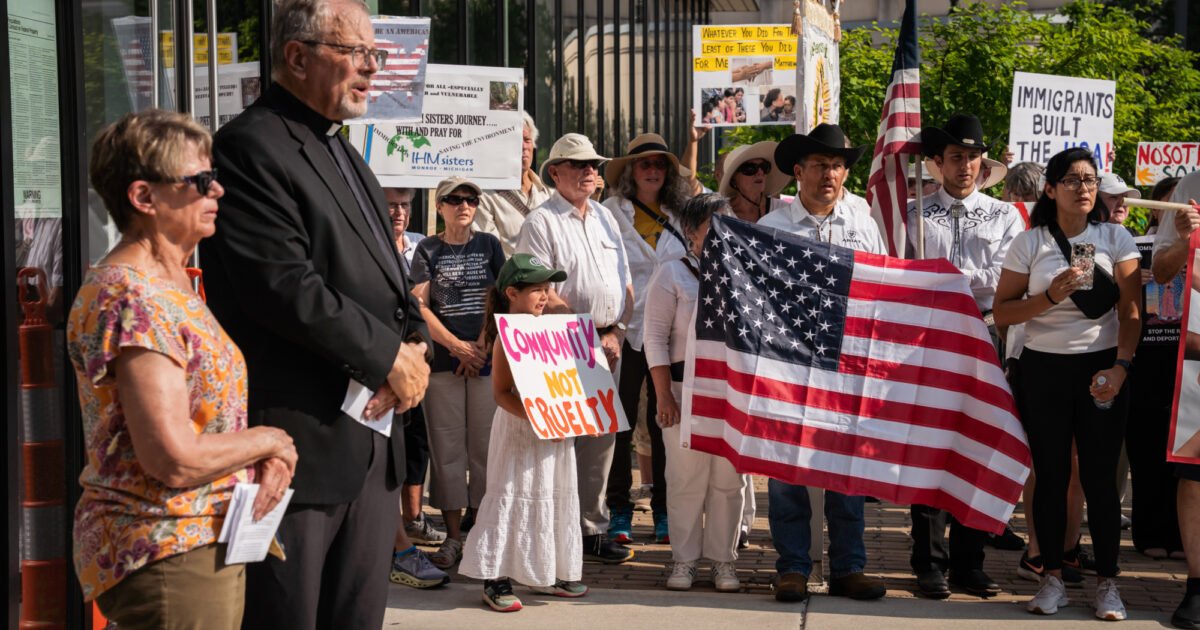
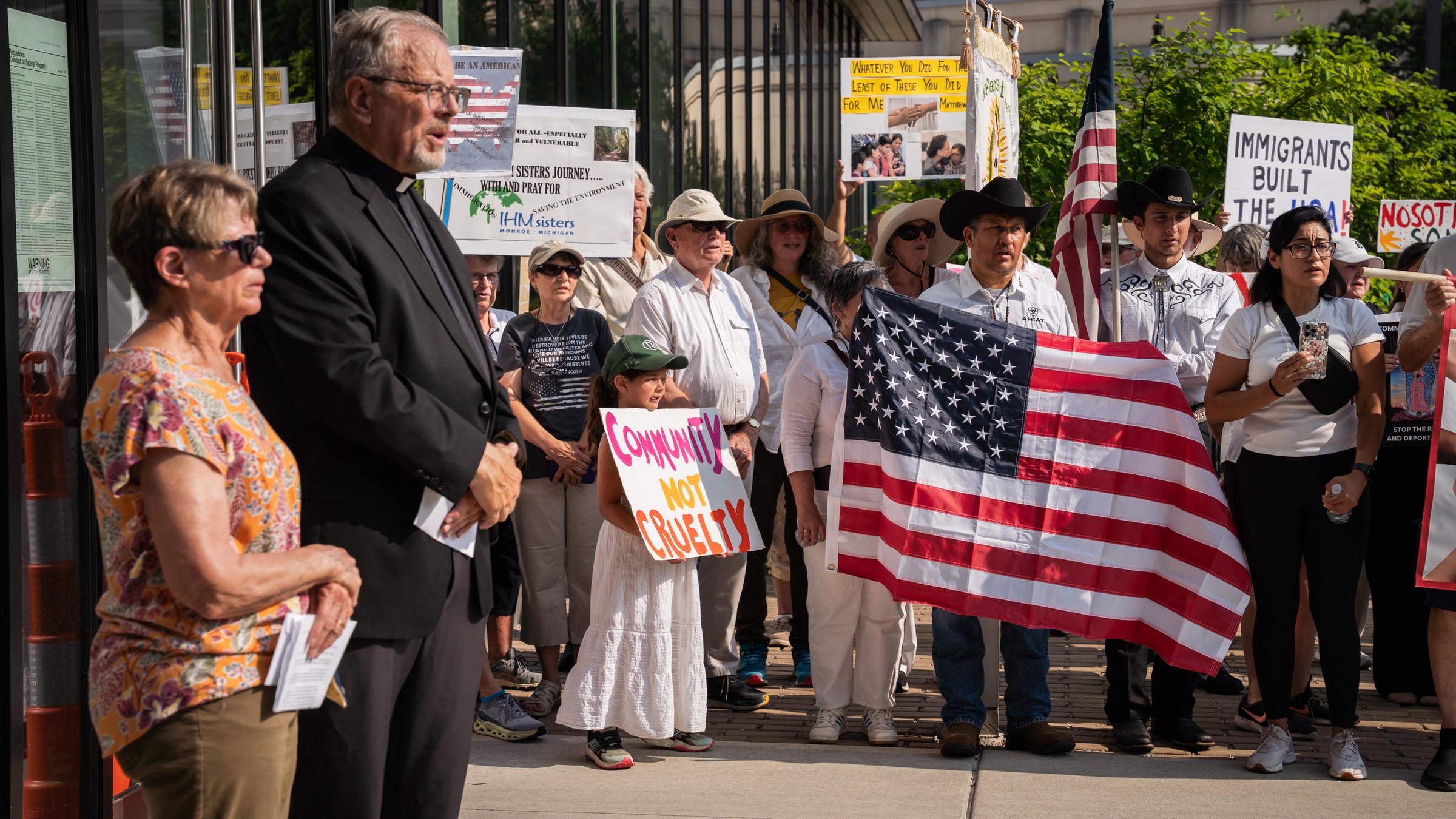
Fr. David Buersmeyer, chaplain of the Detroit-based Strangers No Longer, a grassroots organization supporting and advocating for immigrants’ rights, and Judith Brooks, Strangers No Longer president, address nearly 250 people of various faiths who took part in a solemn procession July 14 to the U.S. Immigration and Customs Enforcement’s Detroit Regional Office. In November, the United States Conference of Catholic Bishops’ Subcommittee on the Catholic Campaign for Human Development approved a grant to Strangers No Longer to help the organization expand its footprint to the Saginaw, Grand Rapids and Gaylord dioceses. (Photo by Valaurian Waller | Detroit Catholic)
$50K grant from Catholic Campaign for Human Development to help group expand its work in Saginaw, Grand Rapids, Gaylord
DETROIT — Strangers No Longer, a Catholic immigrant rights advocacy group based in Detroit, is set to receive a $50,000 grant from the United States Conference of Catholic Bishops to take its mission statewide.
During the conference’s November meeting, the U.S. bishops’ Subcommittee on the Catholic Campaign for Human Development (CCHD) approved a grant that will help Strangers No Longer expand its footprint to the Saginaw, Grand Rapids and Gaylord dioceses.
Strangers No Longer began in Detroit in 2017, forming what it calls “Circles of Support” to accompany immigrant communities and provide advocacy and education in Catholic parishes and schools.
Over nine years, the group has formed dozens of Circles of Support in Catholic parishes and high schools in the Archdiocese of Detroit, sent advocacy groups to Lansing to lobby on immigration issues, conducted immersion trips for high school students, and created awareness by examining immigration policy through a Catholic lens.
The group aims to utilize the grant to establish Circles of Support in Saginaw, Grand Rapids, and Gaylord, thereby supporting immigrant communities throughout the state.
“We received permission from the bishops in these dioceses to expand our work in their dioceses,” Bill O’Brien, executive director of Strangers No Longer, told Detroit Catholic.
O’Brien said the group plans to use the grant to hire staff who live in the suffragan dioceses and to train leaders who want to start grassroot Circles of Support in their own parishes. O’Brien added the group has seen a significant increase in travel costs.

Members of Strangers No Longer process around the campus of the Cathedral of the Most Blessed Sacrament in Detroit before Mass for the World Day of Migrants and Refugees in October, carrying signs in support of immigration rights. (Photo by Daniel Meloy | Detroit Catholic)
There are significant differences in the work Strangers No Longer does in urban areas like the Archdiocese of Detroit and in rural outstate communities, O’Brien said.
“There’s an awareness (of immigration issues) here in southeast Michigan that’s pretty intense, but when you go to places like the Thumb region of Michigan in the Saginaw diocese, there are immigrant communities that are almost hidden,” O’Brien said. “There are thousands and thousands of dairy workers and farm workers who are isolated in their own communities or on their own farms. Just this last year, we did a year’s work of outreach to dairy farmers.”
Strangers No Longer also wants to train local leaders in Circles of Support on how to educate their communities about how Catholic social teaching coincides with the care of the migrant.
“We want people to know the encouragement we have received from popes and bishops in speaking for immigrant communities,” O’Brien said. “And then, when they hear that message, how to make that connection between immigrant and non-immigrant communities in the parishes so they know one another and they can make that connection.”
O’Brien said the Strangers No Longer leadership team will spend part of the holiday break fine-tuning the details of their proposal, which they expect to submit to the USCCB by Jan. 15.
This is the fifth grant Strangers No Longer has received from the U.S. bishops’ conference, O’Brien said, adding two years ago, the group’s work was featured in a video shown during the USCCB’s plenary assembly in Baltimore.

More than 300 people from two dozen parishes and other Metro Detroit churches and faith denominations took part in the July 14 procession, some carrying banners and signs supporting immigrants and calling for just and humane immigration policies and actions.
“The bishops at the national level have been really encouraging us, so that’s been a tremendous inspiration for us as they tell us to keep working,” O’Brien said.
“We have many members of our Circles of Support who have felt a level of fear and anxiety that they have never had before,” O’Brien added, referencing U.S. policies that have led to hundreds of thousands of deportations in 2025. “On the other hand, the circles have been much more aware of their neighbors who are in deep trouble, and those circles have been drawing closer to one another to support each other. So we’ve seen an increase in anxiety and an increase in support all at the same time.”
Fr. David Buersmeyer, Strangers No Longer’s state chaplain, said the past year has been especially terrifying for immigrant communities, with federal agents working with local law enforcement to detain and deport individuals.
“I’ve seen an increase in the intensity of enforcement with his new administration when it comes to efforts to detain and deport immigrants,” Fr. Buersmeyer said. “Even though Michigan hasn’t been a focal point like Portland, Seattle or D.C., where you have Homeland Security’s focus, we have seen tons of arrests, deportations and holding of people, and they aren’t telling their loved ones where they are being detained in Michigan. It’s happening more than people realize.”
Many immigrants are in the custody of Immigration and Customs Enforcement (ICE) in Baldwin, located in west Michigan, in the Diocese of Grand Rapids.

Fr. David Buersmeyer, chaplain of the Detroit-based Strangers No Longer, speaks in front of Most Holy Trinity Parish in Detroit’s Corktown neighborhood before a Strangers No Longer-organized procession to Immigration and Customs Enforcement office on July 14.
“We’ve had a case where the breadwinner of the family was detained and was being held way outside Detroit (in Baldwin),” O’Brien said. “He had four kids, a wife, and they couldn’t go to him. He is in this desperate emergency situation, and we have this family in crisis. So we worked with the local community up there to go visit him, to figure out his legal situation in terms of hearings and confirming with the family where he was being held.”
Strangers No Longer currently has three full-time staffers, all living in the Archdiocese of Detroit, and is hoping to hire a few part-time staff in the other dioceses to widen the group’s geographic footprint and advocacy.
“We’ve had a few statewide campaigns, working with our legislators and building relationships with our elected officials,” O’Brien said. “We are also working with local police chiefs in towns and cities and local sheriffs to advocate for what we call ‘local for local’ — that is to say, local resources being used for local police work and the needs of the local community and not devoted to federal immigration policy.
“That is what these Circles of Support are going to do: educate the parishes, accompany immigrant families in need and work with local officials and representatives in advocating for more humane practices and policies in Michigan,” O’Brien added.

Members of Strangers No Longer process into the Cathedral of the Most Blessed Sacrament in Detroit on Oct. 5 during a Mass for the Jubilee of Migrants. (Photo by Daniel Meloy | Detroit Catholic)
As Strangers No Longer enters 2026 focused on continuing its advocacy work, Fr. Buersmeyer said he hopes all Catholics will review what the Church teaches concerning immigration and the rights and dignity of every person.
“The Church approaches people as human beings; we don’t divide them into legally here and not legally here,” Fr. Buersmeyer said. “There are two core principles: The dignity of every human person, and the common good for the whole group. Within these principles, the Church has developed guidelines — which Pope Leo refers to as Catholic social doctrine — encompassing core aspects of our doctrinal faith regarding how to treat human beings.
“Catholic social teaching isn’t partisan politics, it’s basic human rights, an area where we can have common ground,” Fr. Buersmeyer added. “That is what we focus on. We don’t focus on the political discussion of how many people come in; we focus on whether our people are being treated with dignity. If you separate a child from his parents, that’s not acceptable. When you deny people their right to information, that’s not acceptable. When you confine them to where they shouldn’t be, that’s not acceptable. The Church focuses on the basic needs of a person, not partisan politics. It’s a human rights issue, and that’s the dignity and Catholic doctrine we teach.”
Copy Permalink
Print
Suggested reading