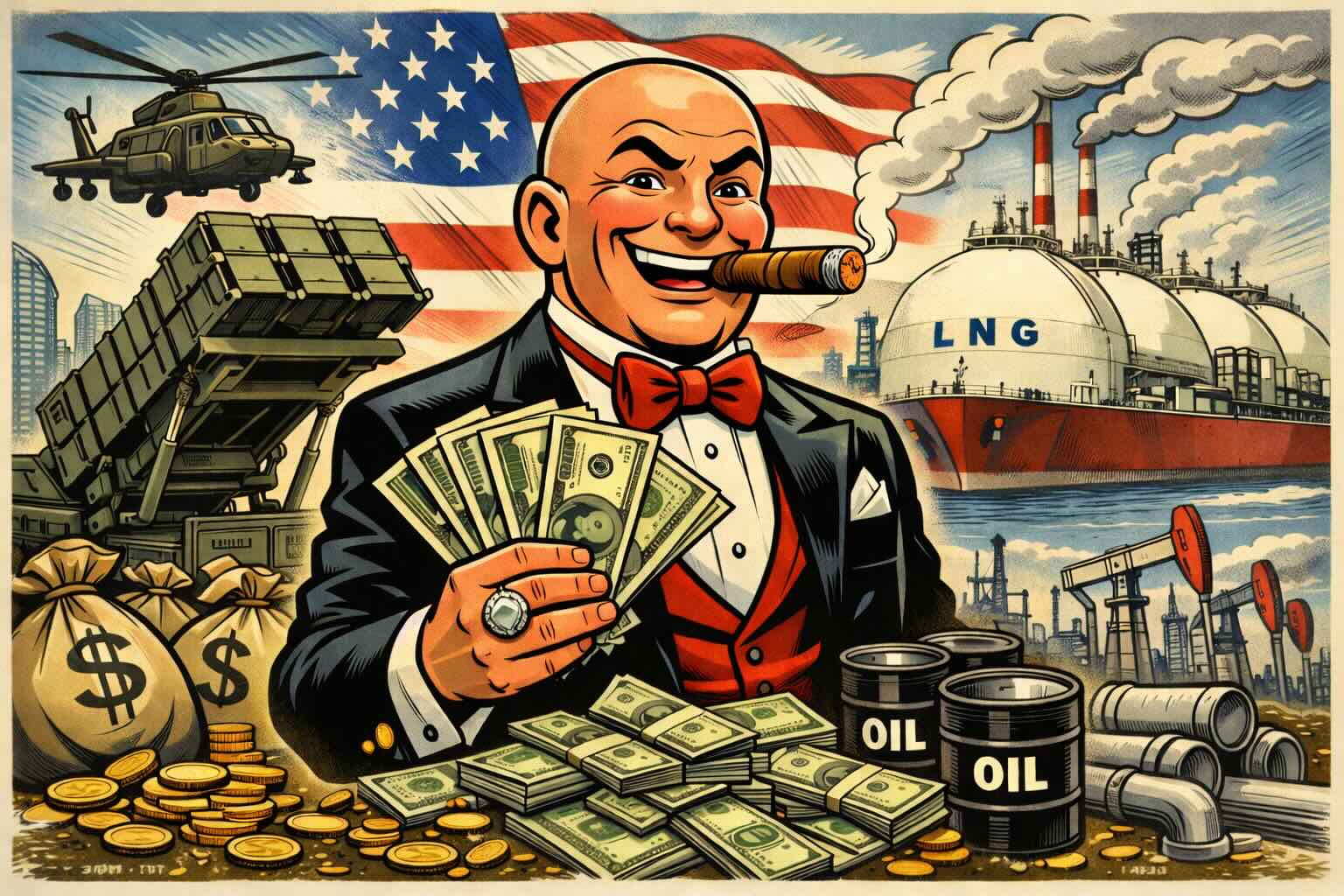
Trump is known as a money-lover who often tells Americans about the billions and trillions of dollars the United States receives under his presidency. Or is America in fact interested in a war in Europe and merely disguising itself as a peacemaker?
It is commonly assumed that the vain Trump simply wants the laurels of a peacemaker in the form of the Nobel Peace Prize, because he has “already stopped eight wars”. In reality, figures speak to the deeper intentions of the American administration more eloquently than any verbal outpouring from the White House. The largest items of American earnings from the war in Europe lie in the arms and energy businesses.
American regimes and programmes for selling weapons to European countries in 2022–2025
US defence materiel and dual-use goods were sold to Europe under several regimes and programmes.
Foreign Military Sales (FMS) are intergovernmental military sales. A foreign government submits a request (Letter of Request) to the US Department of Defence’s Defence Security Cooperation Agency (DSCA). After approval, the US sends an official offer (Letter of Offer and Acceptance) which, once signed, becomes a legally binding agreement.
Foreign Military Financing (FMF) is a grant and loan financing programme that provides funds to friendly foreign governments to purchase American weapons, defence equipment, services, and training.
Direct Commercial Sales (DCS) are direct commercial sales. DCS allows US companies registered with the State Department’s Directorate of Defence Trade Controls (DDTC) to sell defence articles directly to foreign partners. The US Government is not a party to the contract, but retains control through licensing and end-use monitoring.
Excess Defense Articles (EDA) are transfers of surplus US Department of Defence equipment that is no longer needed by US armed forces, on preferential terms or free of charge.
Export Administration Regulations (EAR) regulate exports of dual-use items — goods that have both civilian and military applications. Administration is carried out by the Bureau of Industry and Security (BIS) at the US Department of Commerce.
Ukraine Security Assistance Initiative (USAI) is a Pentagon-led financing programme created by Congress in 2015 to strengthen Ukraine’s capacity to defend itself more effectively against Russian aggression.
Of course, there are problematic points in assessing sales volumes because of a lack of data. Full DCS registers specifying sums, equipment, end user, and recipient country are not published. Open data are only global or regional aggregates and individual country cases. BIS licensing statistics do not systematically disclose military end users, and it is impossible, without access to classified information, to determine what share of EAR exports to European states goes specifically to the security and defence sector. Data for 2025 are incomplete because many contracts are still in notification or implementation, and official statistical reports cover, at most, the period up to 2024.
America’s arms business: sales to Europe in 2022–2025
The United States was the largest exporter of major arms in 2020–2024, accounting for 43 per cent of global arms exports. According to SIPRI estimates, deliveries of American weapons to European states in 2020–2024 rose by 233 per cent compared with 2015–2019, and Europe’s share of US exports reached 35 per cent, up from 13 per cent previously. Poland, Ukraine, the United Kingdom, the Netherlands, and Norway were among the ten largest recipients of US arms in 2020–2024. Ukraine accounted for 9.3 per cent of total US arms exports and 26 per cent of exports to Europe in that period. The US accounted for 53 per cent of European arms imports in 2020–2024, compared with 41 per cent in 2015–2019.
Between 2017 and 2021, the FMS portfolio for US European allies averaged $11 billion, but in 2024 it reached $68 billion. From 2022 to 2024, Polish purchases under FMS exceeded $55 billion, or 30 per cent of European demand. The top recipients of US FMS in Europe in 2022–2024 were Poland, Turkey, Finland, Switzerland, Germany, Italy, Spain, Romania, the Netherlands, and the United Kingdom (collectively, according to FMS notifications, more than $5 billion per country).
According to the State Department, from February 2022 to early 2025 the US provided Ukraine with about $66.9 billion in military assistance (Presidential Drawdown Authority, USAI, FMF, and others), mainly as non-repayable support from Pentagon stocks and contracts paid for from US budgets. The active portfolio of intergovernmental sales (FMS) for Ukraine is about $596 million, with financing potentially coming either from Ukraine or from US FMF programmes. From February 2022 to December 2024, the US allocated $28.6 billion through USAI, of which $21.2 billion was contracted with manufacturers, leaving about $4.1 billion uncontracted as of October 2024. In the 2024 aid package, Congress allocated $13.8 billion for USAI.
NATO’s PURL (Prioritised Ukraine Requirements List) initiative created a new channel through which allies buy US weapons for Ukraine. Based on official statements, by August 2025 more than $2 billion in contributions had been accumulated through PURL from at least eight countries: the Netherlands, Germany, Norway, Sweden, Denmark, Canada, Belgium, and Latvia.
Data on DCS (Direct Commercial Sales) and exports under the EAR/BIS regime are far less transparent, with limited breakdowns by country and category.
Table 1
If one takes as a baseline that Europe’s share of US exports reached 35 per cent, it is possible to estimate, in very approximate terms, the total value of exports of defence goods and dual-use goods in 2022–2024 at $259.56 billion.
If one extrapolates further and assumes that in 2025 Europe’s share of exports remained unchanged (35 per cent), and that the combined FMS and DCS total equalled the lowest value in the reporting years ($205.5 billion in 2022), then the hypothetical value of defence goods and dual-use goods exported by the US to Europe in 2022–2025 could reach, rounded, $331.5 billion.
America’s energy business: sales to Europe in 2022–2025
After the full-scale invasion, with the adoption of the REPowerEU plan in May 2022, the European Union set a course to abandon Russian energy resources, and the first beneficiary of this was the United States. EU imports of liquefied natural gas (LNG) multiplied as a result of rejecting Gazprom’s pipeline supplies. In 2021, Russian gas exports, including LNG, covered 45 per cent of the gas needs of EU-27 countries. They were replaced by additional pipeline volumes from Norway and, above all, LNG supplies from the US and Qatar.
According to official statistics, the EU spent a total of €276.9 billion on LNG purchases from 2021 to the first half of 2025. Based on our calculations, referencing Eurostat’s official statistics and Kpler’s database on the US share in the EU’s overall LNG mix, it can be concluded that from 2021 to the first half of 2025 inclusive, the EU imported US LNG worth €121.7 billion. If 2021 is excluded, the sum is €114.4 billion, or $124.1 billion.
Table 2
16,3
Source: authors’ calculations based on Eurostat and Kpler data
Our estimate is close to that of the US Institute for Energy Economics and Financial Analysis, which calculated that EU LNG imports from the US over the period amounted to €117.4 billion.
The US also increased exports to Europe of liquid hydrocarbons under HS 27 “mineral fuels, oil, products of processing”, replacing Russian supplies after the EU’s sixth sanctions package came into effect, that is, from February 2023. Unfortunately, there is a lack of open statistical data here, except for 2024 — $83.06 billion. However, by estimate, EU imports from the US in 2023 amounted to about $90 billion, and in the first half of 2025 about $44 billion. Thus, overall, from exports of liquid hydrocarbons to the EU, the United States received, for the period from 2023 through the first half of 2025 inclusive, $217 billion.
Overall, exports of energy resources to Europe — liquid hydrocarbons and natural gas in liquefied form — brought the US $341 billion.
Summary and conclusions
Let us sum up the estimates above for exports of defence goods and dual-use goods — $331.5 billion — and energy resources — $341 billion — and obtain a total estimate of $672.5 billion in revenues for the period from 2022 to the first half of 2025. This is roughly equal to Poland’s GDP. Considerable money for the United States, whose overall wealth is increasingly уступає Chinese wealth.
However, a question then arises: if the US benefits so much from a war in Europe, why does Trump present himself as a peacemaker? After all, revenues from a distant war, with the US “behind a beautiful ocean” and nothing threatening it, bring America prosperity, as in previous world wars. One might, of course, answer that Trump is obsessed with the laurels of a peacemaker, meaning that he wants the Nobel Prize at any cost. But that is disingenuous. In reality, the picture is different.
For Trump, Ukraine is not important as an independent and sovereign state; he is interested in territory where there are certain “minerals” and a “large nuclear power plant”. It therefore does not matter whether this territory becomes an analogue of Belarus or a copy of the Ukrainian SSR, or becomes, in the plural, some “Novorossiyas” and “Malorossiyas” within Russia. What matters for the US is to get “its own”. And this is what the Kremlin führer promises him, who also wants to get “his back” — not only in Ukraine, but in Europe as well. And here Trump is already on the hook.
For Trump, a united Europe is not only unimportant; it is not needed, meaning the European Union as such. Moreover, the US National Security Strategy has in effect declared a political war against a united Europe. The document formally закрепило what the US Vice-President lectured Europeans about at the Munich Security Conference: that it is not Russia and China that are the threat, but European liberal democracy. Trump accused the European Union of allegedly being created in order to rob America. And this despite the fact that the Marshall Plan and subsequent US post-war policy were aimed at uniting Europe in the face of the communist contagion. All post-war US presidents understood the importance of investing in Europe’s security for basic US national interests. From now on, all that can be forgotten.
Trump, like his idol Putin, prefers bilateral relations with European countries, because it is easier that way to impose on a specific country his view of the world, his approaches, his products and services, from which one cannot refuse. Trump wants not only to weaken but to destroy the EU in co-operation with Putin, and then impose his will and purchases of American goods on member states — from energy resources to high-technology weapons and the services of tech giants. Trump is ready to play a balancing role between an aggressive Russia and a divided Europe.
Trump’s US administration, proceeding from a revived and modernised Monroe Doctrine of two centuries ago, concentrates Washington’s interests in the zone of both American continents, while simultaneously giving Russia the opportunity to restore its zone of geopolitical influence in Europe and Asia. This is a kind of bribe to Putin from Trump. You want Ukraine, the post-Soviet space, Europe — take it… if you can. At the same time, Trump wants to weaken Russia through war so that later, as he believes, it will be easier to pull it away from China and earn “many billions of dollars for America” from its mineral and raw-material resources. However, this is an illusion. First, Russia and China share common authoritarian values (though here there are no disagreements with Trump, but there are with the political establishment and American society). Second, Russian and Chinese interests in pushing the US off the geopolitical Olympus and weakening a united Europe as a geopolitical actor fully coincide. In addition, one should not hope for “many billions of dollars for America”. Even without taking into account the absence in Russia of the rule of law and the sanctity of private property, hopes for Russia as an Eldorado are futile. In the best year for bilateral trade, 2011, total turnover of goods amounted to $42.9 billion. The largest US investment was in 2013 — $14 billion — while Russian direct investment in the US economy was $6 billion.
Still, the situation may look different if one starts from the maxim “what is good for Trump and the family is good for America”. Thus, a detailed investigation by journalist David Kirkpatrick in The New Yorker in August 2025 claims that the Trump family earned approximately $3.4 billion thanks to the presidential office. Of this, more than $2.3 billion came from various cryptocurrency projects. Go and find there Kremlin-affiliated crypto-dollars.
Putin, as a security-service man who over the past quarter-century has studied several dozen leaders of Western states, could not, on the example of Schröder, Sarkozy, and Berlusconi, fail to reach the conclusion that buying them is entirely realistic and profitable. And the examples of Orbán, Fico and others are additional confirmations. And then there is the jackpot — an American president who wants both “many billions for America” and the Nobel Peace Prize. It is therefore not accidental that there were proposals on the Dmitriev–Witkoff track to share part of the frozen Russian central bank assets in Europe, as well as talk of all sorts of promising projects for developing rare earths, deposits of critical mineral raw materials in the Arctic, and so on. The condition is that Ukraine, the Baltics, and Central and Eastern Europe gradually return to Russia’s orbit.
For Trump, Ukraine is a low-value asset for sale, and if there is a buyer willing to pay, why not? All that is needed is to present defeat, capitulation, and the further destruction of Ukraine as the “establishment of peace” in Europe. At the same time, in Trump’s conception, America will be rewarded by Russia, which as payment and gratitude will switch to the US side against China, and by “many billions of dollars” from business. And if, suddenly, something does not work out, the status quo of the Russian–Ukrainian war, with hundreds of billions earned from Europe and Ukraine, has already shown its profitability. That is why it was not accidental that Trump and representatives of his administration sounded a warning in advance about stepping away from peacemaking if the sides do not reach an agreement. After all, if it is not possible to bargain Ukraine away to Russia and tame Europe, then business can continue as usual — weapons and energy resources to Europe and Ukraine. And in order to stimulate Putin towards a “peace deal”, one can threaten him with providing Ukraine with Tomahawks and ultimately not provide them, while to some extent assisting with intelligence for strikes by Ukraine’s Defence Forces against tankers of the “shadow fleet”.
Therefore, there is no need to have illusions about the repeatedly promised “any day now” end to the war. Its continuation fully suits the Trump administration, accompanied by “peace negotiations”. America’s profit formula looks simple: earn from war while talking about peace. That is why “hellish sanctions”, under both Biden and Trump, are constantly postponed, thereby assisting the aggressor. And the so-called anti-escalation model of US behaviour in reality only encourages the aggressor.
Contributing authors
Mykhailo Honchar is President of the Strategy XXI Globalistics Centre.
Oksana Ishchuk is Executive Director of the Strategy XXI Globalistics Centre.
Oleksandr Khara is an expert at the Centre for Defence Strategies; an expert at “Maidan of Foreign Affairs” (2014–2020); and a member of the Council of Civil Associations of Ethnic Minorities of Ukraine.
Post Views: 976