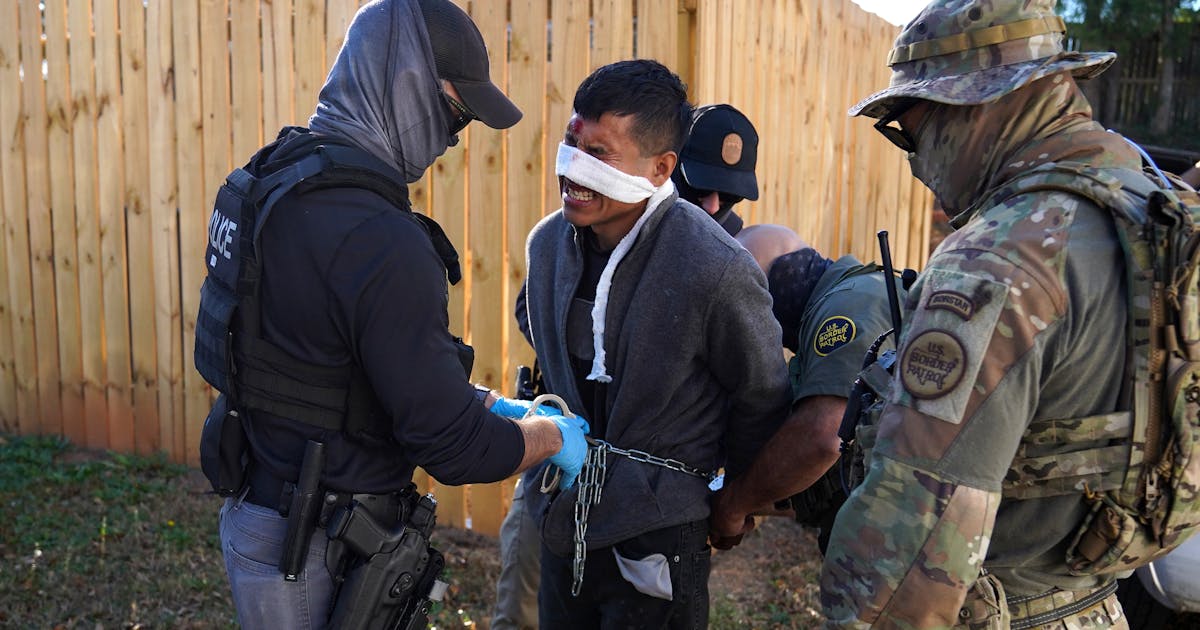
Shortly after the raids on Home Depot parking lots and car washes began in L.A., civil and immigration rights groups filed a lawsuit accusing the administration of racially profiling Latino people. Notably, a federal judge ordered the government to stop, and arrests dropped dramatically. The Supreme Court eventually ordered a pause on that temporary restraining order, allowing raids and stops based on skin color, language, and presence in areas where immigrants live and work to continue.
There was no majority opinion, but in a concurring opinion, Justice Brett Kavanaugh wrote that people who are in the country illegally have no right not to be racially profiled. As for U.S. citizens or legal residents, Kavanaugh wrote, once immigration officials establish legal status, “they promptly let the individual go.”
In a dissent, Justice Sonia Sotomayor wrote that Kavanaugh’s “concurrence improperly shifts the burden onto an entire class of citizens to carry enough documentation to prove that they deserve to walk freely.” It effectively made anyone who “looks immigrant” into a second-class citizen.
Kavanaugh added that if immigration officers violate other rights of citizens or legal residents, such as by using excessive force or not “promptly letting that individual go,” those people could always sue. It had been just three years since Kavanaugh joined the majority in all but overturning Bivens, effectively shutting down the right to sue federal law enforcement.
Kavanaugh’s claim that citizens and legal residents would simply be “let go” hasn’t held up. About a month after the ruling on racial profiling, ProPublica published a report documenting 170 cases in which immigration officers had detained U.S. citizens. The publication found 130 cases in which U.S. citizens had been arrested for allegedly interfering with immigration operations or assaulting officers but were often never charged. It found over 20 cases in which U.S. citizens were held for more than a day without being permitted to contact an attorney or their families. “Americans have been dragged, tackled, beaten, tased and shot by immigration agents,” the publication wrote. “They’ve had their necks kneeled on. They’ve been held outside in the rain while in their underwear. At least three citizens were pregnant when agents detained them. One of those women had already had the door of her home blown off while DHS Secretary Kristi Noem watched.” More recently, immigration officers stopped a Latino U.S. citizen in Los Angeles during a raid on a Home Depot. They arrested the man for an alleged assault and weapons violation, then drove off in his vehicle with the man’s one-year-old daughter still in the back seat. All of this in just the first 10 months of the new administration.
“This version of the Trump administration is a stress test for the United States,” said Bidwell. “They’re very good at identifying cracks in the system, then working at those cracks to widen them. These gaps in accountability for federal police have been around for a long time. We’re going to see how bad it can get when those gaps are exploited by an administration with no respect for constitutional restraints.”
Shredding Due Process
In a different world, immigration judges might be a check on all this abuse by immigration officers. But that isn’t the world we’re inhabiting. Despite their name, immigration courts have always operated within the executive branch, not the judicial, so they lack the independence of federal courts. Still, previous administrations mostly just tinkered with these courts at the margins, replacing judges as necessary with judges more in line with their policies. The Trump administration has changed all of that. Shortly after the inauguration, the DOJ issued memos to immigration judges making clear that they’d be expected to support the administration’s deportation goals. “There was a drastic change in tone,” Pappas said. “They were denigrating the people before us in terms of leadership, calling judges and leadership in the courts unethical and unprofessional.”
The following month, the firings began. Since February, DOJ has fired at least 98 immigration judges, and another 55 or so left voluntarily after seeing the writing on the wall. “Amanda” was one of the first judges fired in February. “I was never told why I was let go,” she said. “A lot of people were shocked. I don’t think anyone would have described me as a liberal judge. I’m a former immigration prosecutor. The feeling was that if they’d fire someone like me, no one was safe. Which is probably the message DOJ wanted to send.”
Amanda said there was one incident in her record, when she worked for the Executive Office of Immigration Review, that may have flagged Trump’s DOJ. “I was once reported for engaging in ‘illegal DEI,’” she said. “One of the individuals I supervised moved the seating arrangements for African American staff to the same undesirable hallway, causing staff to refer to that hall as ‘Jim Crow Row.’ I told her she had to stop doing that. When this new administration called for reporting of ‘illegal DEI,’ the staff member forwarded an email to me to notify me that she had reported me. Maybe that’s why I was fired. But my termination notice was a few sentences long. So who knows.”
In October, the DOJ announced that it would begin appointing military lawyers from the JAG Corps to serve as temporary immigration judges—the officers who had survived Hegseth’s purge. The move has been widely derided in the legal community as an effort to turn the courts into little more than a rubber stamp for the administration. “Immigration law is incredibly complicated,” Pappas said. “There’s just no way you’re going to be able to pick it up in a matter of weeks and treat these cases with the judgment and care they require.”
The most immediate effect of the administration’s politicization of immigration courts will be in denials of asylum claims and in expedited removal orders and deportations. “Immigration courts are like litigating death penalty cases in a traffic court setting,” said Marks, the longtime immigration judge who retired in 2021. “When you deny asylum to someone, there’s a real possibility that person will turn up dead after they’re deported.”
Trump has also purged the board that hears immigration appeals and replaced those members with his own appointees. The new, Trump-friendly version of the board then announced that judges could no longer order bond for anyone in the country illegally. That decision—which has been roundly rejected when challenged in federal courts—potentially means millions more people in federal detention, where conditions are rapidly deteriorating.
This, too, is all part of the plan. Miller, Tom Homan, and the architects of the child separation policy during Trump’s first term have made clear that one goal of their immigration policy is to disincentivize people from coming to the United States by inflicting suffering on those who do. One way to make people suffer is to take away their children. Another is to stuff them into overcrowded cells, deny them access to a shower, medication, and clean food and water, and make it all but impossible for them to contact their families or attorneys. Human rights groups have already documented these and other inhumane conditions at detention facilities all over the country, including at brand new centers like “Alligator Alcatraz” in Florida.
It Is Happening Here
When Trump took office in January 2025, there were 39,000 people in ICE custody. By September, there were more than 60,000, and there will be capacity for around 107,000 by January 2026. As of this writing, 23 people have died this year in ICE custody. That’s the most since 2005, and more than the previous three years combined. The conditions faced by those in custody are only likely to get worse as deportation efforts continue to ramp up.
At the same time, the administration has hollowed out the offices within DHS and DOJ that oversee detention facilities. “There’s no oversight. There’s no reporting. There’s no access,” said “Dan,” a longtime former DHS employee and immigration prosecutor. “Until this administration, if a lawyer or an NGO complained about inhumane conditions, that was something we took very seriously. Now they just don’t care. It’s fully part of the plan. They’re open about it. You put people in detention, deny them access to a lawyer, and just continue to squeeze them until they’re so miserable that they give up their rights.”
In the midst of all of this, the Pentagon began engaging in this administration’s most egregious and brazen breach of due process to date: bombing boats in the Caribbean and eastern Pacific Ocean, off the coasts of Colombia and Venezuela. The Pentagon claimed the occupants of the boats were “narco-terrorists,” but provided no evidence to support the accusation—nor would it be justified to kill them if they were. Smuggling drugs is not a capital crime in the United States. It also seems unlikely that most of the boats were bound for the United States, and neither Colombia nor Venezuela produces or exports significant quantities of fentanyl, the drug most responsible for overdose deaths in America.
The strikes are illegal, under both domestic and international law. The United States is not engaged in an armed conflict with drug cartels, drug cartels are not terrorists or enemy combatants, and the administration has provided no evidence beyond its say-so that the people it has killed fit into any of those categories. The administration later conceded that it doesn’t actually know the identities of the people it is killing, but that it would be legally justified to kill anyone who is “as much as three hops away from a known member” of a designated terrorist organization. Setting aside the fact that, again, drug cartels are not terrorist groups, sociological studies estimate that the average person knows about 600 people. This means that under the “three-hop rule,” which allows authorities to pursue individuals three “hops” away from the target, each member of a terrorist group would make about 216 million people eligible for legal assassination by the U.S. government.
As of publication, the administration had killed more than 83 people in 21 strikes. The strikes embody Trump’s most authoritarian instincts—unchecked and unreviewable executive power; crass imperialism; a feverish, 1980s-era approach to illicit drugs (Trump has frequently said that drug dealers should be executed); and xenophobic bigotry, particularly toward the developing world. Both Trump and Vice President Vance have even joked about the possibility that the strikes may have killed innocent people, delivering wry bons mots about how Caribbean fishermen probably don’t go out on the water much anymore.
The strikes are abominable, reckless acts of violence in and of themselves. But it isn’t difficult to envision how an administration with so little regard for law, human life, and due process might make the leap to think it can also carry out extrajudicial executions inside the United States, particularly one run by a president who equates criticism of him with treason, likens immigrants to vermin, and calls his opponents “the enemy within.” This, after all, is an administration already trying to legally define peaceful protesters and their supporters as “terrorists,” the same term it uses to justify those extrajudicial killings.
There would certainly be far more popular and political backlash to such strikes within U.S. borders, or against U.S. citizens. But public opinion isn’t a dependable bulwark against an administration that has anointed itself judge, jury, and executioner. It’s of little comfort in the throes of an administration that believes it can kill on demand, regardless of domestic or international law, and feels no obligation to justify its decision to do so to Congress, the courts, or the public.
Perhaps that sounds overwrought. But if you had suggested in 2024 that if elected, the Republican candidate for president would instruct federal police to sweep immigrants off the street—some of whom were here legally, and most of whom had no prior criminal record—put them on airplanes, and send them to a Central American gulag, all without ever letting them speak to a judge, you’d also have been called overwrought. But it is happening.
If you had suggested 10 years ago that federal agencies would use Nazi, fascist, and white nationalist iconography and allude to explicitly white supremacist literature in their social media posts, or that the Department of Homeland Security would use nativist, blood-and-soil messaging about preserving Western heritage in its outreach to recruit new immigration officers, you’d also have been called overwrought. But this, too, is happening.
If you had suggested during the Obama era that a U.S. president would encourage a violent assault on the U.S. Capitol in order to prevent his successor from taking office, that said president would then be reelected, would pardon all of the insurrectionists, and then go about erasing that history from official records, you’d also have been called overwrought. But Trump has done all these things.
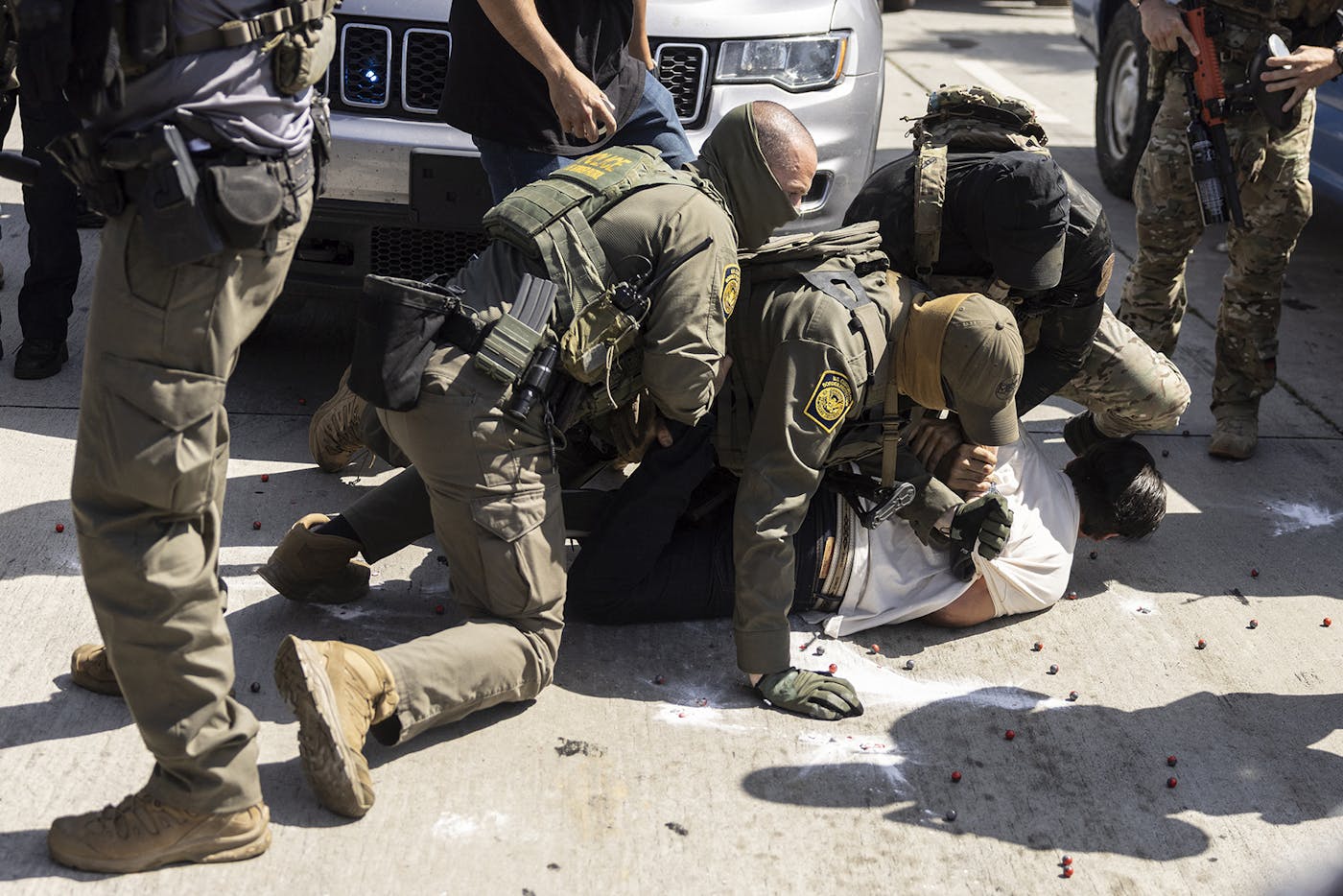
A man was detained after a Customs and Border Protection raid on a Los Angeles store in June.
ETIENNE LAURENT/AFP/GETTY
During the week I finished this story, a federal judge ruled that the conditions at the main immigration detention facility in Chicago were “inhumane.” U.S. District Court Judge Robert Gettleman found that prisoners were being forced to sleep on top of one another, slept next to overflowing toilets, were provided with no beds or access to showers, didn’t have adequate food or medicine, and were forced to drink water that “tasted like sewer.”
The following day, in a separate lawsuit, U.S. District Court Judge Sara Ellis ruled that federal immigration officers in the city were using levels of force that “shocks the conscience.” She found that Border Patrol commander Gregory Bovino and other government agents had lied to her in court proceedings. In an impassioned opinion, Ellis mounted an eloquent defense of both the city of Chicago and American values, quoting Carl Sandburg and John Adams. She also ruled that federal forces were deliberately undermining free speech by detaining and beating protesters. “The freedom of speech is a principal pillar in a free Government,” she wrote, quoting Benjamin Franklin, “when this support is taken away the Constitution is dissolved, and Tyranny is erected on its Ruins.”
The next day, Bovino and his agents were back in Little Village, clashing with protesters. In the days that followed, they dragged a day care teacher out of her school as she screamed, used tear gas on large groups of protesters, and pepper-sprayed a one-year-old (they denied at least the pepper-spraying of the infant). Later, Bovino and his agents posed in front of Cloud Gate, the iconic sculpture more commonly called the Bean. According to local reports, the officers shouted out “Little Village!” as they mugged for a group selfie.
Just a few days before Ellis’s ruling, in a prime-time interview on CBS’s 60 Minutes, President Trump was asked if in tear-gassing entire neighborhoods, beating U.S. citizens, terrorizing children, and lying to federal courts—if given all of that—he thought that perhaps his deportation force in Chicago may have gone too far.
He answered, “I don’t think they’ve gone far enough.”