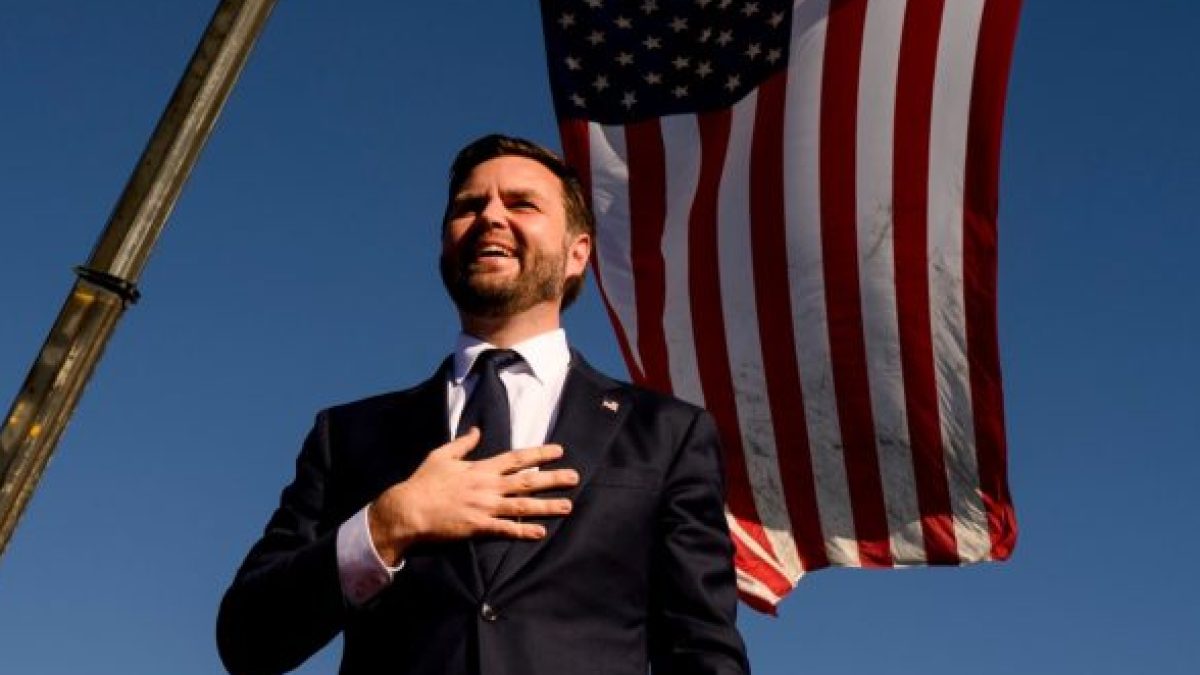
The Vice President is stepping out of Donald Trump’s shadow ahead of the next US election
When JD Vance ran to be the junior senator from Ohio in 2022, a 177-page opposition research document prepared for him to anticipate attacks was posted online. Vance was by this time a national figure because of his memoir Hillbilly Elegy, about growing up poor in the Rust Belt. The campaign research said he was vulnerable to ridicule as a rich venture capitalist “cosplaying” Snuffy Smith, a Hillbilly comic strip character from the Appalachian town of “Hootin’ Holler”.
Vance wasn’t much like the ornery, shiftless, moonshinin’ Smif, as it’s pronounced, who wore patched overalls, mangled the English language, and rode a stubborn mule. But the attack played to an issue that continues to dog the US vice president to this day: authenticity. Who is the real JD Vance?
The question becomes even more urgent because Vance is the clear favourite to be the Republican Party’s nominee for president at the end of Donald Trump’s second term. One poll put him more than 30 points ahead of his nearest rival, Marco Rubio. The nomination is his to lose: at the age of 41, he is the heir apparent. He’s even polling better than the actual heir, Donald Trump Jr. Don Jr has left the door open to a run, while publicly downplaying it. He has over 15m followers on X and is popular with Maga true believers. But Vance is even more popular – remarkable given what he has said about Trump in the past.
Voice of American liberalism to Maga loyalist
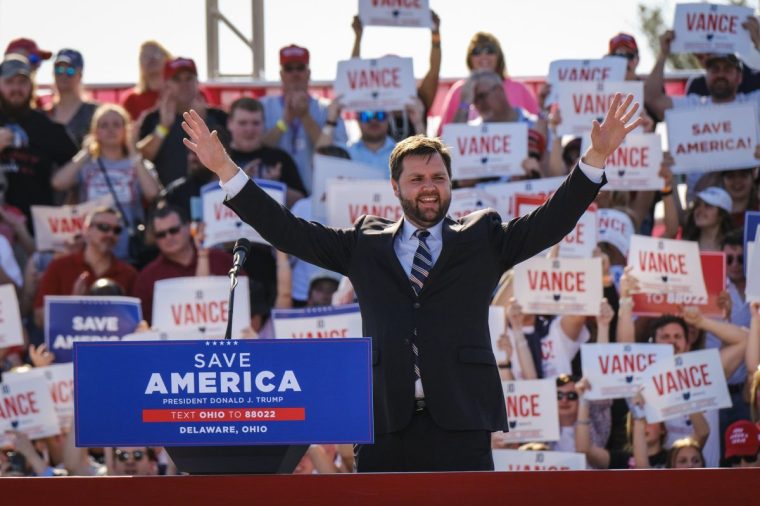 Vance, then candidate for Ohio, waves to supporters during the ‘Save America’ rally with Donald Trump at Delaware County Fairgrounds in April (Photo: Eli Hiller/Bloomberg)
In 2016, Vance asked a friend whether Trump could be “America’s Hitler”. That was in a private Facebook message, but he also wrote a magazine article describing Donald Trump as “cultural heroin” for poor whites. Trump, he wrote, makes some feel better for a bit, “but he cannot fix what ails them, and one day they’ll realise it”. He said that Trump was “leading the white working class to a very dark place”.
This was penned for The Atlantic magazine, the voice of American liberalism. Vance was writing for The New York Times opinion page too, explaining to America’s elites why the white working class supported Trump’s candidacy. Back then, he was a liberal Republican. His ideal president was Jon Huntsman, the cerebral former US ambassador to China, a man as unlike Trump as you could imagine.
Then Vance became the kind of Maga loyalist Trump could endorse for the Senate – and Vance called him “the best president of my lifetime”.
After a year in office, Vance seems to have changed personality as well as politics, or at least a new side of him has been revealed. He has slipped easily into the traditional vice presidential role of attack dog, a persona far removed from the thoughtful essayist of The Atlantic. He is sometimes compared to Nixon. Both men became vice president at the age of 40. Both demonstrated an unsettling capacity for political reinvention.
But more than anyone, Vance resembles Nixon’s own “hatchet man”, his vice president, Spiro Agnew. Agnew called college professors “an effete corps of impudent snobs”. He came to be defined by his swipe at the media as “the nattering nabobs of negativism”. Vance is known for his attacks on the liberal elites, especially the “crybabies in the media”.
So, Vance has been on a journey. He has changed religion, from Protestant to atheist-agnostic and then to Roman Catholic. He has changed his name. He was JD Hamel through his 20s, serving under that name as a Marine in Iraq, and writing under that byline in The Atlantic. When his parents divorced, he became Vance, after his beloved grandmother. The single syllable “Vance” may have been the reason he was nominated to be vice president. Trump has a thing for short surnames. He calls them “tough and clean”. And when Vance first ran for office, he made a small but careful change: J.D. became simply JD.
The memoir that launched a political career
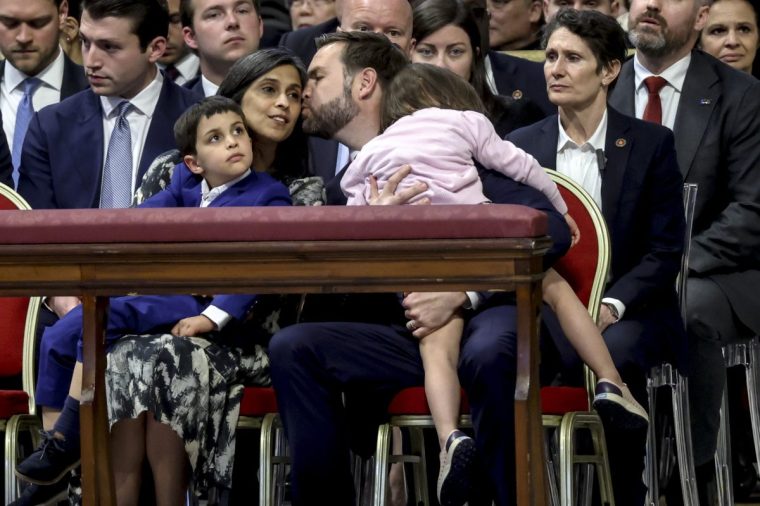 Vance, Second Lady Usha and their children. He met his wife at Yale; he discusses their early relationship in Hillbilly Elegy (Photo: Alessandra Benedetti/Corbis)
Vance was launched into politics by the success of Hillbilly Elegy. Like another gifted politician, Barack Obama, his writings are almost exclusively autobiographical, though both men’s personal stories speak to the agonised national debate over America’s identity. In Hillbilly Elegy, Vance describes how he was transformed by going to Yale after growing up in poverty. As autobiography, the book is no doubt self-serving, but no one questioned its truthfulness after months on the bestseller lists. It does not depict a man without principles, an opportunist.
He went to Yale’s law school and in 2012 was in the running for a prestigious federal clerkship. But one of his professors warned him that it would ruin his relationship with his girlfriend, Usha, taking him “a thousand miles away”. Vance decided it was “okay to put a girl above some shortsighted ambition”. This was before fame, before politics, before anyone was really watching.
Usha Vance came from an upper-middle-class family in San Diego; her parents were academics from India. She literally taught him which knife and fork to use. One evening, he rushed out of a smart dinner to phone her for advice. Just go from the outside in, she said. Vance went on to marry Usha in a ceremony that included Hindu rites. He has been subjected to crude attacks from the racist provocateur Nick Fuentes, who said: “Do we really expect that the guy who has an Indian wife and named their kid Vivek is going to support white identity?”
Fuentes, who once called Hitler “awesome”, has dined with Trump at Mar-a-Lago. He has a million followers on X, known as “groypers”, named, for some reason, after a fat, green internet frog. The groypers are largely young, working-class men, a group crucial to Trump’s coalition – votes that Vance will need if he’s to become President.
A possible rival for the Republican nomination, Governor Ron DeSantis of Florida, has called H1-B visas, used by many Indian professionals, a “total scam”. To many, this seemed a means of slyly attacking Vance. It may hurt him with parts of the Maga base. Nevertheless, Vance is still the most likely successor to Trump.
Vance is the candidate for Silicon Valley oligarchs
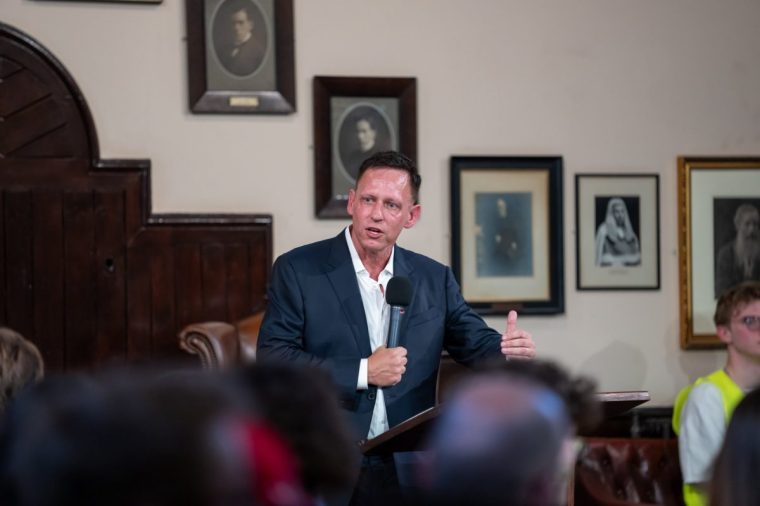 Vance wrote to tech baron Peter Thiel, pictured, and went to work in his venture capital firm. Thiel later gave him $100m for his own tech investment fund, then bankrolled Vance’s Senate campaign with $15m (Photo: Nordin Catic/Getty for The Cambridge Union)
The other supremely important relationship that Vance formed at Yale Law School was with the tech baron Peter Thiel. Thiel, who built his fortune on PayPal and Facebook, had come to give a lecture there. He spoke about how cutthroat competition — for clerkships, jobs at elite law firms, and partnerships — offered only “longer work hours, social alienation and work whose prestige would fail to make up for its meaninglessness.” Hearing that, Vance wrote, was “the most significant moment” of his time at Yale. He had been “running a desperate race where the first prize was a job I hated”. He had “prioritised striving over character”.
Vance wrote to Thiel and went to work in his venture capital firm. Thiel later gave him $100m for his own tech investment fund. And then he bankrolled Vance’s Senate campaign, giving $15m, the largest donation ever made to a Senate candidate. It was Thiel who paid for the opposition “Snuffy Smif” research Vance used in Ohio. (The only way to get it to Vance, without breaking campaign finance laws, was to publish it online.) Finally, Thiel lobbied Trump to pick Vance as his candidate for Vice President.
Vance remains closely aligned with the oligarchs of Silicon Valley. He is their candidate for President. One Silicon Valley venture capitalist posted an image of Vance with the caption “The next 12 years”. As Thiel’s biographer, Max Chafkin, wrote, Vance has taken up many policy positions friendly to big tech. He is, after all, a former tech venture capitalist himself.
So, we return to the question of Vance’s authenticity. Is he the populist spokesman for the Maga masses, or a shill for Silicon Valley’s plutocrats? The Italian-Swiss author Giuliano da Empoli has written an elegant indictment of the relationship between politicians and the tech billionaires, The Hour of the Predator. Da Empoli is a former advisor to an Italian prime minister and writes that Western leaders have responded to Silicon Valley’s rise like the Aztecs meeting the Spanish conquistadors. “Faced with the fire and thunder of the internet, social media and artificial intelligence… [they]have bowed down.” In a recent interview, he said Vance was probably already “an employee” of the tech barons.
Or Vance is acting out of conviction. That’s the view of Samuel Hammond, chief economist at the Foundation for American Innovation, a conservative think tank that aims to bridge the gap between Silicon Valley and Washington DC. Hammond told me that Vance represents a new coalition between blue-collar America and the nouveau riche of big tech. Both opposed the “permanent managerial class that sits on top of American society and which has governed it in its own interests”. Both wanted to smash an oligarchy that combined the bureaucracy of the big government “Paper Belt”, academia, the mainstream media, and legacy corporate interests.
The most controversial venture from Vance’s backer, Thiel, is the big data company Palantir. It has made sophisticated AI tools to enable the intelligence services to track terrorists and other enemies of the state. It’s one of several Silicon Valley behemoths – Facebook, Google, X — that have the power to track us, spy on us, and censor us, giving enormous power to the state. Hammond doesn’t think this will cause problems for Vance with his conservative base. Thiel, he maintained, wanted to fight terrorism while preserving civil liberties. Neither liked the surveillance state. Perhaps Thiel and Vance can sell libertarians in the Maga coalition on the idea of “ethical surveillance”.

But what if Silicon Valley puts blue-collar America out of a job? Where would Vance stand then? Hammond predicts that the first losers from AI won’t be plumbers and carpenters, but Hollywood screenwriters and Washington paper pushers, the “effete knowledge class”. In time, however, factories would be automated because of advances in robotics. Fundamental economic structures would have to be “reset”. Everyone would be better off but “it may not even look like capitalism”.
Is Vance the leader to usher in this new era? At the very least, his serial reinventions suggest a man who can adapt. He may have to reinvent himself yet again as he steps out of Trump’s shadow to campaign to be president himself. He’ll have the same problem all vice presidents have: how to gracefully distance themselves from the boss. The Vance doctrine is, though, already clear. You might call it the Vance-Thiel doctrine: the people and the tech billionaires have shared enemies.
It’s a promise to overthrow the old elites. Whether the new elites will be any different is the question that will define Vance’s race to be president in 2028.