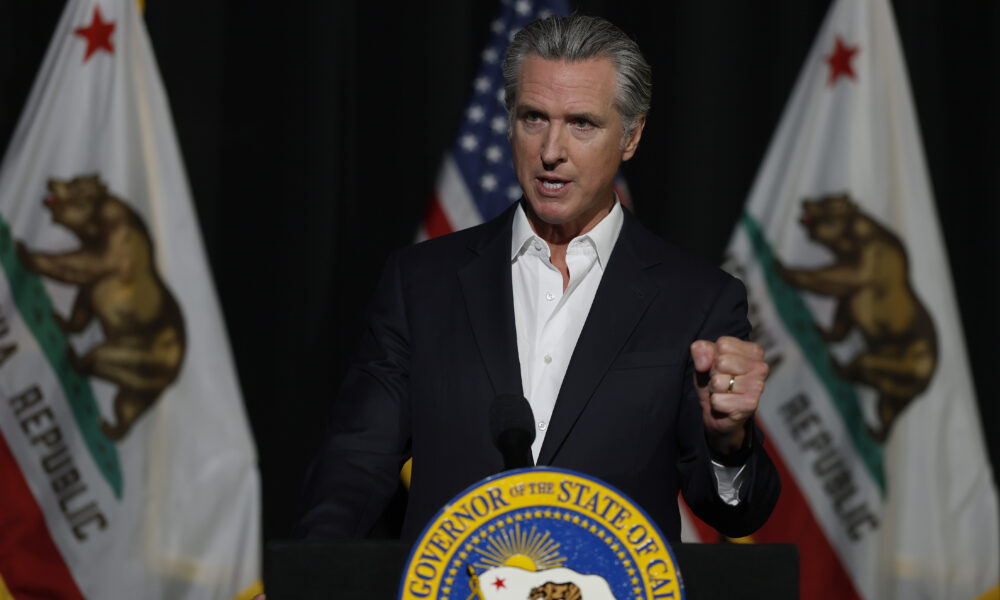
California’s health care landscape today would probably disappoint the Gavin Newsom who spent much of 2017 and 2018 on the road, campaigning to become governor.
Before taking over as California’s top executive, Newsom, who had previously done a high-profile stint as San Francisco’s mayor, loudly espoused a single-payer system of care under which the state would be the sole supplier of health coverage and everybody would be included.
“There’s no reason to wait around on universal health care and single-payer in California,” Newsom said on the campaign trail. “You have my firm and absolute commitment as your next governor that I will lead the effort to get it done.”
But as former New York Gov. Mario Cuomo once observed, politicians generally campaign in poetry and govern in prose. Upon taking office in 2019, Newsom, faced with massive budget issues and political pushback, quickly began retreating from the single-payer-system idea. In so doing, he angered groups like the California Nurses Association, which had campaigned aggressively for him because of his devotion to that specific concept. (Disclosure: The CNA is a financial supporter of Capital & Main.)
Instead, the governor pivoted to “universal access” to care — the notion that, through one program or another, everyone in the state would be able to see a doctor.
Newsom pitched it as a bridge to a better health care system down the line. Now, as he prepares for the final year of his second term and eyes a potential presidential run in 2028, that slimmed-down vision for California remains unrealized.
The state’s severe budget deficit this year forced Newsom to back off expansion of Medi-Cal to low-income adults who don’t have legal residency, and the looming expiration of federal subsidies due to cuts through the Affordable Care Act will push hundreds of thousands of Californians off the plans they’ve bought through Covered California.
The governor has carved out some notable gains through the years, including a cap on out-of-pocket costs on insulin and multiple expansions of Medi-Cal coverage for various age groups, regardless of their immigration status. As Newsom begins his final year in Sacramento before he is termed out of that office, the landscape is shifting again.
Here are a few of the major changes in California’s health care policies and coverage for 2026:
Enrollment freeze for undocumented adults. Beginning Jan. 1, low-income adults ages 19 and older who are undocumented are no longer eligible to sign up for Medi-Cal. Those who are already enrolled may stay in the program as long as they renew their coverage.
Under Newsom, the Legislature folded almost all undocumented residents into Medi-Cal, California’s version of Medicaid, which covers about a third of all people in the state. In the absence of a plan for a single-payer system, Newsom had touted this expansion as a way to get the state closer to health care access for everyone.
Between that move and a surge of sign-ups during the pandemic — when income eligibility requirements were temporarily suspended — Medi-Cal experienced rapid enrollment growth, rising from about 13 million to nearly 15 million today. As a result, the price tag for administering the health coverage plan soared.
Medi-Cal had to borrow $3.4 billion from the state’s general fund this year to meet escalating costs. Earlier this year, the state estimated that about 1.6 million undocumented immigrants were enrolled in the program.
With the state facing an estimated $12 billion budget deficit, Newsom and Democratic lawmakers scaled back the commitment to undocumented adults. Newsom’s administration has estimated that the enrollment freeze, along with a monthly Medi-Cal premium for immigrants beginning in 2027 and a reduction in dental coverage this year (see below), could save the state more than $5 billion.
Reinstatement of the Medi-Cal asset test. Beginning Jan. 1, adults can be denied access to Medi-Cal if they’re deemed to hold too much in assets, like bank account totals, cash on hand, second cars or second homes.
The asset limit is $130,000 for an individual and $195,000 for a couple. It applies to those who are over 65, have a disability, live in a nursing home or are part of a family that otherwise makes too much to qualify for Medi-Cal.
California had eliminated the asset test in 2024, overjoying advocacy groups who’ve long contended that it stymies adults who are just trying to save modest amounts to achieve some financial security.
Now the state is bringing the test back, albeit in a less restrictive way. The Legislature declined to go with Newsom’s original proposal to set the asset limits at $2,000 per person and $3,000 for a couple, instead putting the much higher numbers in place.
Elimination of some dental coverage. On July 1, the state will end so-called full scope dental coverage for undocumented immigrants age 19 and over. Only emergency dental care will be covered. Children and pregnant people will continue to receive full dental coverage regardless of their immigration status.
The state has been down this road before. In 2009, California eliminated nonemergency dental coverage for most adult Medi-Cal patients in a budget-cutting move before slowly reinstating much of it over the next five years. The 2026 policy applies to undocumented adults only, not the rest of the Medi-Cal population. State estimates project $300 million in savings for the 2026-27 fiscal year.
Lower insulin costs. Newsom signed into law a new $35 cap on the cost of a month’s worth of insulin beginning Jan. 1 for people with private health coverage through large insurers like Kaiser, Anthem, Blue Shield and Health Net. Smaller group insurers, such as small businesses who buy coverage through Covered California, will be subject to the cost cap beginning in 2027.
The governor also announced that, starting Jan. 1, insulin pens will be available to California consumers at $55 for a five-pack through the state’s own CalRx program. (The pens are also available to pharmacies for $45 per five-pack.) State-compiled data released during the governor’s October announcement pegged the cost for a five-pack made by major pharmaceutical companies at between $90 and more than $400, indicating substantial savings under the state-led production partnership with a nonprofit generic drugmaker, Civica Rx.
“California and Civica are showing the nation what it looks like to put people over profits,” Newsom said in a statement accompanying the announcement. “No Californian should ever have to ration insulin or go into debt to stay alive — and I won’t stop until health care costs are crushed for everyone.”
With 12 months before he moves on, that goal of Newsom’s won’t be reached. Instead, he’ll spend that time making small steps to regain some of the ground that’s been lost over the tumultuous past year — the pure reality of governing.
Copyright 2025 Capital & Main