Welcome to Foreign Policy’s South Asia Brief.
It has been a rough year for South Asia, which has suffered surging terrorism, economic stress, diplomatic tensions, natural disasters, and the deleterious impacts of ongoing conflicts in Ukraine and the Middle East. Predictably, the biggest stories from South Asia in 2025—some surprising, some less so—are mostly downers. But in a few cases, 2026 could be a year of significant change.
Welcome to Foreign Policy’s South Asia Brief.
It has been a rough year for South Asia, which has suffered surging terrorism, economic stress, diplomatic tensions, natural disasters, and the deleterious impacts of ongoing conflicts in Ukraine and the Middle East. Predictably, the biggest stories from South Asia in 2025—some surprising, some less so—are mostly downers. But in a few cases, 2026 could be a year of significant change.
Below are five stories that defined the region this year.
India-Pakistan Conflict
The year began with India-Pakistan ties relatively stable, thanks in large part to a border truce in effect since February 2021. But in April, militants killed 26 tourists in Indian-administered Kashmir. India—without providing proof—said that Pakistan was complicit, and two weeks later, it carried out airstrikes across the border.
For four days, India and Pakistan sent drones and missiles deep into each other’s territory, resulting in their most serious conflict since 1971. The military campaigns were accompanied by significant disinformation.
A May 10 cease-fire ended hostilities, but not the serious diplomatic freeze. As the year draws to a close, the India-Pakistan relationship remains in deep crisis. Borders are mostly closed, and trade is halted. India has suspended the Indus Waters Treaty, long viewed as a rare success story for bilateral cooperation. Even cricket became a tension point.
Dialogue is practically nonexistent. Rare terrorist attacks in Islamabad and New Delhi on consecutive days in November amplified the risks of further violence. The conflict was an unsettling reminder to the world of the peril of nuclear escalation in South Asia. Its aftermath underscored how tortured India-Pakistan relations remain, even after years of uneasy calm.
Uprising in Nepal
Barely a year after Bangladeshi protesters stunned the world by forcing their prime minister out with mass demonstrations, their neighbors in Nepal repeated the feat. In September, crowds led largely by young people took to the streets across the country to denounce their government. Within a few days, Nepali Prime Minister K.P. Sharma Oli stepped down, giving way to an interim government charged with preparing for national elections in March.
The protests began after the announcement of new restrictions on social media platforms, largely seen as facilitating censorship, but the issues that demonstrators were most angry about were corruption, nepotism, economic stress, and the perception that the political class was more concerned about their own issues than mounting public grievances.
What happened in Nepal wasn’t surprising. Youth discontent about politics had been apparent for years. That discontent could flare anew next year: The protesters want an end to rule by the usual political suspects, and several new parties—including those involved in the protests—have registered for the March elections. But there is still a good chance that the next government will be led by the old establishment.
U.S.-India Ties Deteriorate
For a few decades, Washington’s relationship with New Delhi was one of its fastest-growing and most stable, including during U.S. President Donald Trump’s first term. The partnership also got off to a good start during the early days of Trump’s second term, with Indian Prime Minister Narendra Modi invited to a White House summit in February.
Then things went south in a hurry. Trump’s 50 percent tariffs on India (which is tied with Brazil for the highest U.S. tariff rate of any country), heavy U.S. pressure on New Delhi to stop buying Russian oil, and a surprising resurgence in U.S.-Pakistan ties sunk the bilateral relationship to its worst level in decades.
That said, the relationship didn’t collapse. There was still cooperation in defense, including joint military exercises and a new 10-year defense framework agreement; space, where the two countries launched a satellite; and law enforcement, where the FBI apprehended a few figures wanted in India.
But the United States and India will enter 2026 on bad footing and in need of a confidence-building measure, such as a new trade deal or a Trump trip to India, to get it back on track.
Another Afghan Refugee Crisis
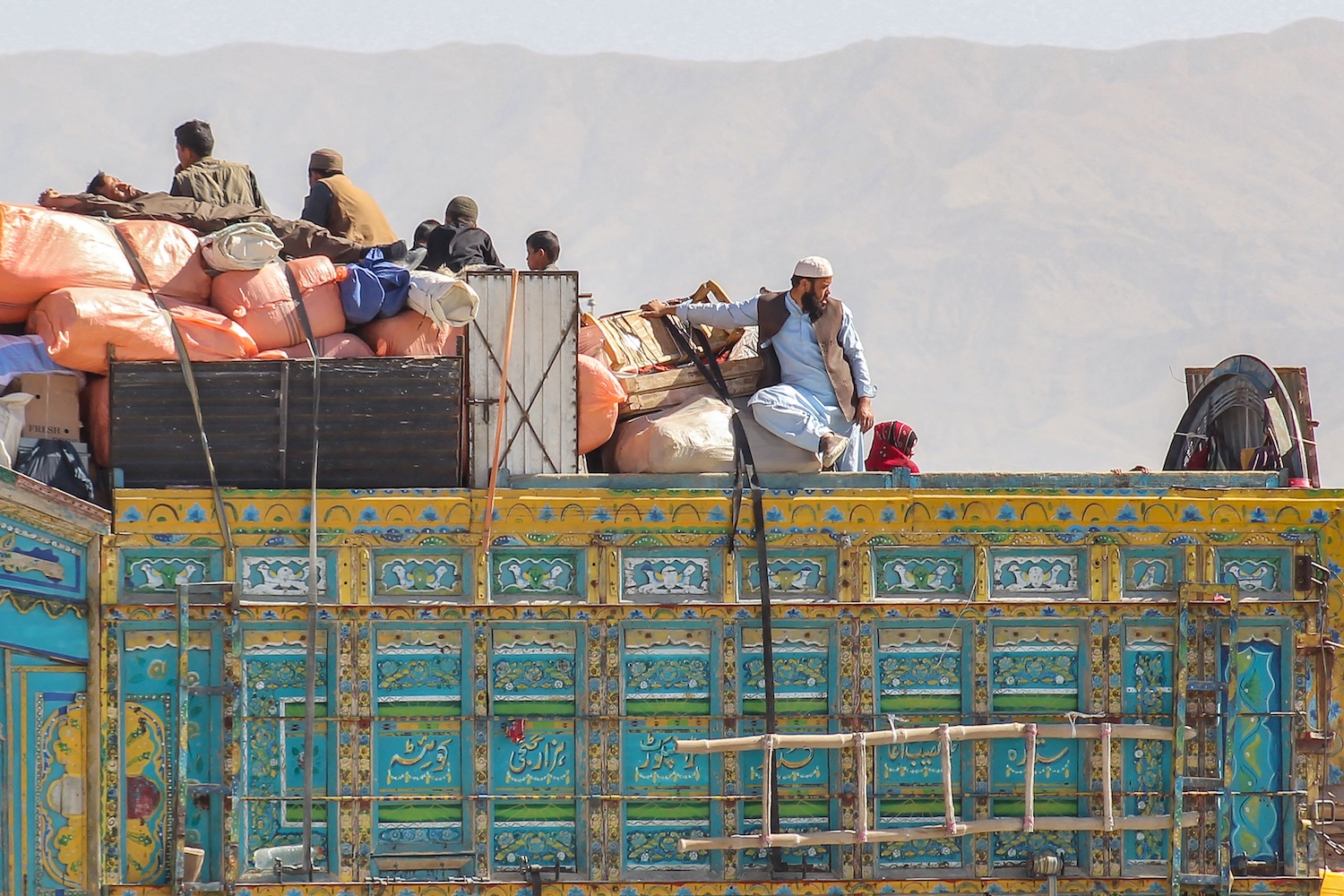
About half a dozen people perch on the back of a truck piled high with bundles and trunks. One man at the back has his hand splayed over a suitcase as he looks over his shoulder. A mountain looms against a hazy sky in the background.
A family sits on a truck as they await deportation to Afghanistan near the Pakistan-Afghanistan border in Chaman, Pakistan, on Nov. 7.Abdul Basit/AFP via Getty Images
One of the most overlooked developments in the region this year was a familiar story: the massive number of refugees uprooted from their communities and sent to Afghanistan, where many of them had never been. In recent years, Pakistan and Iran—the two most common destinations for Afghan refugees—have taken a harder line against the community that they have long hosted on such a large scale.
But this year, the numbers were especially striking. As of this week, according to United Nations data, nearly 2.8 million people had returned to Afghanistan from Iran and Pakistan in 2025, including more than 1.3 million deportees. The biggest movement came in July, when more than 600,000 Afghan refugees returned, the vast majority driven out of Iran over just 15 days.
In both Iran and Pakistan, Afghan refugees were often victims of geopolitics. Deepening tensions between Islamabad and Kabul over cross-border terrorism made vulnerable Afghan communities an easier target. And in Iran, amid a brief conflict with Israel, some Afghans were falsely accused of being Israeli spies.
The Unprecedented Power of Asim Munir
It is well known that the military is Pakistan’s most powerful institution, and the Pakistani Army chief has traditionally been its most powerful figure. But this year, the power of army chief Asim Munir increased to unprecedented levels. Soon after the May conflict with India, Munir was promoted to the rank of field marshal—an honor bestowed on only one other Pakistani, former military dictator Ayub Khan.
In November, a constitutional amendment was passed establishing a new post, the chief of defense forces, held concurrently by the Army chief. The amendment also introduced changes that grant five-star generals such as Munir lifetime immunity from prosecution and extended his tenure as army chief through 2030—staggering privileges for an unelected official.
Munir’s story is a wider commentary on Pakistan’s democratic trajectory, which has grown increasingly dim amid the military’s legally sanctioned consolidation of power—something that the country’s civilian leadership and parliament have bought into with little resistance.