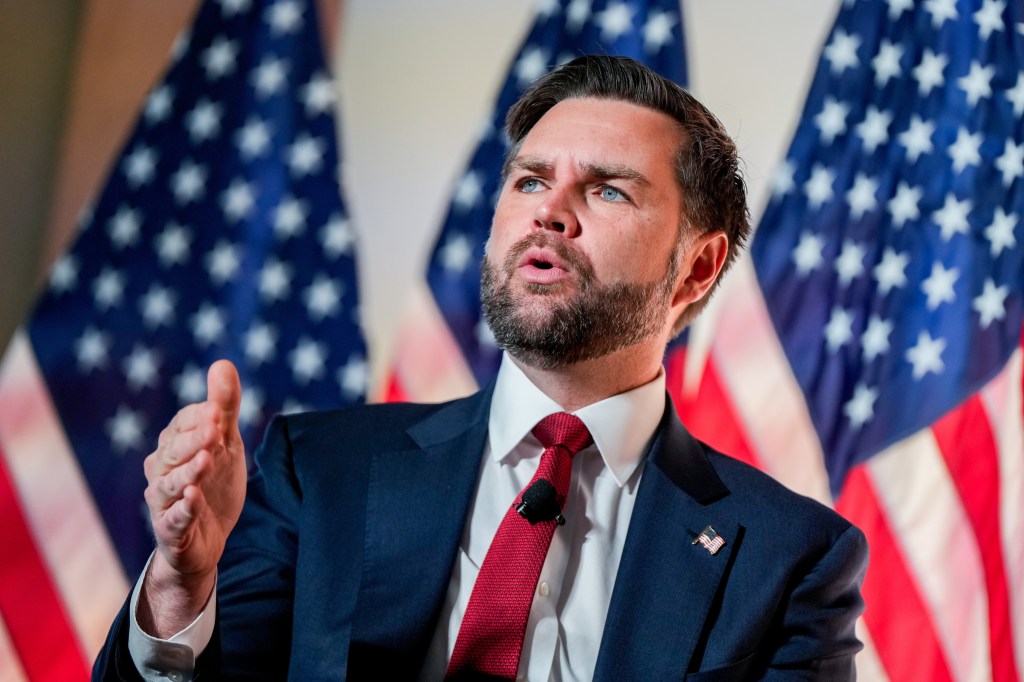
JD Vance looks friendly on the surface—but optics aren’t policy, and smiles aren’t commitments.
The Appearance of Friendship
In October 2025, Vice President JD Vance made what can only be described as a very photo-op-ready visit to Israel. He was warmly welcomed by Prime Minister Netanyahu—handshakes, smiles, the whole diplomatic cheer package. The headline writes itself: the sitting US Vice President is on friendly terms with the Jewish state, standing shoulder to shoulder with its leadership in this fraught moment in history. Fast-forward to late December, and Vance’s schedule still looks like it was drafted by someone who thinks goodwill toward diaspora communities should come with festive accessories. At a Hanukkah reception he hosted alongside a Christmas event, the Vice President appeared to double-down on the optics of warm interfaith solidarity—latkes and holiday lights included.
Put it all together, and it can look like someone who genuinely values the US–Israel relationship: official visits to Jerusalem, public engagements with Jewish communities, and a tightly curated image of holiday camaraderie. That’s the headline, and it’s a headline that almost writes itself, complete with friendly visuals and talking points about unity. And yet, appearances have a way of being exactly that—appearances. Visiting, welcoming, attending receptions—these are all things that good politicians do. They’re what humans with busy schedules and communications teams do whenever there’s news to be made and optics to be polished. Friendly gestures are cheap; commitments are not.
So before we start drafting commemorative postcards of Vance planting an olive tree for peace (the official Israeli government pic already has enough blue-and-white flags to wallpaper a diplomat’s dream den), let’s pause and ask the journalist’s favorite question: Does warmth of optics equal clarity of conviction?
The Problem With “No Purity Tests”
If your politics were a salad bar, JD Vance’s recent speech at Turning Point USA would be the ultimate “build-your-own” special: a little of this, a little of that, and everyone invited so long as they say these magic words—“I love America.” At TPUSA’s AmericaFest in Phoenix, Vance took to the stage and delivered what he cast as a unifying message: the conservative movement should reject “purity tests” and welcome everyone who pledges allegiance to the flag, even if their views might make a historian weep.
In plain English, that means he explicitly refused to set boundaries around bigotry. Vance said he didn’t “bring a list of conservatives to denounce or to de-platform,” even as some leading voices at the same event were calling out figures accused of espousing racist or antisemitic rhetoric. Instead, he leaned into an expansive definition of belonging: “Every American is invited,” he told the crowd, cautioning that the movement has “far more important work to do than canceling each other.”
There’s an elegance to this kind of linguistic pyrotechnics: it allows you to sound like a peacemaker while sidestepping the actual work of naming and confronting harmful ideas. It’s one thing to say antisemitism and all forms of ethnic hatred have no place in politics—which Vance has indeed said elsewhere, dismissing racist attacks on his wife with a brusque, “eat s**” response to critics. It’s another to stop short of condemning the people and networks through which such ideas spread within one’s own political base.
Here’s the awkward bit: the phrase “purity tests” was not deployed out of the blue. It was the direct answer to a moment in which conservatives were actively debating whether certain far-right influencers, including those accused of antisemitism or white supremacism, should be welcomed or rebuked within the movement. Vance could have been the straight talker calling out bigotry directly. Instead, he waved away the question, effectively saying, “Let’s not get hung up on that — we have more important things to unify around.”
That’s not just political triangulation; it’s the kind of strategic fence-sitting that perfectly suits someone trying to hold together a coalition with both traditional pro-Israel conservatives and elements of the MAGA base who are ambivalent or hostile on issues of race and religion. It’s also, intentionally or not, a way of threading the needle between public support for Jews and a refusal to play referee when it comes to the far right’s internal battles over what counts as acceptable rhetoric.
In other words: you don’t have to actually condemn antisemitism to declare it unwelcome if you simply define it out of the conversation altogether. And when the guy aiming to lead a major political movement after Trump’s era frames refusing purity tests as a virtue, you can bet he’s not doing it out of philosophical clarity — he’s doing it out of political calculation.
The MAGA Chessboard
If American politics were chess, JD Vance might be the guy who shows up with pieces that look like knights but move like pawns, he’s not just Vice President; he’s the early favorite in the scramble to succeed Donald Trump as the Republicans’ next big thing—partially because he comes with the right blend of MAGA credibility and media‑friendly temperament. He reportedly leads in early polling among Republican primary states and is even being publicly touted as a 2028 contender by key conservative figures at major gatherings like Turning Point USA.
Internal party strategists have described the emerging lineup as a choice between characters rather than clear doctrines—“a pit bull and a poodle,” in the memorable phrasing of one commentator—and Vance, with his rough‑edged social‑media defense of Trump and simplistic rhetoric, is very much in the pit‑bull lane. His support among the base is such that even in straw polls at conservative festivals he’s been lauded as the figure to carry the movement forward.
But here’s where the board begins to tilt in an unexpected direction: the very Republican coalition Vance needs to keep intact is shifting beneath his feet. A series of recent polls show younger Republicans becoming markedly less enthusiastic about unwavering US support for Israel. In one survey, a majority of GOP voters under 45 expressed support for candidates who would reduce financial aid to Israel and were skeptical of extending long‑term security agreements—even when such support historically enjoyed broad bipartisan consensus. This is not a quirk of fringe opinion; it’s a generational divide that cuts across traditional party allegiances. Another poll found that the once‑solid Republican sympathy for Israeli leadership drops sharply among younger voters, with support for Prime Minister Netanyahu plunging into near parity between favorable and unfavorable views.
For a politician like Vance—whose broader appeal depends in part on keeping GOP factions aligned—this presents a classic strategic dilemma. Leaning too hard into unconditional support for Israel risks alienating a blossoming America‑First cohort that sees overseas entanglements as unnecessary or even politically burdensome. But softening that stance, or failing to articulate a clear policy, invites accusations of political timidity or worse, opportunism, from traditional conservative corners and pro‑Israel advocates alike. In short, the more Vance tries to keep everyone on the same chessboard, the more the board itself seems to be reconfiguring.
So the question isn’t just whether Vance likes Israel or Jews—it’s whether he can survive politically in a Republican Party where the traditional pro‑Israel consensus is no longer a given, especially among the emerging voter base. And if the party’s own grassroots are increasingly skeptical of support for Israel, that puts him in the uncomfortable position of thwarting his own ostensible allies or diluting his foreign‑policy clarity to keep a fragile coalition intact. That’s less a statesman’s chess move and more a politician doing calculus with rapidly sliding numbers.
Silence, Optics, and Strategic Friendship
By now, a pattern emerges: warm optics in Israel, careful language about purity tests, cautious positioning on the MAGA base—and conspicuous silence when it comes to articulating a detailed stance on Israel itself. JD Vance has plenty of gestures—visits, photo ops, holiday receptions—but when it comes to policy specifics or responses to rising antisemitism, he remains deliberately vague. This silence is itself a strategy.
Political silence has a peculiar virtue: it allows a leader to appear supportive without being pinned down. Shake hands with Netanyahu, host a Hanukkah reception, signal solidarity to the Jewish community—all while leaving room to pivot if domestic political winds shift. The optics are intact, the headlines read pro-Israel, yet no inconvenient commitments are forced into the record. Clarify too early, and he risks alienating the younger, America-First GOP voters. Stay silent, and he preserves flexibility—keeping both traditional pro-Israel conservatives and skeptical MAGA-aligned younger voters within reach.
This calculated quiet comes with consequences: when political gestures replace policy, the community being “supported” risks becoming little more than a prop. Warm words, holiday lights, and public appearances signal inclusivity and solidarity—but they do not guarantee action. Jewish concerns and US-Israel interests exist in a kind of political twilight: recognized, celebrated, yet ultimately subordinate to strategic calculations. Expressing substance risks alienating some factions; saying too little risks angering others. The result? Maximal appearances, minimal commitments. Solidarity becomes conditional on optics rather than principle. The question remains: will the Jewish people and US-Israel relations ever move from set dressing to substance in Vance’s playbook, or is this calculated warmth the entirety of his commitment?
In other words, silence is not merely a lack of position—it’s a carefully staged statement, designed to project unity, preserve flexibility, and maintain political advantage, even when the very community one appears to defend remains sidelined in the calculus of ambition.
Which Way, Mr. Vice President?
So where does that leave us? JD Vance can smile with Netanyahu, toast Hanukkah with menorahs, speak of unity to a MAGA crowd, and skillfully avoid committing to anything substantive on Israel. On the surface, he looks pro-Israel, sympathetic to the Jewish people, and savvy in the optics department. Beneath the surface, the picture is murkier: every gesture seems calibrated, every silence strategically placed, and every nuance designed to keep multiple factions satisfied without forcing himself to choose.
The real question isn’t whether Vance likes Israel—it’s whether he’s prepared to act on that support when it conflicts with political calculus. In the chessboard of Republican politics, Israel may be less a principle and more a pawn, useful when convenient, silent when complicated. Which way, Mr. Vice President? The optics are comforting. The words are measured. But the substance—the stand that truly matters—remains conspicuously absent. Until it is revealed, all we have is the artful performance of friendship, carefully staged, perfectly lit, and potentially fleeting.
Friendship in politics is easy; principle, costly. The question: which will Vance choose?