
A new study has revealed that even modest levels of road traffic across Iceland’s lowlands can significantly reduce the abundance of breeding birds, including globally important populations of waders.
The research, conducted in 2018-19 and published in Journal of Avian Biology, examined how bird densities change with distance from roads carrying up to 1,500 vehicles per day – levels classed as ‘low-traffic’ in the Icelandic countryside.
Using 400-m transects set perpendicular to road verges at multiple sites in southern Iceland, the team analysed decades of field knowledge from the country’s long-running raptor- and wader-monitoring programmes.
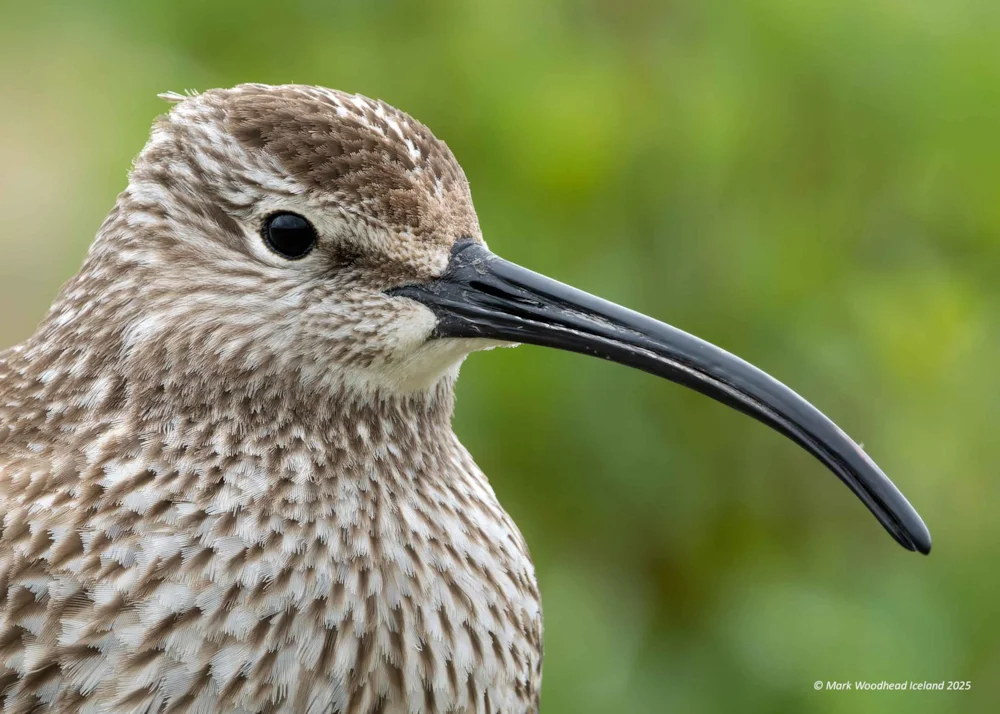
The study found Whimbrel to be one of the species showing breeding declines close to roads in Iceland (Mark Woodhead).
More breeding further from roads
A clear and consistent pattern emerged: bird numbers increased steadily with distance from the road. Total abundance rose by around 6% for every 50 m gained, plateauing only beyond 150-200 m. Within this zone, densities were roughly 20% lower than farther into the landscape.
Four species showed particularly strong declines close to roads: Whimbrel, European Golden Plover, Dunlin and Meadow Pipit all occurred in significantly reduced numbers.
Dunlin were especially sensitive, with steeper declines recorded along roads carrying the higher traffic volumes within the ‘low-traffic’ category. Other species responded more variably; Black-tailed Godwit, Common Snipe and Common Redshank showed little consistent effect, while Redwing was occasionally more abundant near busier stretches.
Driving declines
The scale of potential impact is substantial. Road networks now cut deep into Iceland’s lowlands, and the study estimates that 17.4% of this landscape lies within 200 m of a road. If bird densities are around 20% lower within that band, road proximity may already have caused an approximate 3.5% reduction in total lowland bird abundance — a figure expected to grow as new routes are developed.
The authors outline several mechanisms likely driving the declines. These include increased collision risk, disturbance from noise and human presence, shifts in vegetation structure around verges, and enhanced access for predators. For open-habitat specialists such as Whimbrel and European Golden Plover, any change that reduces visibility or alters the structure of breeding territories may be enough to render roadside habitat unsuitable.
With Iceland supporting some 1.5 million breeding pairs of waders, most in the lowlands, even moderate habitat displacement could have wider population-level consequences.
The study concludes that identifying and protecting key open lowland areas from further roadbuilding – alongside understanding how predators, vegetation and disturbance interact at roadsides – will be crucial for safeguarding this internationally significant bird community.
Reference
Pálsdóttir, A E, et al. 2025. Effect of low-traffic roads on abundance of ground-nesting birds in sub-Arctic habitats. Journal of Avian Biology. DOI: doi.org/10.1002/jav.03572