In May, India and Pakistan faced off in their worst military conflict in decades, perhaps permanently altering the status quo on the subcontinent. The crisis began with a terrorist attack in Indian-administered Kashmir. New Delhi quickly—and without concrete evidence—blamed the violence on Islamabad; a few weeks later, India launched missile strikes against militant targets in Pakistan, which swiftly retaliated.
The resulting confrontation lasted four days and killed dozens of people, including civilians. It saw faster escalation than ever before and the first full-scale use of combat drones between the two nuclear-armed countries. The fighting ended abruptly with a cease-fire that generated further disagreement and both India and Pakistan claiming that they had won. Ultimately, the brief military skirmish may have raised the risks of a future war.
In May, India and Pakistan faced off in their worst military conflict in decades, perhaps permanently altering the status quo on the subcontinent. The crisis began with a terrorist attack in Indian-administered Kashmir. New Delhi quickly—and without concrete evidence—blamed the violence on Islamabad; a few weeks later, India launched missile strikes against militant targets in Pakistan, which swiftly retaliated.
The resulting confrontation lasted four days and killed dozens of people, including civilians. It saw faster escalation than ever before and the first full-scale use of combat drones between the two nuclear-armed countries. The fighting ended abruptly with a cease-fire that generated further disagreement and both India and Pakistan claiming that they had won. Ultimately, the brief military skirmish may have raised the risks of a future war.
The conflict had an immediate impact on India’s relationship with the United States, starting with a battle of narratives: U.S. President Donald Trump said he brokered the cease-fire, while Indian Prime Minister Narendra Modi denied any U.S. mediation. Meanwhile, ties between Washington and Islamabad have grown cozier in its wake. The conflict’s fallout has also had unexpected effects in the region, including the Taliban regime reaching out to India.
As 2025 concludes, India-Pakistan relations remain in crisis: Dialogue is limited, a key water-sharing treaty is suspended, and commercial flights between the countries are disrupted. Below are five of the best articles that Foreign Policy published this year analyzing the conflict from the beginning through its ongoing aftermath.
1. Kashmir Attack Shatters Illusion of Calm
by Sumit Ganguly, April 28
At the end of April, militants attacked a group composed mostly of tourists in Pahalgam, Indian-administered Kashmir, killing 26 people and wounding many others. The assault, clearly targeted at Indian Hindus, set off the chain of events that led to India and Pakistan’s most serious conflict in decades.
In the immediate wake of the attack, FP columnist Sumit Ganguly wrote that its brazenness suggested a potential intelligence failure by New Delhi, which in recent years projected an image of normalcy in restive Kashmir, highlighting a surge in tourism and infrastructure investment.
“It is possible that Indian authorities who were buoyed by the boost in tourism in Kashmir may have lowered their guard,” Ganguly writes. “For all of India’s messaging about restoring a degree of political normalcy to Kashmir, the Pahalgam attack and a host of other recent incidents belie this claim.”
2. Drones Are Transforming South Asian Warfare
by John Haltiwanger, May 15
On May 7, India launched Operation Sindoor, deploying missile strikes in Pakistan that it said targeted facilities associated with Pakistan-based militant groups. The confrontation quickly heated up, with both sides using drones against each other for the first time in armed conflict.
This marked a significant shift in South Asian warfare, FP’s John Haltiwanger writes, signaling that drones are likely to play a role in the region’s future conflicts due to their cost effectiveness, precision, and perceived usefulness to limit escalation. But the May conflict also raised questions about whether drones are in fact less escalatory, particularly when used between nuclear-armed states.
“Some experts warned that portraying drones as an effective means of responding to provocations without crossing red lines is a slippery slope,” Haltiwanger writes.
3. India-Pakistan Cease-Fire Cements a Dangerous Baseline
by Sushant Singh, May 15
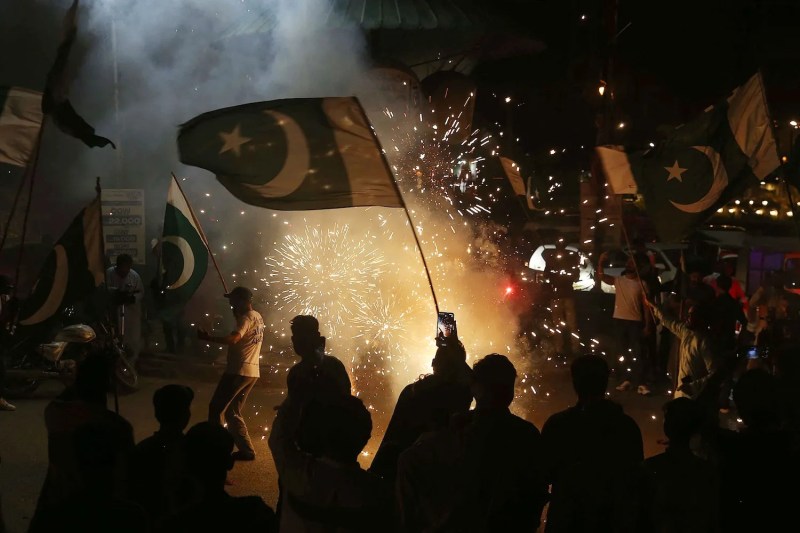
Pakistanis wave the national flag as they celebrate after the cease-fire between Pakistan and India, in Hyderabad, Pakistan, on May 10.
Pakistanis wave the national flag as they celebrate after the cease-fire between Pakistan and India, in Hyderabad, Pakistan, on May 10. Husnain Ali / AFP via Getty Images
India and Pakistan reached a cease-fire on May 10, abruptly ending the conflict after just four days. But Sushant Singh, a journalist and former Indian military officer, argues that the truce set a dangerous precedent because it “raised the escalation ladder’s starting rung.”
In other words, the disconnect between the two belligerents—both claiming victory—in addition to technological advances that have compressed decision-making timelines mean that the next India-Pakistan conflict could escalate with greater speed and intensity. “South Asia now stands precariously balanced between an unstable peace and catastrophic war,” Singh writes.
Singh reaches what he calls an “uncomfortable” conclusion that the world must grapple with: “Peace in a nuclearized South Asia is not a product of strategic wisdom but of fortuitous circumstances and international scrutiny.”
4. The Kashmiris Caught in the Crossfire
by Fahad Shah, May 20
Shortly after the May conflict, journalist Fahad Shah filed a dispatch from one of the communities grappling with its devastating fallout, reporting from Indian-administered Kashmir in areas that suffered heavy shelling after the initial Indian airstrikes across the border.
“In the latest clash, the Indian border districts of Uri, Rajouri, Poonch, and Akhnoor saw the human cost of mounting tensions,” Shah writes. “As I traveled across the region this month, villages and towns emptied as people migrated away from the border areas to safer locations.”
Shah interviews families whose lives were devastated by the four-day conflict, underscoring the tense status quo for those literally caught in the middle of the India-Pakistan rivalry. “Most Kashmiris who live near the border have now started to return to their homes, but the trauma of the latest clash will remain etched in their memory,” he writes.
5. India Faces Down New Security Calculus
by Sushant Singh, Oct. 9
Despite its brevity, the May conflict had geopolitical implications—including the White House warming up to Pakistan in the months that followed. In September, Pakistan and Saudi Arabia inked a comprehensive defense pact formalizing their partnership that could alter the strategic landscape for India.
Again, Singh weighed in on the potentially far-reaching consequences of the new agreement: “More than just emboldening Pakistan, the formal partnership will constrain international responses to a future crisis like the military conflict that erupted with India in May, making it harder for New Delhi to mobilize global support,” he writes.
Singh argues that the Saudi Arabia-Pakistan defense pact fundamentally alters the calculus for India, which must carefully calibrate any future response. “This alignment reshapes South Asia’s strategic environment in ways that New Delhi did not anticipate, and the uncomfortable truth is that it sleepwalked into this predicament,” he writes.
“India must develop ideas and cultivate leaders capable of fashioning policies that avoid the traps of the last decade.”