
In 1896, the Stollwerck family founded the Imperial and Royal Austro-Hungarian Court Chocolate Factory in Bratislava. They invested 300,000 marks in a production site on Račianska Street, which at the time lay outside the city.
The location offered two major advantages: inexpensive labour and proximity to the Danube, which allowed cocoa to be imported and finished sweets exported throughout the Habsburg monarchy.
Initially, the factory produced milk caramels (packing around 25 kilograms a day), marzipan and peppermint sweets. Towards the end of the First World War, it added chocolate bars to its range, producing between 200 and 400 tonnes annually.
The Stollwercks also introduced fondant sweets coated in chocolate and wrapped in shiny paper, which were hung on Christmas trees using threads or hooks.
The name salónky derives from the word salón (drawing room). These sweets were traditionally served to guests in the grand living rooms of aristocratic homes at Christmas. They were expensive and regarded as a luxury enjoyed only by the wealthy.
The decorative use of salónky is thought to have originated in neighbouring Hungary. “There are similar sweets elsewhere in the world, but as far as I know, only in Hungary were they used as Christmas tree decorations,” recalled Anna Beke, former president of the Hungarian Association of Confectionery Manufacturers.
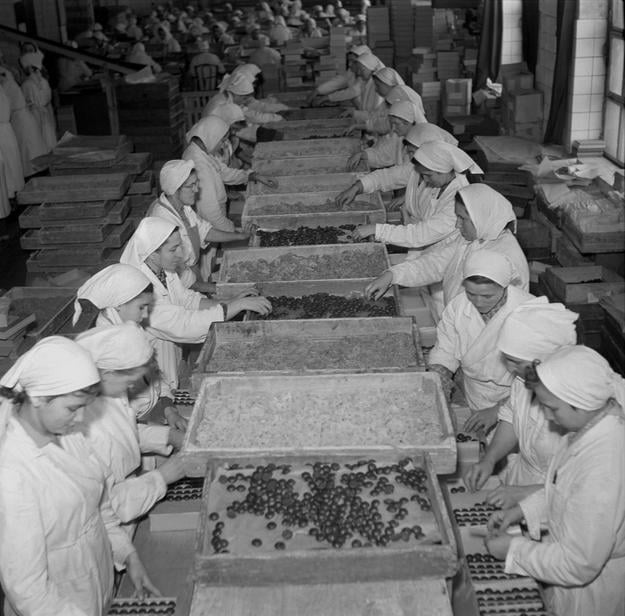
In the mid-1950s, the Stollwerck factory produced two varieties of salónky. (source: TASR)
From Stollwerck to Figaro
Chocolate and fondant salónky continued to be produced in Bratislava after the collapse of Austria-Hungary and the creation of Czechoslovakia. The Stollwerck factory expanded its range to include desserts and boxed chocolates with patriotic names such as Kriváň and Detvan.
Annual chocolate production reached 800 to 1,500 tonnes, aided by modernisation and reduced reliance on manual labour. By the outbreak of the Second World War, output had risen to 2,000 tonnes a year, with around 800 employees.
The war took a heavy toll. The factory was hit by rationing, damaged by Allied bombing in 1945 and further affected by the three-month presence of Soviet troops.
After the war, the factory was nationalised under the Beneš Decrees. Following the communist takeover in 1948, it became part of the state-run Slovak Chocolate, Confectionery and Fruit Products Works.
Interestingly, chocolates continued to be sold under the Stollwerck name until the mid-1950s. Only in 1958 was the Bratislava plant renamed Figaro and transformed into a national enterprise alongside factories in Trnava and Piešťany.
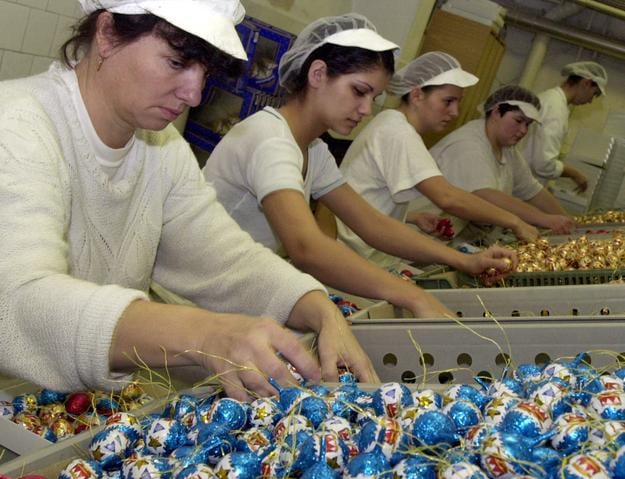
(source: TASR)
Mass production under socialism