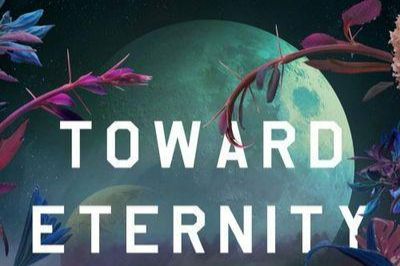
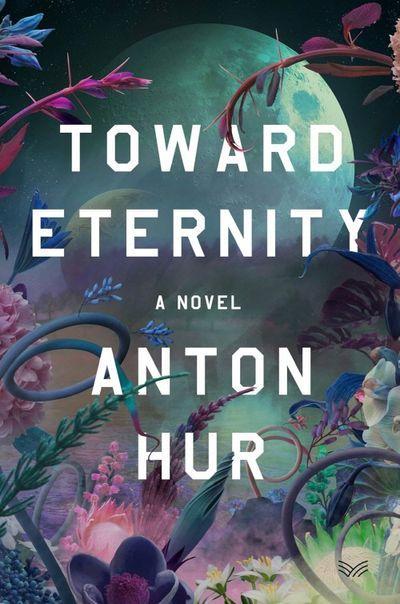
The cover of “Toward Eternity” by Anton Hur / Courtesy of HarperVia
“Toward Eternity,” the debut novel by Anton Hur, who has built a worldwide reputation as a star Korean-to-English literary translator, borrows heavily from the ideas of technofuturists. They theorize a point — the singularity — at which superintelligent machines tilt things toward a posthuman sci-fi future, and human-machine hybrids start to replace us. Hur’s story begins at the cusp of that revolution.
Those who have heard the technofuturist gospel will readily recognize the premise behind the novel. Ray Kurzweil, computer scientist and the real-world chief prophet of technofuturism, predicted superintelligent machines by 2045 in his 2005 magnum opus, “The Singularity is Near.”
“[T]he social and philosophical ramifications of these changes will be profound,” Kurzweil wrote, “and the threats they pose considerable.”
With these ideas in mind, “Toward Eternity” grapples with an increasingly timely question: How can human meaning survive in a world of superintelligent machines?
The first central character in “Toward Eternity” resembles Hur himself: a cosmopolitan literary expert of Korean origin. But unlike Hur (as far as I know), the character is also an expert in artificial intelligence (AI). He donates his body to science, for use in pioneering “nanotherapy” work. The end goal is to replace bodies, from the cells up, with “nanodroids” — a real-world Kurzweil-singularity techno-prophecy.
Further discussion of plot or characters would get complicated. Suffice it to say, many characters, or iterations of characters, undergo the body replacement process, or derivatives of it.
Whatever the dreams of nanotechnology may have been, the project gets hijacked. The evil Janus Corporation, from Korea, is at the center. They, or their AI successors, want world domination. Humanity — nonaltered humans are around, but are coldly called “Redundants” — is in the way.
The plot deals in a certain well-trodden trope of both sci-fi and mythology: man playing god. The ideology replaces much of traditional religion with the idea of eternal life, delivered digitally. Gods are outsourced to, or superseded by, godlike AIs. Digitally enhanced humans evolve into posthuman status. Human spiritual bodily incarnations, out; technological incarnations, in.
In a world under pressure from technology, what of art? Hur addresses this crisis of meaning with literature, which acts as a major plot element.
We see in “Toward Eternity” an appeal to the written word, to how writing and literature connect us over space and time. “Language is like DNA,” one of the characters says, directly stating a major theme. In this world, humanity has been defeated. But poetry is undefeated. Poetry finds interesting ways to refuse to die.
It lives on in the novel, used to render a sci-fi version of past-life memories. These visions, which read like religious revelations, haunt and inspire. They serve as a defense of humanity even in a posthuman future.
Hur’s novel can be read, in part, as an allegory for reincarnation. In many ways, it bears many similarities with David Mitchell’s 2004 novel “Cloud Atlas,” which is also about reincarnation — even if it avoids saying so directly. “Cloud Atlas” is an awe-inspiring tribute to the mysteries of life and human destiny. Hur’s vision with “Toward Eternity” is similarly ambitious, although it may have been easier to attempt something tighter in scope.
“Toward Eternity” also embeds its literary allegory in the framing of the story: There is no single narrator, just a range of different narrators across time. Each narrator is a character in, but also a writer of, the story.
Each chapter is an update in a paper notebook passed down, starting in the mid-21st century and well into the future. Characters find, or otherwise acquire, the notebook, and spontaneously write updates in it. It survives through chaos and calamity.
This is the “found manuscript” device, able to inspire across time.
Unfortunately, there are a few inconsistencies in the execution. Hur skates around the difficulties of this framing device by simply ignoring them. For example, much of the book consists of intricate dialogue sequences, which are hard to imagine being written down in a notebook after the events. With the frequent introduction of new narrators, the story can be hard to keep track of. And the characters tend to all sound the same.
Despite that, “Toward Eternity” is not a bad novel. It’s just that it doesn’t always rise to the challenge it set for itself.
The future is Korean
It’s sometimes said that a literary translator is really someone waiting to write their own novel. In an essay published in Korean in 2023, Hur confirmed as much about himself. He had gotten into literary translation, he wrote, with a mind to hang around the scene until he could publish his own novel.
His success as a prolific translator led to “Toward Eternity” being published in mid-2024 by HarperVia, an imprint of HarperCollins that spotlights international literature and largely deals in translated works.
Although written in English, “Toward Eternity” is infused with Koreanness. This quality seems unironic and without apology, even when it feels forced.
Twenty years earlier, “Cloud Atlas” had used Korea as a central setting for one of its storylines, set in the future. It may have been the first major novel in English to conceptually associate Korea with “sci-fi futuristic.” In Korea itself, science fiction as a genre was quite marginal, underdeveloped and without much respect until a trend got going in the mid-2010s.
The 1982 film “Blade Runner,” another work from which “Toward Eternity” seems to draw inspiration, famously featured a dystopic futurescape heavily influenced by Japan. It was, in part, an interpolation of the direction Asian megacities would go.
Japan may have been seen as futuristic in 1982. Korea was not. But a few decades later, Korea has built a similar image. Commentators often talk about how today’s Seoul can at times have a sci-fi feel. Some of the city’s showpiece areas and general feeling can draw parallels to cyberpunk.
Maybe the recent rise of interest in translated Korean science fiction makes sense. Whatever we make of it, Hur’s Korean-infused science fiction novel is a part of that trend.
As for the big question of human meaning threatened by technological developments? We can continue hoping for the best. An ancient aphorism comes to mind: “Life is short, art is long.” In the age of AI, we could do worse than look to literature for inspiration, much as some of the characters in “Toward Eternity” do. Think of it as a defense of humanity.
“Toward Eternity” is available through dbbooks.co.kr.
Peter Juhl is a researcher focused on Korean political and security issues.