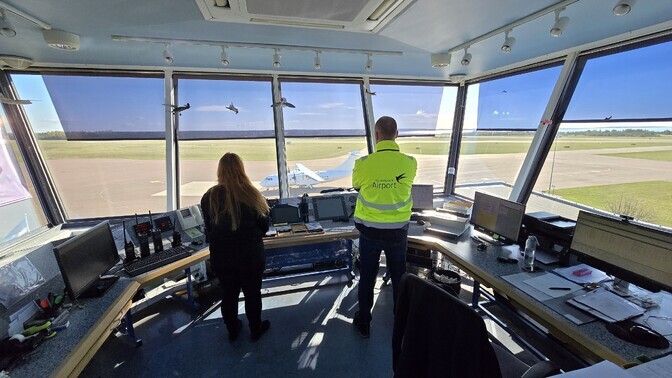
While Tallinn Airport had a good year in 2025, passenger numbers fell noticeably on year at most regional airports in Estonia, with only Tartu Airport bucking the trend.
The regional airports covering the islands and southern Estonia come under Tallinn Airport’s (Tallinna Lennujaam AS) remit.
Passenger numbers at Kuressaare Airport on Saaremaa have fallen by a fifth on year. At Kärdla Airport on Hiiumaa, the drop is even bigger, at a quarter.
This is largely put down to higher ticket prices.
At the same time, air connections to the islands are seen as vitally important. Hiiumaa municipal elder Hergo Tasuja (SDE) called the decline in passenger numbers worrying, as it telegraphs that the service is not highly needed.
However, air connections could be vital in the case of medical emergencies, for instance.
“It could once again prompt views that our air connection is merely a convenience route and is perhaps not needed at all. From the standpoint of medical necessity, I see no way it would be conceivable for us not to have an air connection,” Tasuja said.
The numbers have also fallen at the Pärnu Airport, which already has a notably low throughflow in any case. Pärnu mayor Kristel Voltenberg said efforts are under way to restart international flights, however.
Negotiations are ongoing with Finnish carrier Redstone, which wants to set up links to Finland and Sweden, initially. “I have personally met with their representatives too. Redstone has been in very close contact with Tallinn Airport, as well as with the ministries. They have also prepared an initial business plan, which still needs refinement. I believe that by mid-January we will already be wiser. At the moment we are quite optimistic,” Voltenberg said.
Of other regional airports, Tartu stands out in having managed to significantly increase passenger numbers in 2025, primarily thanks to Finnair’s Helsinki route operating there.
Nonetheless, as all regional airports require investment, Tallinn Airport is looking to the state for a long-term plan. “As Tallinn Airport, what we most expect from the state is a strategic view regarding the future of regional airports. Whether they are needed, how many are needed, and on that basis a long-term investment plan, because these airports wear out over time. The infrastructure there needs renewal, and that requires financial resources,” Tallinn Airport board member Eero Pärgmäe said.
Sander Salmu, deputy secretary general for mobility at the Ministry of Climate, said all regional airports face different challenges. A one-year decline in passenger numbers at some airports does not necessarily justify making changes immediately, he said. At the same time, the ministry plans in the new year to analyze whether changes might be needed with the regional airports, and what form these may take.
“We have set ourselves the goal of reviewing all six of our regional airports in the first half of next year, looking at how they operate, what investments are needed, and, if necessary, also making decisions on how to finance these regional airports going forward. Today, the state supports them to the tune of about €2.3 million,” Salmu said.
State support for regional airports has also fallen in recent years due to austerity measures and efforts to balance budgets, he noted.
Finnair is set to connect Kuressaare and Helsinki next summer.
Tallinn Airport itself enjoyed its second best-ever month in October this year, and has seen carriers Wizz Air, Eurowings and Jet2 recently announce new routes from the airport. The airport is also to get a €75-million expansion and makeover in the coming years.
—