A new global peace ranking has highlighted the world’s least safe countries, revealing that some of the most dangerous places to live or travel are closer to Slovakia than many might expect.
The index, which assessed 163 countries, compared factors such as crime levels, political stability and the presence of armed conflict. While much of Europe continues to rank among the world’s safest regions, stark contrasts remain within the continent.
Iceland retained its position as the world’s most peaceful country. According to security expert David Zámek, this is largely due to its geography and demographics. “Iceland is an island with a small population and is naturally removed from many external security threats,” he said.
Iceland
Ireland
New Zealand
Austria
Switzerland
Singapore
Portugal
Denmark
Slovenia
Finland
Iceland is followed in the ranking by Ireland, New Zealand, Austria and Switzerland. Despite frequent public debate about migration and social tensions, Austria continues to score highly. “Although there is growing discussion about migration and minority-related issues in Austria, an objective look at the data shows it remains one of the safest countries in the world,” security analyst Martin Královič told TV Markíza.
Overall, eight of the ten safest countries globally are located in Europe, reflecting generally low crime rates and relatively stable political environments.
Slovakia was placed 28th overall, ranking in the middle among European countries. Analysts cite political instability and higher levels of violent crime compared with top-performing states as the main factors affecting its score. However, its location in a largely stable region remains a significant advantage. “The index places Slovakia 19th out of 33 European countries. That is not outstanding, but we benefit from being in a safe region, with the exception of Ukraine,” Královič noted.
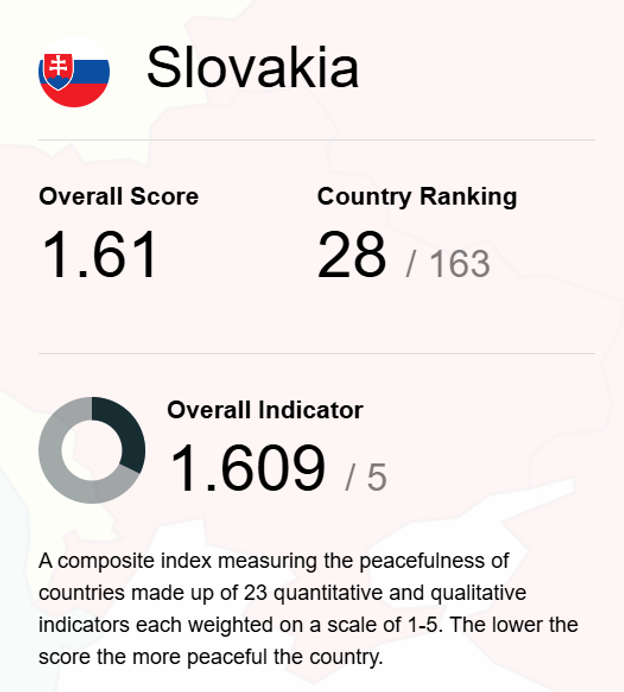
1. Ongoing domestic and international conflict (1.604/5)
External conflicts fought: 1/5
Deaths from external conflict: 1/5
Deaths from internal conflict: 1/5
Internal conflicts fought: 1/5
Intensity of internal conflict: 2/5
Relations with neighbouring countries: 3/5
2. Societal safety and security (1.678/5)
Homicide rate: 1.562/5
Violent crime: 1/5
Terrorism impact: 1.409/5
Political terror scale: 1.5/5
Perceptions of criminality: 2.25/5
Number of refugees and internally displaced persons: 1.004/5
Violent demonstrations: 1.5/5
Number of jailed population: 2.198/5
Number of internal security officers and police: 2.874/5
Access to small arms: 1/5
Political instability: 1.875/5
3. Militarisation (1.483/5 )
Military expenditure (% of GDP): 1.956/5
Number of armed services personnel: 1.353/5
Weapons imports: 1.896/5
Weapons exports: 2.164/5
United Nations peacekeeping funding: 1.159/5
Nuclear and heavy weapons: 0.996/5
At the bottom of the ranking are countries experiencing active conflict or severe internal instability. Ukraine, Slovakia’s eastern neighbour, was listed among the least safe countries worldwide due to the ongoing war. Russia ranked as the least safe country overall.
Compiled by the Institute for Economics and Peace (IEP), the Global Peace Index (GPI) is regarded as the leading international measure of peace and security.
Global peacefulness has deteriorated every year since 2014.
There are currently 59 active state-based conflicts – the most since the end of WWII, with 152,000 conflict-related deaths recorded in 2024.
The number of globally influential countries has nearly tripled since the end of the Cold War, rising from 13 to 34 by 2023.
Conflicts are becoming more internationalised, with 78 countries involved in conflicts beyond their borders in 2024.
The global economic impact of violence reached $19.97 trillion in 2024, equivalent to 11.6 percent of global GDP, with military expenditure alone accounting for $2.7 trillion.