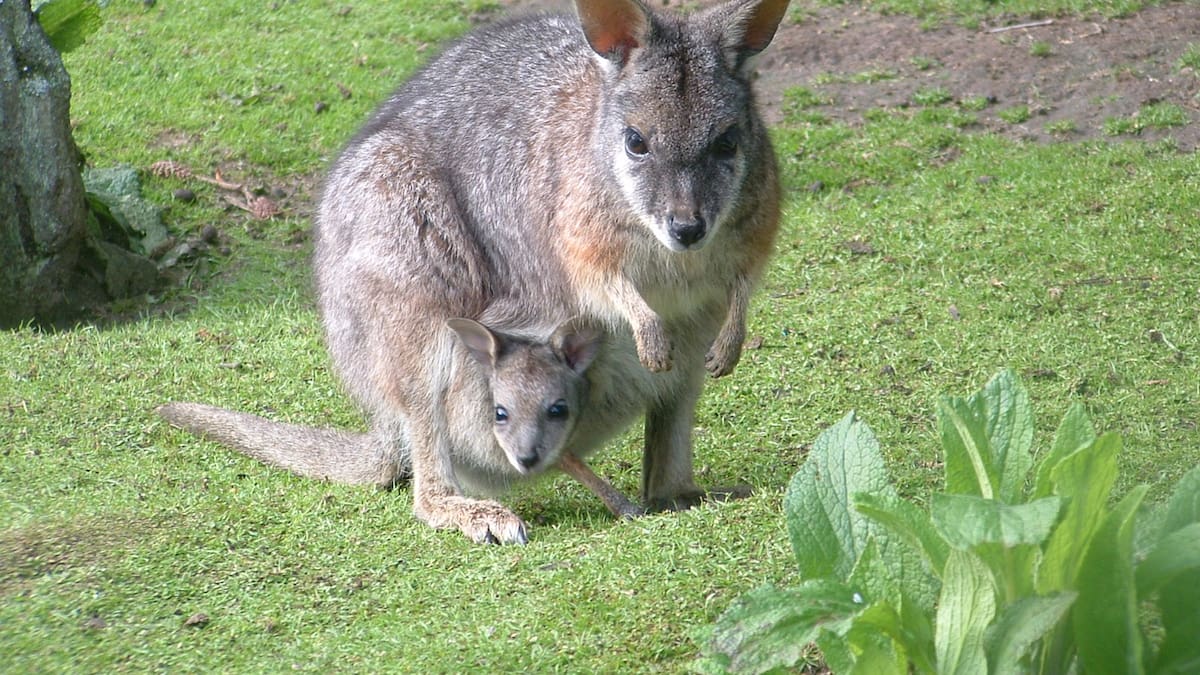
“Wallabies eat everything within their reach in our native bush, including the seedlings that make up future forests,” said Department of Conservation Rotorua operations manager Zane Jensen.
Wallabies “destroy” forest regeneration and productive farmland, equating to a massive financial cost.
“Wallabies cost New Zealanders millions of dollars in lost farm production and lost benefits from the environment,” Jensen said.
The Department of Conservation works alongside numerous entities and the Tipu Mātoro National Wallaby Eradication Programme to reduce the spread of wallabies with an ultimate goal of eradication, with the Government putting up $1 million over two years to aid efforts.
Jensen said DoC was also working alongside Bay of Plenty mana whenua to “limit existing wallaby populations” and prevent further spread.
Dozens of wallabies pictured on a Rotorua paddock in 2022. Photo / Supplied
“This has seen the upskilling and capacity building of mana whenua to also undertake wallaby control on their own lands.”
The Bay of Plenty Regional Council is responsible for pest control in the region and is part of the eradication programme.
In June, the regional council changed its Regional Pest Management Plan, to contain all wallaby species known to be present in the region as an eradication or progressive containment species.
Eradication involves the killing of the pest with the aim of removing all presence from the region. Progressive containment aims to stop a pest from spreading outside its containment area.
The Central North Island wallaby containment area uses natural features such as rivers, steep gorges, and lakes to form its barriers, with a surrounding buffer zone in place, where operational work takes place.
Wallaby populations inside the containment area are targeted from the outside in, with the hope of full eradication.
But it is not simple. The Central North Island containment area is roughly 260,000ha – about the same size as the country of Luxembourg.
Efforts are ongoing and the regional council eradicated 15 wallabies in 2024-25, with a further 1988 “contained”, meaning prevented from spreading outside the containment zone.
“Current activity is focused on finding and eliminating all wallaby populations in areas outside this core range,” Bay of Plenty Regional Council wallaby programme leader Davor Bejakovich said.
Contractors, with wallaby indicator dogs and trail cameras, locate and determine the extent of wallaby populations.
“Where wallaby populations exist outside of the containment area, council will work with the landowners to plan and deliver wallaby control,” Bejakovich said.
“In these areas, the numbers of wallabies killed is less relevant than determining whether any survived, as our focus is on finding and eliminating the last wallaby in the area.
“Wallaby control work in the form of night shooting is undertaken within the containment area at strategic locations.
“The aim is to reduce wallaby numbers and prevent spread outside containment.”
Wallabies are not the region’s only animal pest issue.
Twenty pest animals are listed for management in the Bay of Plenty.
The regional council manages exclusion and eradication pests, like wallabies and goats, while landowners handle containment species.
The regional council received 147 public inquiries for other animal pests in the year to June 30. These pests, such as rabbits, stoats and possums, were considered advisory threats as they are already well-established. The regional council could not give an accurate number on which pests made up the majority of complaints.
The regional council can assist with control advice, but responsibility lies with the landowners or occupiers.
This arrangement caused confusion with a “rabbit plague” at an Ōkere Falls location in 2025.
Nearly 1000 feral goats have also been processed this year, with eight eradicated and 960 contained, in what was the 20th year of the Eastern Bay of Plenty Feral Goat Programme.
Roughly 35,000 goats have been controlled across the two decades, with $10 million invested to cover an area equivalent to more than a million rugby fields.
Mathew Nash is a Local Democracy Reporting journalist based at the Rotorua Daily Post. He has previously written for SunLive, been a regular contributor to RNZ and was a football reporter in the UK for eight years.
– LDR is local body journalism co-funded by RNZ and NZ On Air.